Visa Harness: An Open-Source Security Testbed for Auditable AI Vulnerability Scanning

Visa Harness turns AI vulnerability scanning into an auditable, accountable engineering pipeline.
Visa Harness is an open-source Agentic vulnerability analysis testbed that rejects the "one-click scan" model. Instead, it orchestrates threat modeling, multi-lens research, adversarial reproduction, and structured reporting into a traceable pipeline — making AI security findings trustworthy and accountable for real security teams.
A Misunderstood Open-Source Project
As "AI-powered automatic vulnerability scanning" becomes a buzzword in the security community, Visa's open-source Agentic vulnerability analysis testbed — Visa Harness — deliberately pushes back against the hype. Its core stance isn't "let AI freely scan code," but rather to orchestrate threat modeling, vulnerability research, adversarial reproduction, and report generation into a pipeline that security teams can actually be held accountable for.
What is an Agentic AI tool? Agentic AI tools are AI systems capable of autonomous planning, tool invocation, and multi-step reasoning — distinct from traditional single-query models. In security, these tools can simulate a security researcher's workflow: first understanding the target system's architecture, then progressively analyzing potential attack surfaces. However, the very "autonomy" of Agentic systems introduces new engineering challenges — how do you ensure every step of the AI's reasoning is traceable and auditable, rather than an inexplicable black-box output? This is the fundamental tension that Visa Harness aims to resolve at the architectural level.
Behind this lies a judgment that the industry broadly ignores: it's no longer surprising that AI can find problems — the real challenge is what happens after discovery. Most automated scanning tools can spit out hundreds or thousands of "candidate vulnerabilities," but handing those results to a security team typically creates noise rather than value.

The Bottleneck Isn't Discovery — It's Triage Speed
There's a line in the project README worth sitting with: the real place security teams get stuck is not whether candidate vulnerabilities exist, but who decides which ones are worth fixing.
This effectively redefines the value metric for Agentic security tools. Conventional thinking evaluates scanners on recall and coverage — but in real security operations, the cost of handling false positives and the human overhead of prioritization are the hidden burdens that crush teams.
Alert Fatigue: An Underestimated Systemic Risk The false positive problem in security scanning is known as "Alert Fatigue." Research suggests that some SAST (Static Application Security Testing) tools have false positive rates as high as 50–80%, meaning security teams waste effort on at least one invalid alert for every two they investigate. Working in a persistently high-noise environment not only wastes resources but can cause teams to miss real threats out of sheer exhaustion — a phenomenon especially prevalent in large enterprise SOCs (Security Operations Centers). This is the core motivation behind Visa Harness embedding adversarial reproduction directly into the pipeline: actively reducing false positives rather than offloading all the filtering to humans.
Visa Harness is designed to solve exactly this "downstream" problem.
Visa Harness's Pipeline Approach
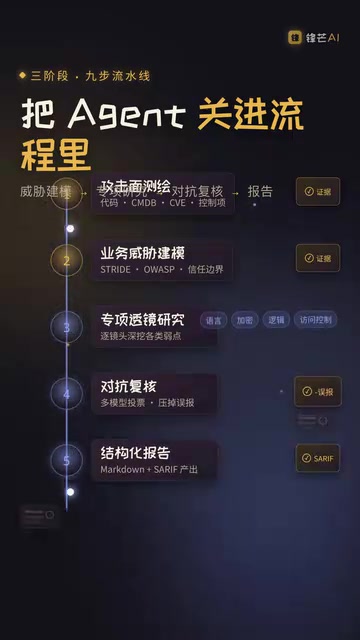
The design philosophy of Visa Harness is to decompose a vulnerability analysis into distinct stages with clear responsibilities — not a one-shot "black-box scan."
Multi-Stage, Multi-Lens Agent Orchestration
The overall flow breaks down roughly as follows:
- Attack surface and business threat modeling: The Agent first understands the system's attack surface and business context before reading any code.
- Multi-lens research: Vulnerability research is broken into separate dimensions — language layer, cryptography layer, logic layer, access control, etc. — each analyzed in depth.
- Adversarial reproduction stress testing: Candidate vulnerabilities are validated through adversarial reproduction to proactively reduce false positives.
- Structured report output: Final output is structured candidate findings — not a vague "there's a hole here."
Why Does Threat Modeling Come First? Threat modeling is a core methodology in security engineering. By systematically identifying assets, attackers, attack paths, and defenses, it helps teams understand risk priorities before vulnerabilities occur. Common frameworks include Microsoft's STRIDE (covering Spoofing, Tampering, Repudiation, Information Disclosure, Denial of Service, and Elevation of Privilege) and the attacker-centric PASTA methodology. Placing threat modeling as the first step of an AI scanning pipeline means the Agent evaluates vulnerability severity within business context — not in code isolation. This allows the same code defect to receive different priority assessments in different business scenarios, which is precisely the kind of core judgment that human security experts provide.

The Real Highlight: Every Step Leaves Evidence
Many tools sell the idea that "Agents think autonomously," but Visa Harness's value is precisely the opposite. Its real highlight is that every step leaves structured evidence.
When the Agent reports a vulnerability, human auditors can trace back which threat model it was based on, which validation steps were taken, and what the adversarial reproduction results showed. This auditability is what makes AI output "trustworthy and accountable" — it cages the AI's natural tendency toward sprawling, unconstrained output inside a disciplined process.
Why Is Auditability a Hard Requirement in Financial Services? Auditability carries direct legal implications in compliance-driven industries like finance and healthcare. When a vulnerability is flagged or missed by an AI tool, auditors must be able to reproduce the AI's decision path to demonstrate that security processes meet standards such as SOC 2, PCI-DSS, or ISO 27001. As a core infrastructure provider for the global payment network — processing tens of billions of transactions annually — Visa's internal security processes operate under extreme regulatory scrutiny. This context explains why Visa Harness places such heavy emphasis on "leaving a trail" and "structured evidence": it's not just engineering best practice, it's a direct reflection of the parent company's compliance culture, which also explains why this project's process design is more conservative and rigorous than comparable open-source tools.
Data and Boundaries: A Conservative Read
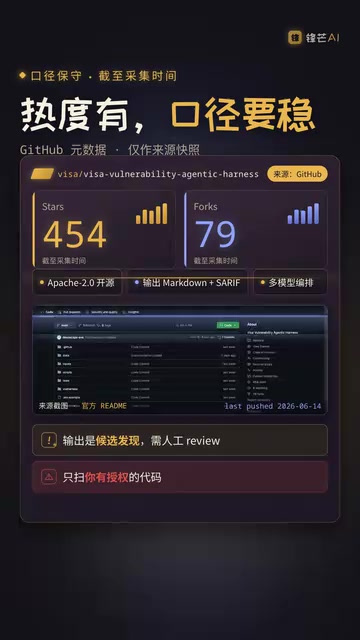
When evaluating projects like this, a conservative evidential posture matters. As of data collection time, Visa Harness shows approximately 454 stars and 79 forks on GitHub, with the last recorded push on June 14, 2026. These numbers indicate some traction, but the project is far from mainstream and remains in relatively early adoption stages.
The project README is also notably restrained, explicitly stating two boundaries:
- Output consists of candidate findings that require human review — it is not a one-click verdict and does not make final decisions on your behalf.
- Only scan code you are authorized to scan — the most basic compliance red line for any security tool.
This style of communication — not overstating capabilities, clearly defining responsibility boundaries — is itself a sign of security engineering maturity.
How to Think About This Project
Taken as a whole, Visa Harness is better understood as a reference testbed for Agent pipeline design aimed at security teams — not a plug-and-play "scan button" for the average developer.
If you're a security engineer or researching Agentic security architectures, its real learning value lies in: how to constrain a large model's natural tendency toward unconstrained output into an auditable, accountable engineering process. That methodology is more valuable than any count of vulnerabilities it finds.
For practitioners focused on deploying AI Agents in production, Visa Harness offers a paradigm worth borrowing: in high-stakes scenarios, the value of AI is not replacing human judgment, but organizing the evidence required for that judgment clearly enough that humans can work faster and with better grounding. To explore further, search "Visa Vulnerability Agentic Harness" and pay close attention to how it embeds AI capabilities into a complete, evidence-preserving pipeline.
Key Takeaways
Related articles

Disaster and Glory of the Apollo Program: The History We Must Revisit Before Returning to the Moon
From the fatal Apollo 1 fire to Apollo 8's daring lunar orbit to Apollo 11's successful landing—revisiting the disasters, fears, and compromises of the Apollo program and their lessons for today's return to the Moon.

Netflix Trust Exercise Turns Into Firing Trap: Where Are the Boundaries of Corporate Trust?
A Netflix employee was fired after sharing private info in a trust exercise. We analyze the risks of corporate trust exercises and how employees can protect themselves.

AMD CDNA5 Architecture Deep Dive: Technical Evolution and the AI Computing Competition Landscape
Deep analysis of AMD's CDNA5 architecture covering Chiplet packaging upgrades, HBM memory evolution, and low-precision compute optimization, examining how AMD challenges NVIDIA's AI chip dominance.