Visualize and Edit AI Reasoning Chains: Making LLM Thinking Transparent and Controllable

A web tool that lets you view and edit an AI's chain-of-thought reasoning before it answers.
A new Show HN project lets users visualize and directly edit the chain-of-thought reasoning that LLMs like OpenAI o1 and DeepSeek R1 generate before answering. The tool turns the AI black box into a glass box, enabling human-AI collaborative reasoning and more precise debugging — while raising important questions about whether visible reasoning chains truly reflect a model's internal computation.
A New Attempt to Make AI "Thinking" Transparent
Recently, a developer posted a Show HN project on Hacker News: a web tool that lets you view and edit what an AI is "thinking" before it gives an answer. While the project hasn't generated a huge amount of discussion, it touches on a core topic in the large language model (LLM) space — the interpretability and controllability of the reasoning process.
As reasoning-capable models like OpenAI o1 and DeepSeek R1 become more widespread, models generate an internal "chain of thought" before answering questions. This thinking process is typically hidden from users, or presented only in summary form. The value of this tool lies precisely in cracking open that black box — letting users not only see the reasoning, but actively modify it.
What is Chain-of-Thought (CoT)? Chain-of-Thought (CoT) prompting was first systematically introduced by Google researchers Wei et al. in their 2022 paper "Chain-of-Thought Prompting Elicits Reasoning in Large Language Models." The core idea: rather than having a model jump directly to a final answer, guide it to decompose complex problems into a series of intermediate reasoning steps. Research found this significantly improves model accuracy on math reasoning, logical inference, and multi-step Q&A tasks. OpenAI later internalized this concept into model training itself — the o1 series automatically performs extensive internal "thinking" before generating responses, with model parameters optimized for self-reflection and step-by-step reasoning rather than relying solely on prompt triggers. DeepSeek R1 took this further by using reinforcement learning (the GRPO algorithm) to teach models to autonomously generate high-quality reasoning chains, without requiring large amounts of human-annotated reasoning data.

Why "Seeing the Thinking" Matters
From Black Box to Glass Box
Traditional AI interaction is a classic input-output black box: you ask, it answers, and what happens in between is anyone's guess. When a model gives a wrong answer, users are often left blindly tweaking prompts without knowing which step in the reasoning went wrong.
This tool tries to turn that black box into a glass box. By exposing intermediate reasoning steps, users can pinpoint exactly where things went wrong — did the model misunderstand the question, make a logical error midway, or distort the final output? This fine-grained transparency has real value for debugging complex tasks and verifying model reliability.
The Broader Context of Explainable AI (XAI) The direction this tool points toward is known in academia as Explainable Artificial Intelligence (XAI). XAI isn't a new concept — even before deep learning, the ML field had "white box" approaches like decision trees and rule extraction. But as deep neural networks came to dominate on performance, their opacity became a growing problem. The EU's General Data Protection Regulation (GDPR) in 2018 explicitly granted users the right to algorithmic explanations, further driving demand for XAI in production systems. Current mainstream XAI methods include LIME (Local Interpretable Model-Agnostic Explanations), SHAP (game-theory-based feature contribution scoring), and attention visualization. Chain-of-thought transparency represents a new XAI path for the LLM era — not explaining at the neuron-activation level, but using language itself to build readable reasoning traces, turning "explanation" from a tool for technical experts into an interface ordinary users can interact with directly.
From "Observe Only" to "Actively Intervene"
The more significant innovation is the editing capability. Seeing the reasoning process is just step one — allowing users to modify the chain of thought and have the model continue from there is what really matters.
When a user spots that the model made a flawed assumption at step three, they can directly correct that assumption and let the model continue reasoning along the right path — without rewriting the entire prompt from scratch. This "mid-course correction" style of interaction is essentially human-AI collaborative reasoning — humans provide domain judgment and error correction, while the model handles logical inference and text generation.
Potential Use Cases
Education and AI Literacy
For learners and researchers who want to understand how AI "thinks," tools like this are excellent teaching aids. They make the abstract concept of a reasoning chain concrete, helping people build intuition for model capabilities and limitations — understanding both what models excel at and where they tend to go wrong.
Prompt Engineering and Debugging
For developers, visualized reasoning chains can dramatically speed up debugging. Rather than blindly rewriting prompts over and over, directly observing and intervening in reasoning steps is a more precise, "surgical" optimization method — and better aligned with modern Prompt Engineering practice.
The Evolution of Prompt Engineering: From Trial-and-Error to Systematic Debugging Prompt Engineering refers to the practice of carefully designing input text to guide LLMs toward desired outputs. Early prompt engineering relied heavily on intuition and trial-and-error, with practitioners accumulating empirical techniques like few-shot examples, role prompting, and CoT trigger phrases. But as models get deployed in complex production environments, the limitations of this "blind tuning" approach become obvious — developers can't tell whether poor output quality stems from an unclear problem description, bad example selection, or a flawed reasoning path in the model itself. Visualized chain-of-thought tools essentially introduce the concept of a "single-step debugger" to Prompt Engineering: just as a programmer can inspect variable states at any breakpoint during code execution, developers can now inspect and correct the model's "intermediate variables" at any node in the reasoning chain — upgrading from empirical trial-and-error to an observable, reproducible, systematic debugging workflow.
Human Review in High-Stakes Domains
In fields like medicine, law, and finance — where accuracy requirements are extremely high — AI outputs must be vetted by humans. If reviewers can see and correct a model's reasoning chain, they can intercept errors before the final result is generated, rather than fixing things after the fact. This is an important piece of building Trustworthy AI systems.
Technical and Ethical Considerations
Does the Chain of Thought Equal Real Reasoning?
Some caution is warranted here. There's ongoing academic debate about whether the chain-of-thought text actually reflects the model's internal computation. Research suggests that the thinking text a model outputs sometimes looks more like "post-hoc rationalization" than a genuine decision-making trace. So while editing the chain of thought can influence the final output, users should be aware: you're editing text the model generated, not its actual "neural activity."
This distinction is subtle but important. The "interpretability" the tool provides is functional and interaction-level transparency — not a complete window into the underlying mechanism.
The "Faithfulness" Problem: The Limits of Chain-of-Thought Trustworthiness Academia frames this as the "faithfulness" debate around chain-of-thought reasoning. Multiple studies from Stanford, DeepMind, and others have found significant gaps between LLM-generated reasoning steps and the model's actual internal weight activation paths. A classic phenomenon is "post-hoc rationalization": the model may have already "predicted" the answer through parallel feedforward computation, with the subsequent chain of thought merely supplying plausible-sounding justification for that conclusion. 2023 research also found that when researchers deliberately inserted obviously incorrect reasoning steps into a chain of thought, models would still often produce the "correct" final answer — indicating that final outputs don't strictly depend on the textual reasoning chain. This means chain-of-thought visualization tools provide "behavioral interpretability": they help users understand and influence model output behavior, but they don't equate to mechanistic interpretability of the neural network. The latter is what companies like Anthropic are deeply researching — trying to find readable "features" and "circuits" directly in activation space.
Commercial Reasons for Hiding Reasoning Chains
Interestingly, some commercial models (like OpenAI's o1 series) deliberately hide the complete raw chain of thought, providing only a summarized version. Official reasons involve safety alignment and preventing the chains from being used to distill competing models. As a result, which models such third-party tools can cover — and how complete the reasoning content they can access is — depends entirely on how open the underlying API is. This is a real constraint any such project must navigate.
Model Distillation: Why Reasoning Chains Are a Trade Secret Understanding why companies like OpenAI choose to hide raw reasoning chains requires knowing about knowledge distillation. The core idea: use a powerful "teacher model" to generate large volumes of high-quality input-output pairs, then use that data to train a smaller, cheaper "student model" that approximates the teacher's performance on specific tasks. When a reasoning chain is fully exposed, it provides a richer supervision signal than the final answer alone — researchers can collect large amounts of "question + full reasoning process + answer" triplets to train low-cost alternatives that mimic top-tier reasoning models. DeepSeek R1's technical report explicitly mentions that some of its variants used chain-of-thought data from R1 for distillation training. This is precisely why complete reasoning chains have enormous commercial value — and why OpenAI explicitly designated the chain of thought as a core asset to protect when releasing o1, deliberately obscuring it at the API level. This business decision profoundly shapes the technical boundaries of chain-of-thought visualization tools: what a tool can do depends largely on what the model provider is willing to expose.
Summary: A Small Project Pointing to a Big Direction
While this Show HN project is currently small in scale, it represents a warming trend: AI interaction is evolving from one-way Q&A toward two-way, intervenable collaborative reasoning.
As reasoning models become mainstream, helping users genuinely understand, trust, and effectively guide a model's reasoning process will become a central challenge in product design. Chain-of-thought visualization tools may be small, but they point toward a more transparent, more controllable, and more human-centered AI future. For developers and researchers focused on AI interpretability and human-AI collaboration, this is a space well worth watching.
Related articles

Code with Claude Event: AI-Powered Creative Experiments on Tiny Computers
At Code with Claude, Anthropic gave participants tiny computers to build creative projects with AI assistance, showcasing how AI coding tools empower the maker community.
Claude Code Adds Agent View: A Research Preview for Unified Session Management
Claude Code's new Agent View feature (research preview) consolidates all coding sessions into a unified list, advancing AI tools toward multi-agent orchestration.
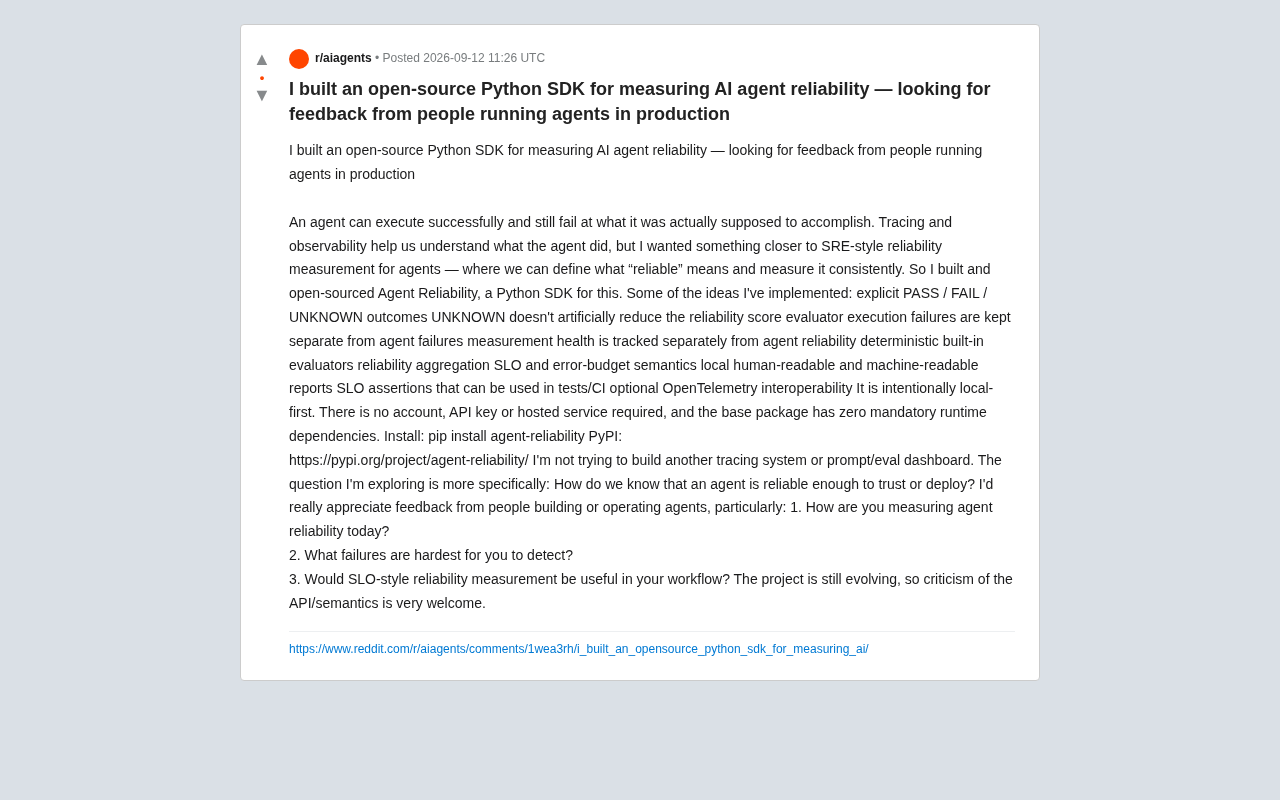
Open-Source Python SDK: Measuring AI Agent Reliability with SRE Principles
Agent Reliability is an open-source Python SDK that applies SRE's SLO and error budget concepts to AI Agent evaluation, with PASS/FAIL/UNKNOWN states, CI assertions, and zero forced dependencies.