Vitrify Exact Learning: From Numerical Data to Exact Differential Equations and Closed-Form Solutions

Vitrify recovers exact differential equations and closed-form solutions from data using weak forms and symbolic solving
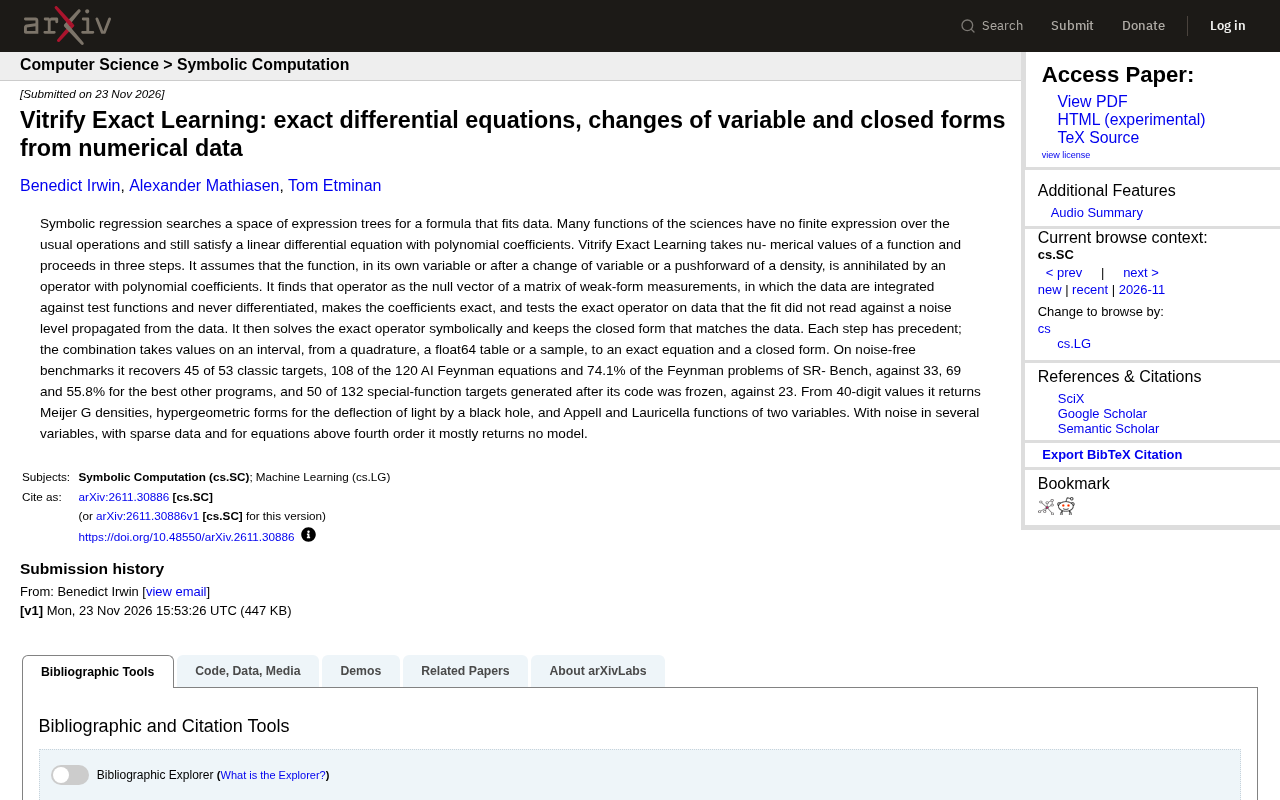
Vitrify Exact Learning proposes a three-step method to recover exact differential equations and closed-form solutions from numerical data: identify a polynomial-coefficient operator as the null vector of a weak-form measurement matrix to avoid numerical differentiation; exactify coefficients and test the operator on held-out data using the noise level as a threshold; then solve symbolically and match closed forms. On noiseless benchmarks it recovers 45/53 classic targets and 108/120 AI Feynman equations, reaching 74.1% on SR-Bench—significantly outperforming other programs—and 50/132 special-function targets. It suits clean or low-noise, data-rich, low-order settings.
Symbolic regression typically fits data by searching through the space of expression trees, but many scientific functions cannot be represented with a finite number of ordinary operations—yet they satisfy a linear differential equation with polynomial coefficients. Vitrify Exact Learning proposes a new approach: starting from numerical data, directly recover exact differential equations and closed-form solutions.
A Three-Step Pipeline: From Numbers to Exact Equations
Vitrify's method consists of three steps. Each step has precedents, but combined they achieve an end-to-end transformation from numerical values on an interval (quadrature nodes, float64 tables, or samples) to exact equations and closed-form solutions.
Step 1: Find the Operator Using Weak-Form Measurements
It assumes that the target function (in its own variables, or after a change of variables or pushforward of a density) is annihilated by a polynomial-coefficient operator. The key is that it solves for this operator as the null vector of a weak-form measurement matrix—the data and test functions are integrated, and differentiation is never performed. This avoids the noise amplification caused by numerical differentiation, which is especially important for noisy data.
The core idea of the weak form is not to differentiate noisy data directly, but instead to multiply both sides of the differential equation by a smooth test function and integrate over the interval, using integration by parts to shift derivatives from the data onto the test function. In this way, the highest-order derivatives appearing in the equation act only on known test functions that can be differentiated arbitrarily many times, while the data itself only participates in integration (quadrature), thereby avoiding the amplification of noise by numerical differentiation. For noisy data, this technique keeps errors at the level of the integral average, making operator identification more robust to noise.
Step 2: Coefficient Exactification and Noise Testing
After finding the operator, Vitrify exactifies the coefficients and tests the exact operator on data that were not read during the fitting stage. The test uses the noise level propagated from the data as a threshold, thereby determining whether the operator truly holds rather than being an artifact of overfitting.
Step 3: Symbolic Solving and Closed-Form Matching
Finally, it solves the exact operator symbolically, retaining the closed-form expressions that match the data. This step converts the solution of the differential equation into interpretable mathematical expressions, such as Meijer G densities, hypergeometric forms, and so on.
The Meijer G function is a very general class of special functions: many elementary functions, hypergeometric functions, and common probability densities (such as the Gamma, Beta, and normal densities) can all be written as special cases of it. It is defined by a Mellin-Barnes-type contour integral, and its parameters can flexibly capture various asymptotic behaviors such as power laws and exponential decay. Because of its extremely broad coverage, once the solution of a differential equation is expressed in Meijer G form, it can often unify multiple seemingly different closed-form expressions at once—this is why Vitrify can return results such as "Meijer G density."
Hypergeometric functions (such as the Gauss hypergeometric ₂F₁ and the confluent hypergeometric ₁F₁) are the standard solution family for second-order linear differential equations, and analytical solutions in many physics problems fall within this framework. In the classic calculation of gravitational deflection of light by a black hole, the light-ray trajectory equation can be reduced to hypergeometric form, yielding an analytical expansion for the deflection angle. Appell and Lauricella functions are extensions of hypergeometric functions to two and multiple variables, respectively, suitable for describing special-function solutions with multivariate coupling—this corresponds to Vitrify's outputs on bivariate targets.
Benchmark Performance
According to the paper, on noiseless benchmarks Vitrify recovered 45 of 53 classic targets, 108 of 120 AI Feynman equations, and achieved a 74.1% recovery rate on the Feynman problems in SR-Bench. By comparison, the best-performing other programs achieved 33, 69, and 55.8%, respectively. Among 132 special-function targets generated after its code was frozen, it recovered 50, versus 23 for other programs.
Starting from 40-digit-precision numerical values, Vitrify returned Meijer G densities, the hypergeometric form of black hole gravitational deflection, and bivariate Appell and Lauricella functions. These results demonstrate the method's potential in the domain of special functions.
Limitations and Applicable Boundaries
The method is not universal. The paper explicitly states that in the cases of multivariate noisy data, sparse data, and equations of order four or higher, it mostly returns no model. This means the current version is better suited to scenarios that are clean or low-noise, with sufficient data and low-order equations.
From a broader perspective, Vitrify's value lies in bringing "exactness" into data-driven equation discovery: the weak form avoids differentiation noise, exactification and independent testing control overfitting, and symbolic solving guarantees interpretability of results. For researchers who need to infer governing equations or special-function forms from experimental data, this is a path worth watching.
One-line Summary
Vitrify uses weak forms and symbolic solving to recover exact differential equations and closed-form solutions from data
Paragraph Summary
Vitrify Exact Learning proposes a three-step method for recovering exact differential equations and closed-form solutions from numerical data: first, identify a polynomial-coefficient operator as the null vector of a weak-form measurement matrix, avoiding numerical differentiation; then exactify the coefficients and test the operator on data not used in fitting, using the noise level as a threshold; finally, solve symbolically and match closed forms. On noiseless benchmarks, it recovered 45 of 53 classic targets and 108 of 120 AI Feynman equations, reaching 74.1% on SR-Bench—all significantly outperforming other programs—and recovered 50 of 132 special-function targets. The method is suited to clean or low-noise scenarios with sufficient data and low-order equations.
Related articles

Braised Meat Shop Forced Out by Rent Hike: A Life-and-Death Contest Between Craft and Location
Braised meat shop owner forced out by a 100,000 yuan rent hike moves overnight; landlord's daughter takes over with seasoning packets and overnight meat sickens customers. A tale of location versus craft.

AI One-Click Emotional Short Drama: Bilibili Creator Tests the "Beautiful Landlady" Script
Bilibili creator uses AI to produce the emotional short drama "The Beautiful Landlady Comes to Fix the Guy's Drain," testing everything from script generation to character consistency.
Braised Meat Stall Goes Viral, Landlord Raises Rent—She Leaves Gracefully by Contract While Rival Cuts Corners and Loses Everything
A braised meat stall's rent was hiked from ¥68K to ¥168K after going viral; the owner moved out by contract while her rival cut corners and lost it all.