Vivo's India Joint Venture: A New Blueprint for Chinese Smartphone Brands Going Local

Vivo's India joint venture offers a replicable localization blueprint for Chinese smartphone brands navigating geopolitical headwinds.
Vivo's decision to establish a joint venture in India marks a turning point for Chinese smartphone manufacturers seeking to maintain market presence amid rising geopolitical tensions. By combining equity concessions with retained operational control, Vivo's model offers a pragmatic template for OPPO, Xiaomi, and others. Set against India's PLI incentive scheme and tariff escalation policies, this move reflects the convergence of supply chain de-risking, industrial policy, and corporate localization strategy reshaping global smartphone manufacturing.
India's Manufacturing Story Moves Beyond Apple
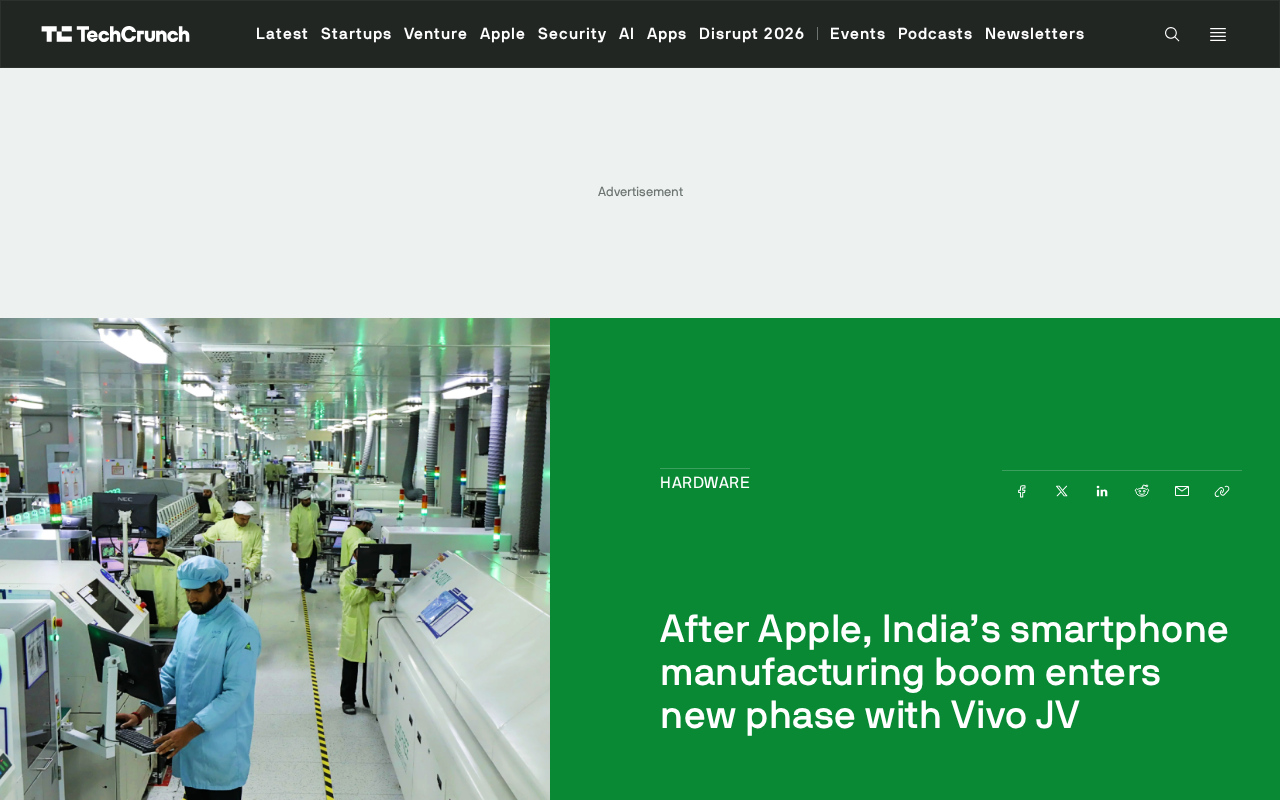
Following Apple's large-scale expansion of iPhone production capacity in India, the country's smartphone manufacturing sector has reached a critical inflection point. Vivo's decision to establish a joint venture (JV) in India marks the beginning of a new chapter in local manufacturing for the world's second-largest smartphone market.
Over the past several years, India's government has successfully attracted Apple and its supply chain partners — Foxconn, Pegatron, and Wistron — to shift a portion of their production from China to India, largely through the Production Linked Incentive (PLI) Scheme. Launched in 2020, the PLI scheme is a cornerstone of Prime Minister Modi's Atmanirbhar Bharat (Self-Reliant India) initiative. For the smartphone segment, it offers participating companies cash incentives of 4% to 6% based on incremental sales generated from India-manufactured devices, with total incentives valued at approximately ₹120 billion (around USD 14.5 billion).
Notably, the PLI scheme features a sophisticated design: subsidies are tied to incremental sales rather than total sales, compelling companies to genuinely expand domestic production capacity rather than simply rerouting products to claim incentives. The program is divided into two tiers — international brands and domestic brands — each with distinct minimum investment thresholds and sales performance benchmarks. By 2023, companies including Samsung, Foxconn's Hon Hai Precision, Pegatron, and Wistron had met or exceeded their respective targets, collectively creating over 100,000 direct jobs in India. The underlying logic is to compress the cost disadvantage of setting up factories in India through a "subsidize first, evaluate later" mechanism, enabling Indian manufacturing to compete with China's well-established industrial base.
From a global industrial policy perspective, the PLI scheme embodies a distinctive design philosophy. Unlike the tax breaks or land incentives commonly offered by Southeast Asian nations, PLI anchors its subsidies to incremental sales — making it a performance-linked, dynamic mechanism. This borrows from South Korea's export-oriented subsidy playbook of the 1970s, which nurtured conglomerates like Samsung and Hyundai, but adds stricter performance-exit mechanisms to avoid the long-term industrial dependency that open-ended subsidies can create. Importantly, India has extended the PLI model from smartphones to 14 key sectors — including pharmaceuticals, textiles, and solar panels — with total committed incentives of approximately ₹2 trillion. Smartphones, in other words, are just the starting point of India's broader national manufacturing strategy.
This wave of manufacturing investment is no longer confined to the Apple ecosystem. It now extends to Chinese Android players like Vivo, officially ushering in a new era of diversified competition in India's domestic smartphone manufacturing landscape.
The Strategic Logic Behind Vivo's Joint Venture Model
Unlike Apple's reliance on contract manufacturers, Vivo has chosen to deepen its India presence through a joint venture — a decision driven by very practical realities.
The Galwan Valley clash of June 2020, which resulted in casualties on both the Indian and Chinese sides, marked a significant turning point in bilateral relations. India's government swiftly introduced a series of economic countermeasures: banning TikTok and over 200 other Chinese apps, and revising FDI policy through Press Note 3 (2020), which required investments from countries sharing a land border with India — primarily China and Pakistan — to undergo Cabinet Committee on Security approval rather than the previously available automatic approval route. This policy subjected new investments, equity changes, and even management appointments by Chinese smartphone companies to lengthy administrative review processes, significantly limiting their operational flexibility. Xiaomi, OPPO, Vivo, and other Chinese brands subsequently faced tax investigations, asset freezes, and executive arrests in India, with total amounts under scrutiny running into tens of billions of rupees.
Against this backdrop, the joint venture structure offers a distinctive form of regulatory flexibility. Under India's Companies Act (2013) and the Foreign Exchange Management Act (FEMA), a JV structure allows a foreign party to retain a minority or equal equity stake while locking in technology licensing rights, brand usage rights, and key management positions through a Shareholders' Agreement (SHA) — satisfying the legal requirement for "local shareholding" while preserving de facto influence over core business operations. This approach of "ceding equity while retaining control" is not new for Chinese companies entering emerging markets — Huawei's early-stage technology licensing partnerships with local Indian partners followed a similar logic.
For Vivo, forming a joint venture with a local partner not only reduces policy risk but also provides a "localized wrapper" for Chinese capital, addressing Indian regulators' sensitivities around shareholding structures and control rights — an arrangement that allows the company to integrate more smoothly into India's commercial and manufacturing ecosystem.
Reports suggest that Vivo's JV arrangement "could become a template for Chinese smartphone brands in India." This implies that OPPO, Xiaomi, Transsion, and other Chinese players may well adopt similar equity structures and operating models going forward, maintaining their competitiveness in this vast market while satisfying India's localization requirements.
From Assembly to Deep Localization: An Industrial Upgrade
The evolution of India's smartphone manufacturing industry is fundamentally a journey from "simple assembly" to "deep localization."
In the early stages, whether for Apple or Chinese brands, production in India was largely limited to SKD (Semi-Knocked Down) or CKD (Completely Knocked Down) assembly. Under the SKD model, products are imported as semi-finished major components and assembled into finished goods locally; CKD involves importing all individual components for full in-country assembly. Both approaches share a key characteristic: core components still rely on imports, with Indian factories handling only the final assembly and testing stages — resulting in minimal local value-add.
SKD and CKD assembly are classic pathways through which developing nations use tariff policy to nurture domestic manufacturing capabilities, with rich historical precedent globally. Brazil attracted companies like Motorola to assemble phones on a CKD basis through the Manaus Free Trade Zone in the 1990s; Indonesia has mandated manufacturers to progressively increase local content through its TKDN (Tingkat Kandungan Dalam Negeri) requirements. India's current tariff escalation policy is essentially replicating this "tariff-ladder-driven localization" industrial policy paradigm. The core tension is this: if tariff increases come too quickly, rising component costs may push up end-user prices and erode consumer surplus; if they come too slowly, manufacturers have little incentive to truly embed their supply chains locally.
This dynamic is fundamentally shaped by tariff graduation: India imposes a 20% basic customs duty on finished device imports, while component-level tariffs are typically 5% to 15% lower — a differential that itself creates an intrinsic incentive for local assembly. As India's government progressively raises import tariffs on key components such as printed circuit boards (PCBs) and chargers, while offering additional subsidies for locally produced parts, the overall tariff structure across the value chain is systematically tilting toward deeper localization — compelling manufacturers to bring suppliers into India rather than simply completing the final assembly step at the end of the line.
With PLI incentives continuing to roll out and the Atmanirbhar Bharat strategy deepening, manufacturers are being guided to extend supply chain localization to critical components including displays, batteries, camera modules, and even semiconductor packaging. Vivo's decision to establish a joint venture in India is a pragmatic response to this trend. Compared to a pure contract manufacturing arrangement, a JV structure is more conducive to technology transfer, management knowledge sharing, and deeper integration with local supply chains — and better aligns with the Indian government's expectations around "substantive localization."
Dual Drivers: Geopolitics and Supply Chain Diversification
Behind this wave of India-based manufacturing lies the dual force of global supply chain "de-risking" and geopolitical competition.
For Apple, diversifying production capacity to India is part of a "China Plus One" strategy to reduce dependence on a single Chinese supply chain. This strategy didn't emerge from any single trigger — it was the result of multiple pressures accumulating over time: the systematic rise in Chinese labor costs following the implementation of the Labor Contract Law in 2008, increased cost forecast uncertainty caused by renminbi exchange rate volatility in 2015, and the U.S.-China trade war in 2018 as an accelerating catalyst. In the race to capture China Plus One opportunities, Vietnam was the first to capitalize — leveraging a combination of zero tariffs, low labor costs, and a stable political environment to absorb nearly half of Samsung's smartphone production capacity (at one point Samsung employed over 100,000 workers in Vietnam), making it the most mature example of this strategy in practice. India has since become the second-largest iPhone production base after China, with India's share of global iPhone output surpassing 14% in 2024 and projected to exceed 25% by 2026.
India's breakthrough in this competition rests on several core comparative advantages: a massive domestic demand market of 1.4 billion people (reducing over-reliance on export-oriented policies), an English-language business environment and common law legal system (lowering management friction for multinationals), and a relatively abundant pool of engineers and software talent. However, India's logistics infrastructure costs (road networks, port efficiency) remain roughly 15% to 20% higher than China's, making it difficult in the near term for India's overall manufacturing cost competitiveness to fully surpass leaner export manufacturing economies like Vietnam. The most fundamental difference between India and Vietnam is this: Vietnam has developed a relatively complete export-oriented manufacturing ecosystem spanning components to finished devices, while India's current manufacturing capabilities are still primarily oriented toward serving the domestic market, with export competitiveness still under construction.
For Chinese manufacturers like Vivo, local production in India is more about avoiding India's 20% import tariff on finished smartphones and defending market share. The motivations differ, but both forces jointly accelerate the development of India's manufacturing capabilities.
It is worth noting that Chinese manufacturers face a more nuanced situation in India — navigating increasingly rigorous compliance scrutiny while maintaining price competitiveness in a fiercely contested market. The joint venture, as a "middle-ground solution," may well be the most pragmatic answer available under the current geopolitical climate.
Outlook: Can India Become the Next Smartphone Manufacturing Hub?
As Apple, Vivo, and others continue to scale up their India commitments, the country is steadily progressing toward becoming a global smartphone manufacturing center. But to genuinely challenge China's dominance, India still faces significant hurdles: inadequate infrastructure, a shortage of skilled labor, and an immature component supply chain ecosystem.
In the near term, India is more likely to play an important complementary role in the China Plus One strategy rather than serve as a wholesale replacement. But if Vivo's joint venture model proves successful, it will provide a replicable localization blueprint for more Chinese companies — further cementing India's strategic position in the global electronics manufacturing landscape.
This manufacturing wave — initiated by Apple and carried forward by Chinese Android players — may profoundly reshape the supply chain dynamics of the global smartphone industry over the next decade.
Key Takeaways
- The PLI scheme's performance-linked subsidy mechanism, anchored to incremental sales, is India's core policy tool for attracting global manufacturers — now extended across 14 key industries
- Vivo's JV model, through a legal structure of "ceding equity while retaining control," provides a replicable blueprint for Chinese manufacturers to maintain market presence under geopolitical pressure
- Tariff graduation engineering systematically drives manufacturers from SKD/CKD simple assembly toward deep supply chain localization — serving as the primary lever for industrial upgrading
- In the China Plus One competition, India holds a unique position thanks to its vast domestic market and talent advantages, though logistics costs and export manufacturing ecosystem maturity remain near-term bottlenecks
- The diversification of India's smartphone manufacturing industry is the result of three converging forces: geopolitical competition, industrial policy design, and corporate localization strategy
Related articles

Disaster and Glory of the Apollo Program: The History We Must Revisit Before Returning to the Moon
From the fatal Apollo 1 fire to Apollo 8's daring lunar orbit to Apollo 11's successful landing—revisiting the disasters, fears, and compromises of the Apollo program and their lessons for today's return to the Moon.
Netflix Trust Exercise Turns Into Firing Trap: Where Are the Boundaries of Corporate Trust?
A Netflix employee was fired after sharing private info in a trust exercise. We analyze the risks of corporate trust exercises and how employees can protect themselves.

AMD CDNA5 Architecture Deep Dive: Technical Evolution and the AI Computing Competition Landscape
Deep analysis of AMD's CDNA5 architecture covering Chiplet packaging upgrades, HBM memory evolution, and low-precision compute optimization, examining how AMD challenges NVIDIA's AI chip dominance.