Vivo X300 Ultra Camera System Deep Dive: The New Flagship Benchmark That Rules Telephoto

Telephoto lenses have become the core differentiator in flagship smartphone camera competition.
With main cameras and ultra-wide lenses approaching physical limits, telephoto has become the core battleground for flagship smartphone imaging. The Vivo X300 Ultra, with its industry-leading image quality across all focal lengths and decisive telephoto advantage, has been hailed as the phone with the best camera. The article traces how mobile photography competition has evolved from the pixel race to computational photography to telephoto optical systems.
Telephoto Lens: The Core Battleground of Flagship Phone Photography
In an era of highly homogenized smartphone camera systems, the competitive focus among flagships has undergone a fundamental shift. The industry has long reached a consensus: for Ultra-tier flagship phones, the telephoto lens has become the only truly important differentiating factor. The release of the Vivo X300 Ultra once again confirms this assessment.
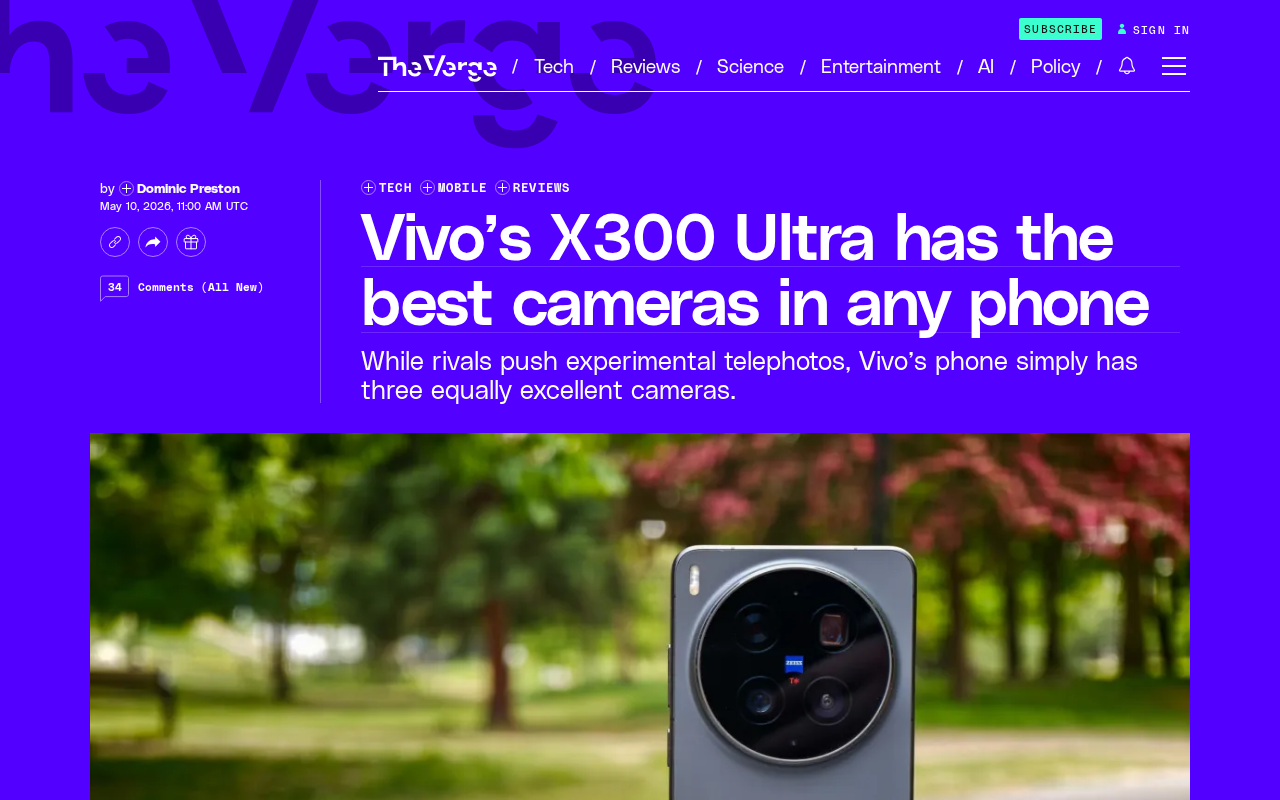
As phone main cameras and ultra-wide lenses approach their physical limits in image quality, major manufacturers have begun pouring more R&D resources into telephoto systems. Notably, the arms race in main camera sensor sizes has nearly hit a physical ceiling in recent years — mainstream flagship main sensors are clustered in the 1/1.28-inch to 1-inch range, and the marginal returns of further increases have diminished significantly. Meanwhile, the diffraction limit also constrains resolution improvements at small apertures: when the aperture shrinks beyond a certain point, diffraction effects caused by the wave nature of light actually soften the image. These physical constraints have narrowed the competitive space in the main camera arena, forcing manufacturers to turn their attention to telephoto — a dimension with much more room for improvement. From periscope lenses to multi-focal-length coverage, telephoto capability has become the core metric for evaluating a flagship phone's imaging prowess.
Periscope Lens Technology Explained: The periscope lens is a key optical innovation enabling telephoto breakthroughs in smartphones. Traditional phone telephoto lenses are limited by device thickness — the optical path can only extend perpendicular to the phone's rear panel, severely restricting focal length. The periscope design places a 45-degree prism or mirror at the lens entrance, redirecting the optical path from vertical to horizontal so light travels along the phone's long axis. This dramatically extends the equivalent focal length without increasing device thickness. This design was first brought to the mainstream market by the Huawei P30 Pro in 2019, achieving 5x optical zoom, and quickly became standard equipment for flagships. Today, periscope lenses can support 10x or even higher optical zoom ratios, and when combined with super-resolution algorithms, can achieve over 100x hybrid zoom — completely redefining the perceived upper limit of smartphone telephoto capability.
Vivo X300 Ultra Camera System: A Comprehensive Analysis
Industry-Leading Image Quality Across All Focal Lengths
The Vivo X300 Ultra has been praised as the product with "the best camera among all smartphones" — an evaluation that isn't directed at any single focal length, but rather a comprehensive endorsement of its entire imaging system. Earning such recognition in a market crowded with formidable rivals like the Samsung Galaxy S25 Ultra, iPhone 16 Pro Max, and Xiaomi 15 Ultra is no small feat.
Behind this achievement are Vivo's breakthrough advances across multiple dimensions including imaging algorithms, optical design, and sensor selection. Whether for casual everyday shots or professional creative scenarios, the X300 Ultra demonstrates convincingly well-rounded capabilities.
Decisive Advantage in the Telephoto System
The latest generation of Ultra-tier flagships are all fiercely competing in the telephoto space. From 3x to 5x, and even 10x optical zoom, every manufacturer is attempting to build a competitive moat through superior telephoto capability. Understanding the value of this competition requires clarifying the fundamental difference between optical zoom and digital zoom: optical zoom changes focal length by physically moving lens elements, achieving magnification without cropping the sensor's image, so image quality doesn't degrade as zoom increases; digital zoom is essentially cropping and interpolating an existing image — the equivalent of cropping in post-processing — which inevitably entails quality loss. Modern flagships typically employ a "multi-camera collaboration" strategy, achieving true optical zoom at each camera's native focal length node, with algorithmic interpolation bridging the gaps between nodes. When shopping, consumers should focus on the "optical zoom ratio" rather than the "hybrid zoom" figures of 100x or more often touted in marketing. The Vivo X300 Ultra delivers industry-leading performance in this critical area, with particularly clear advantages in mid-to-long-range portrait and landscape photography.
The practical value of telephoto lenses far exceeds many people's expectations — concert captures, street documentary photography, wildlife, sporting events — these scenarios once required professional cameras but can now be handled by a single phone.
The Evolving Competitive Landscape of Mobile Photography
The Shift in Focus from Main Camera to Telephoto
Looking back at the development of mobile photography, the migration path of competitive focus is remarkably clear:
- Early stage: Pixel count and sensor size were the core selling points
- Middle stage: Computational photography and AI algorithms became the key differentiators
- Current stage: Telephoto optical systems have become the final "contested territory"
Computational Photography refers to a technological framework that uses digital computation to compensate for optical hardware limitations and enhance image quality. Google's Pixel series was an early pioneer of this approach — its HDR+ algorithm rapidly captures multiple underexposed frames and merges them, achieving results in low-light conditions that far surpassed competitors of the era. In the AI era, neural networks have become deeply integrated into the image processing pipeline — from real-time scene recognition and automatic white balance adjustment to portrait bokeh enabled by semantic segmentation, AI algorithms have permeated every stage of the capture process. However, over-reliance on algorithms has also introduced issues such as "over-sharpening," "smearing artifacts," and "AI hallucinations."
Related articles
 Product Reviews
The Programmer's Desk Setup Guide: Building a Workspace That Feels Like Home
Discover how programmers build productive, comfortable workspaces. From multi-monitor setups to ergonomic design, explore the desk philosophy that drives focus and flow.
 Product Reviews
Qoder vs Cursor Real-World Comparison: Which $20/Month AI IDE Is Better?
Hands-on comparison of Qoder vs Cursor AI IDEs: Agent autonomy, human interaction count, and architecture decisions. Qoder needed only 2 interactions vs Cursor's 8.
 Product Reviews
Cursor Cloud Agent Demo: Eliminating Bottlenecks Across the Entire Software Development Lifecycle
Deep analysis of Cursor's Cloud Agent demo showing how cloud VMs, automated test artifacts, and a full-chain control plane systematically eliminate human bottlenecks across the software development lifecycle.