vLLM Day-0 Support for Looped Inkling Model: Faster Loop Transformer Inference

vLLM achieves Day-0 support for Inkling on release day, accelerating inference adaptation for loop architectures.
vLLM has achieved Day-0 support for thinkymachines' new looped Inkling model, enabling developers to deploy directly with their existing inference stack on release day. Inkling uses 12 shared core layers plus 3 loop passes to expand computational depth with fewer physical layers, and introduces gated message passing between rounds to carry and filter cross-round information, potentially mitigating information degradation. Day-0 support is uncommon in open-source inference frameworks, indicating close collaboration and improving supportability of loop architectures. However, parameter count, context length, and benchmarks were not disclosed, so actual efficiency and quality still require evaluation.
vLLM Achieves Day-0 Support: Looped Inkling Model Compatible at Launch
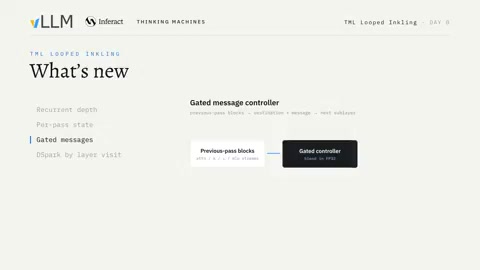
According to the official Twitter account, vLLM has achieved Day-0 support for thinkymachines' newly launched looped Inkling model. This means that on the day of the model's release, developers can deploy it for efficient inference via vLLM without waiting for adaptation. In its official tweet, vLLM highlighted three key structural features of the model: 12 shared core layers, 3 loop passes, and a gated message-passing mechanism (gated messages from one pass to the next).
Day-0 support is uncommon among open-source inference frameworks, which typically require the framework team to intervene in advance to adapt to the model architecture. vLLM's rapid follow-up this time indicates close collaboration with the model team, and also reflects the growing supportability of loop architectures in inference engines.
Day-0 support refers to a mainstream inference framework completing compatible adaptation on the same day model weights are released, so users can deploy without waiting for community contributions or modifying code themselves. This concept is emblematic in the open-source inference ecosystem: it usually means the framework team and the model developer have already aligned on architecture, integrated interfaces, and adapted operators before release—a deep collaboration rather than a post-hoc patch. For models with unconventional structures (such as looped, sparse, or mixture-of-experts architectures), Day-0 support is especially difficult because the framework's standard execution graph, KV Cache management, and batch scheduling often assume a feed-forward, layer-by-layer pass-through relationship. Therefore, the presence or absence of Day-0 support is often seen as an important indicator of a framework's engineering responsiveness and ecosystem position.
Deconstructing the Loop Architecture: 12 Shared Layers + 3 Passes + Gated Messages
From the information disclosed in the tweet, Inkling adopts a "layer sharing + multiple loops" design. The model maintains only 12 shared core layers but expands computational depth through 3 loop passes. This design aligns with the recent direction of looped Transformers: using fewer physical layers with multiple iterations to enhance model expressiveness without linearly increasing parameter count.
More noteworthy is the "gated messages" mechanism. The tweet mentions that gated messages are passed between each pass, indicating that the model does not simply repeat the same computation during looping, but carries and filters information across rounds via gating signals. This helps mitigate the information degradation common in loop structures and allows different loop rounds to take on differentiated computational roles. For inference frameworks, this kind of cross-round state passing requires specialized handling in scheduling and memory management; vLLM's Day-0 support likely involves targeted engineering implementations.
Looped Transformer (Looped Transformer / Recurrent-depth Transformer) is a class of architectures that reuse the same set of physical layers multiple times. Unlike standard Transformers where each layer has independent parameters, loop architectures treat a limited stack of layers as an iterable computational block, increasing effective computational depth through multiple "passes." The motivation is that parameter growth and computation growth can be decoupled, allowing the model to achieve deeper expressiveness with smaller memory footprint during inference. Related research (such as Universal Transformer and the looped depth series) shows that moderate looping can improve performance on compositional reasoning and algorithmic tasks, but too many rounds can lead to training instability and information degradation. Engineering-wise, loop structures require the inference engine to retain and pass hidden states between rounds, which is fundamentally different from the traditional layer-by-layer feed-forward execution mode.
Gated Message Passing draws on ideas from recurrent neural networks and gating mechanisms: after each loop round, the model does not directly feed the hidden state as-is into the next round, but instead uses a gating unit to weighted-fuse or filter the previous round's output with the current round's input. Gating signals are typically generated by learnable parameters, functioning similarly to the forget/input gates in LSTM, determining which information is retained across rounds and which is suppressed. In loop-depth models, this mechanism can alleviate the problem of "representation collapse caused by repeating the same computation across multiple rounds," allowing different rounds to take on differentiated roles. For inference frameworks, gating means there are additional state reads/writes and per-token dependencies between rounds; during batching, state buffers must be handled carefully to avoid cross-contamination of loop states between different sequences.
Practical Implications for Developers: Lower Deployment Barrier
For developers using vLLM, the most direct value of Day-0 support is saving the time cost of adapting the model architecture themselves. Loop structures are not the default path in conventional inference frameworks; without official support, developers often need to modify model loading logic or bypass certain optimizations. vLLM providing compatibility on the day of model release means users can directly integrate Inkling using their existing inference service stack.
However, the tweet did not disclose Inkling's specific parameter count, context length, or performance benchmark data, so its actual inference efficiency and quality still need to be verified through subsequent evaluation. Teams interested in loop architectures can follow the relevant implementation details in the official vLLM repository to understand how gated messages are handled in batch scenarios.
KV Cache is a core memory optimization mechanism in large language model inference: during autoregressive generation, already-computed Key/Value tensors are cached and reused, avoiding recomputation of the entire history for each new token. In standard Transformers, KV Cache is organized by layer, with a fixed number of layers and a regular structure. In loop architectures, the same set of shared layers is called multiple times, so KV Cache organization needs to distinguish between "physical layers" and "logical rounds"; otherwise, cache overwriting or duplicate writes can occur. vLLM is known for managing KV Cache with PagedAttention; whether its paged memory layout can smoothly extend to loop structures, and whether gating states also require independent caching, are key technical points for judging the engineering quality of this Day-0 support.
The Collaborative Trend Between Loop Models and Inference Frameworks
Inkling is not an isolated case. Loop or shared-layer structures are becoming an exploratory path to reduce model parameter footprint and improve inference economics, and whether inference frameworks can quickly follow directly affects the adoption speed of such architectures. vLLM's Day-0 support sends a signal: adaptation responsiveness to non-standard architectures at the framework level is accelerating.
From an engineering perspective, the cross-pass state management and gating logic scheduling introduced by loop structures are new problems that inference engines need to solve. The specific implementation approach of vLLM's adaptation this time may provide a reference template for more loop-type models in the future. For developers focused on inference optimization, this case is worth continued tracking.
One-line Summary
vLLM achieved Day-0 support on Inkling's release day, accelerating inference adaptation for loop architectures.
Paragraph Summary
vLLM has achieved Day-0 support for thinkymachines' new looped Inkling model, allowing developers to deploy directly with their existing inference stack on the day of release. Inkling uses 12 shared core layers plus 3 loop passes to expand computational depth with fewer physical layers, and introduces a gated message mechanism between rounds to carry and filter cross-round information, potentially mitigating information degradation in loop structures. Day-0 support is uncommon among open-source inference frameworks, indicating close collaboration between the framework and model teams and reflecting the growing supportability of loop architectures in inference engines. However, the tweet did not disclose parameter count, context length, or performance benchmarks, so actual efficiency and quality still require evaluation and verification.
Related articles

Nightmare Mode: Engineering Practices for Simulating Disk Failures
Starting from the Hacker News Nightmare mode discussion, this article analyzes typical forms of simulated disk failures, fault injection implementation approaches, and how to integrate fault drills into the development process to improve distributed system fault tolerance.

Datasette-charts-pie Plugin Released: New Options for Pie and Sunburst Charts
Datasette-charts-pie 0.1a0 is released, adding pie, donut, sunburst, and rose charts to Datasette. The author dislikes pie charts but built the plugin to test the plugin architecture.

Diablo II: A Classic Retrospective That Changed Gaming History
From game history writing and tech community discussion, a retrospective on Diablo II's random drops, numerical systems, and multiplayer design—analyzing why this classic ARPG is still discussed by developers today.