vLLM Releases v0.31.0rc2 Preview: Mamba Sparse Sampling Fix
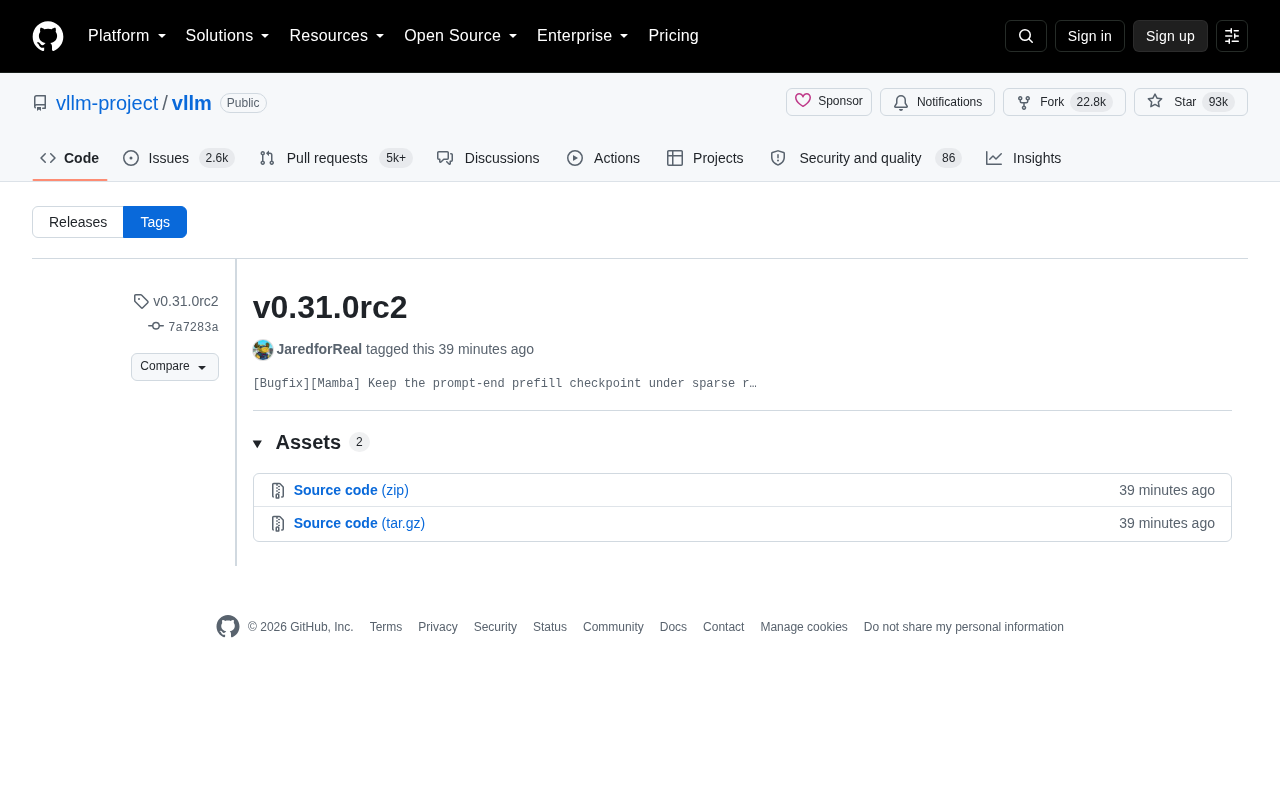
vLLM v0.31.0rc2 fixes Mamba prefill checkpoint retention under sparse sampling.
vLLM has released v0.31.0rc2, the second release candidate before the official 0.31.0 launch. The key change is a bug fix for the Mamba State Space Model architecture: under sparse sampling, the prefill checkpoint at the prompt's end could be incorrectly discarded, causing the decode phase to start from a corrupted hidden state and producing inaccurate or non-reproducible outputs. Since Mamba relies on a fixed-size recurrent hidden state rather than a Transformer KV Cache, precise state management is essential for output correctness. This fix signals vLLM's ongoing commitment to supporting non-Transformer architectures.
vLLM v0.31.0rc2 Overview
The vLLM project recently tagged a new release candidate on GitHub: v0.31.0rc2 (Release Candidate 2). As one of the most popular inference and serving frameworks for large language models, vLLM has accumulated over 93k stars and 22.8k forks on GitHub, making it one of the most actively maintained open-source projects in the community.
This rc2 release is part of the candidate phase leading up to the official 0.31.0 release. Release Candidates typically indicate that features are largely frozen, with the focus shifting to bug fixes and stability improvements — giving the community an opportunity to test and validate before the final release.
Core Change: Mamba Bug Fix
Based on the release notes, a key commit in rc2 is a bug fix targeting the Mamba architecture:
[Bugfix][Mamba] Keep the prompt-end prefill checkpoint under sparse ...
The primary goal of this commit is to preserve the prefill checkpoint at the end of the prompt under sparse sampling conditions. This fix involves state management for Mamba-class State Space Models (SSMs) during inference.
Why This Fix Matters
Unlike traditional Transformers that rely on the attention mechanism, Mamba is a State Space Model architecture whose inference depends on the continuous maintenance of hidden states. During the prefill phase (i.e., the pre-fill stage where the input prompt is processed), the model must correctly record state checkpoints so that token generation during the subsequent decode phase can accurately carry forward the context.
If the prefill checkpoint at the end of the prompt is lost under sparse sampling conditions, it can lead to state corruption, output deviation, or even non-reproducible generation results. While this kind of fix may seem like a minor detail, it directly impacts the correctness of inference results for Mamba models running on vLLM.
In this context, sparse sampling refers to an inference strategy that does not densely save state snapshots at every time step. To conserve GPU memory and reduce computation overhead, vLLM uses a selective checkpointing mechanism for Mamba's state management — only persisting hidden states at key positions. However, the final position of the prompt (the prompt-end) is the handoff point between the prefill and decode phases. Its hidden state must be fully preserved so that the recursive computation during subsequent token-by-token generation starts from the correct initial state. If this checkpoint is incorrectly skipped by the sparse strategy, the hidden state in the decode phase will accumulate errors from a wrong starting point, causing generated content to deviate from expectations. Due to the irreversibility of the state, these errors are difficult to detect or correct after the fact.
Mamba is a State Space Model (SSM) architecture proposed by Albert Gu and Tri Dao in 2023. Unlike the Transformer's attention mechanism, which requires caching a KV Cache for all historical tokens during inference, Mamba compresses historical information using a fixed-size recurrent hidden state. Both memory usage and computation scale linearly — rather than quadratically — with sequence length during inference. This gives Mamba a significant efficiency advantage in ultra-long context scenarios. However, this state-based inference paradigm also requires the inference framework (such as vLLM) to precisely save and restore hidden states in engineering scenarios like batch processing and interrupted recovery — a complexity that far exceeds the simple concatenation operations of a KV Cache.
The Significance of a Release Candidate
For production users, the value of an rc (release candidate) version lies in "early validation." Teams and enterprises can evaluate the new version's compatibility and performance impact on existing deployments in a test environment before the official release — especially teams using Mamba or hybrid architecture models.
It's worth noting that release candidates may still contain undiscovered issues and are generally not recommended for critical production environments. The prudent approach is to wait for the official 0.31.0 release, or to upgrade only after thorough regression testing.
Observations on the vLLM Ecosystem
vLLM's continued support for non-Transformer architectures like Mamba reflects the broader evolution of inference frameworks — moving from a single attention-based architecture toward support for a diverse range of model architectures. As the potential of State Space Models in long-context, low-inference-cost scenarios continues to be explored, the maturity of inference engine support for such architectures will become an increasingly important dimension for evaluating framework competitiveness.
While rc2 is a small, bug-fix-focused iteration, it signals that vLLM's refinement of Mamba support is still actively ongoing. Developers focused on deploying State Space Models should keep an eye on the complete release notes for the upcoming official 0.31.0 release.
Summary
vLLM v0.31.0rc2, as a release candidate ahead of the official release, focuses on fixing the prefill checkpoint retention issue for the Mamba architecture under sparse sampling. This type of fix is critical for ensuring the correctness of inference results with Mamba models. It is recommended that users validate in a test environment before evaluating whether to upgrade to the upcoming official release.
Related articles

Chain of Thought Isn't Just for AI: How Humans Can Use CoT to Improve Thinking Quality
Chain of Thought isn't just a prompt trick for large models. Starting from a Hacker News discussion, this article analyzes why CoT works for human thinking too, breaks down actionable ways to transfer it, and highlights the key differences between human CoT and machine CoT.
Cloudflare Teams Up with OpenAI: Closi…
Cloudflare Teams Up with OpenAI: Closing the Loop from Vulnerability Discovery to Defense with AI
Cloudflare uses OpenAI Daybreak to investigate security vulnerabilities and generate reviewable remediation plans, while developers use Codex to boost coding efficiency and quality.

Orca Multi-Agent Orchestration in Practice: A Guide to Parallel Collaboration with Claude and Codex
Orca is Stable AI's free open-source agent workbench supporting 34 agents like Claude Code and Codex in parallel. Learn its Git worktree isolation, multi-model orchestration, and mobile management.