vLLM Releases v0.40.14-rc0: Fixes Cloud Web Search Response Decoding

vLLM releases v0.40.14-rc0 pre-release, focusing on fixing server-side cloud web search response decoding.
vLLM released v0.40.14-rc0 pre-release on GitHub. Commit 9a3e817 is GitHub-verified, tagged by ParthSareen, and is in the rc validation stage. The core change is server: decode cloud web search responses (#19476), fixing server-side decoding of cloud web search results. Web search is a key part of the model's external tool pipeline; decoding issues can cause unreadable, truncated, or malformed results. Specifics are not disclosed; checking the PR diff is advised. Avoid direct replacement of stable versions in production.
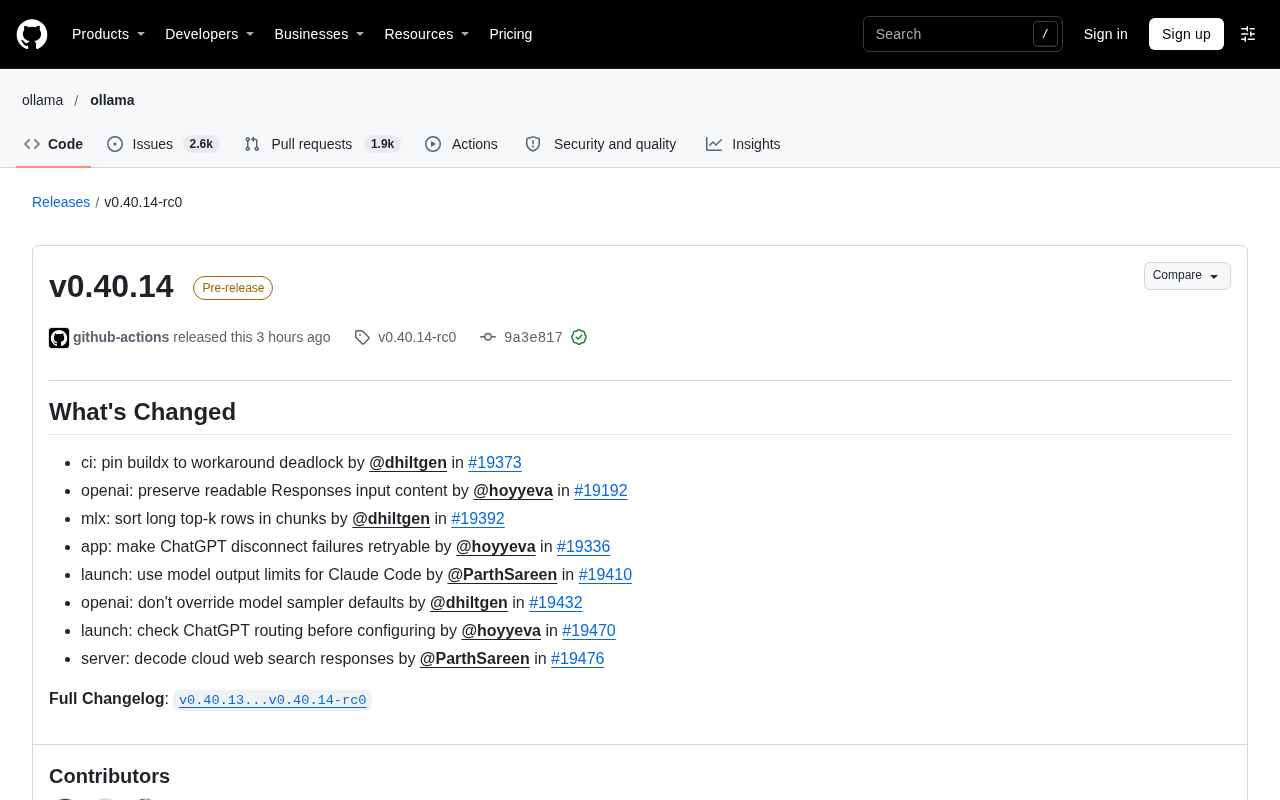
Large model inference framework vLLM has released a new version, v0.40.14-rc0, on GitHub. Judging from the commit information, this is a fix-focused pre-release, with the core change centered on server-side cloud web search response processing.
Basic Version Information
This version corresponds to commit 9a3e817, verified by GitHub with GPG key ID B5690EEEBB952194, indicating the code source is trustworthy. The version tag was created by ParthSareen on 03 Nov 00:59 and is in the rc (release candidate) pre-release stage, typically used to validate fixes before an official release.
GPG signature verification is a source-authenticity mechanism GitHub provides for commits and tags. The author signs the commit object with a private key, GitHub verifies the signature with its public key, and displays a "Verified" badge and the corresponding GPG key ID on the page. This confirms the commit was indeed created by the claimed author and the content has not been tampered with, but it does not guarantee code quality or security. For open-source projects, verified signatures are one of the important ways to determine whether release artifacts come from official maintainers.
Core Change: Decoding Cloud Web Search Responses
The title of this commit is server: decode cloud web search responses (#19476). From the description, it can be inferred that this change targets vLLM's server-side decoding logic when processing results returned by cloud web search.
Web search capability is an important extension direction for current large model applications: before generating an answer, the model often needs to call an external search service to obtain real-time information, then parse the returned results into structured content and inject them into the context. If there is a problem in the response decoding stage, search results may not be read correctly, content may be truncated, or formats may be abnormal, thereby affecting the final answer quality. This commit indicates the team is correcting this pipeline, with the corresponding issue/PR number #19476.
It should be noted that the commit message is quite brief, and the source material does not disclose the specific changes to the decoding logic, the affected search service providers, or the performance impact of the fix. Developers interested in vLLM's search integration are advised to check the diff of this PR directly to confirm the scope of adaptation.
rc (Release Candidate) pre-release version is a stage in the software release process, referring to a candidate build whose features are basically frozen and which is ready to enter official release. It is typically used to let the community and downstream users validate bug fixes and compatibility in real environments; if no serious issues are found, the build may be promoted directly to the official version. In a high-frequency iteration inference framework like vLLM, rc versions often correspond to rapid validation of a single or a small number of fixes, and the version number suffix explicitly marks rc and its sequence number to distinguish it from stable releases.
Tool Calling / Function Calling refers to a large model outputting structured instructions during generation, which the inference framework parses and uses to call external services (such as web search, databases, calculators, etc.), then feeds the returned results back into the context to continue generation. The server side needs to reliably serialize requests, parse external responses, and handle timeouts and format errors. As an inference server, vLLM's responsibility is not only model forward computation but also the orchestration and response decoding of such external tool pipelines, so the parsing logic for search responses directly affects the accuracy and completeness of the final answer.
Release Form and Upgrade Recommendations
This version appears as an rc, meaning it is closer to a validation release than a major feature version. The Assets section of the version page shows 2 asset files for users to download the corresponding build artifacts.
For production environment users, rc versions are generally not recommended for directly replacing stable versions; a safer approach is to validate in a test environment whether business processes related to web search have returned to normal, then wait for the official release. For projects currently integrating cloud search capabilities, this version is worth attention because it directly targets search response parsing, a high-frequency failure point.
Summary
v0.40.14-rc0 is a fix release focused on server-side search response decoding, reflecting vLLM's continuous refinement of the model's external tool calling pipeline beyond inference serving. Whether the subsequent official version contains more changes still needs to be confirmed against the official release records.
One-line Summary
vLLM releases v0.40.14-rc0 pre-release, focusing on fixing server-side cloud web search response decoding.
Paragraph Summary
vLLM released v0.40.14-rc0 pre-release on GitHub. Commit 9a3e817 is GitHub-verified, tagged by ParthSareen, and is in the rc validation stage. The core change is the commit server: decode cloud web search responses (#19476), which fixes the server-side decoding logic when processing results returned by cloud web search. Web search is an important part of the model's external tool calling pipeline; decoding abnormalities may cause results to be unreadable, truncated, or malformed, thereby affecting answer quality. The source material does not disclose specific change details, affected search service providers, or performance impact, so checking the PR diff is recommended. Production environments are not advised to directly replace stable versions; it is better to first validate search-related business processes in a test environment.
Related articles

AI Tools Quietly Altering Settings: Postman Silently Installs Plugin, Codex Sharing Option Auto-Resets
AI Daily reports: Postman silently installs a Mac plugin and self-approves startup hooks, logged as auto-existing upgrade; Hacker News developers say Codex data-sharing opt-out flips back. Plus Simon Willison's raw float weight experiment with QEN 3.8-27B.

AI Learns to Rewrite AI: MIT's "Weightspace Programming" Redraws the Path to Recursive Self-Improvement
MIT team proposes weightspace programming: GPT-6 Astra reads and edits AI model weights directly. Math scores jump several-fold, hand-written networks beat trained models. Eight experiments analyzed, plus Anthropic's same-day warning and the real boundaries of recursive self-improvement.

Running Qwen 3.8 on a Laptop to Read Raw Weights: 46 Minutes Per Answer
Simon Willison reproduced weight space programming with Qwen 3.8 27B on a laptop: a 17GB model file, 46 minutes per answer, 43,506 reasoning tokens, Pong over an hour, Freeway failed. Suited for interpretability researchers.