vLLM Speculative Decoding Lands on AMD GPUs: Inference Acceleration and an Ecosystem Breakthrough
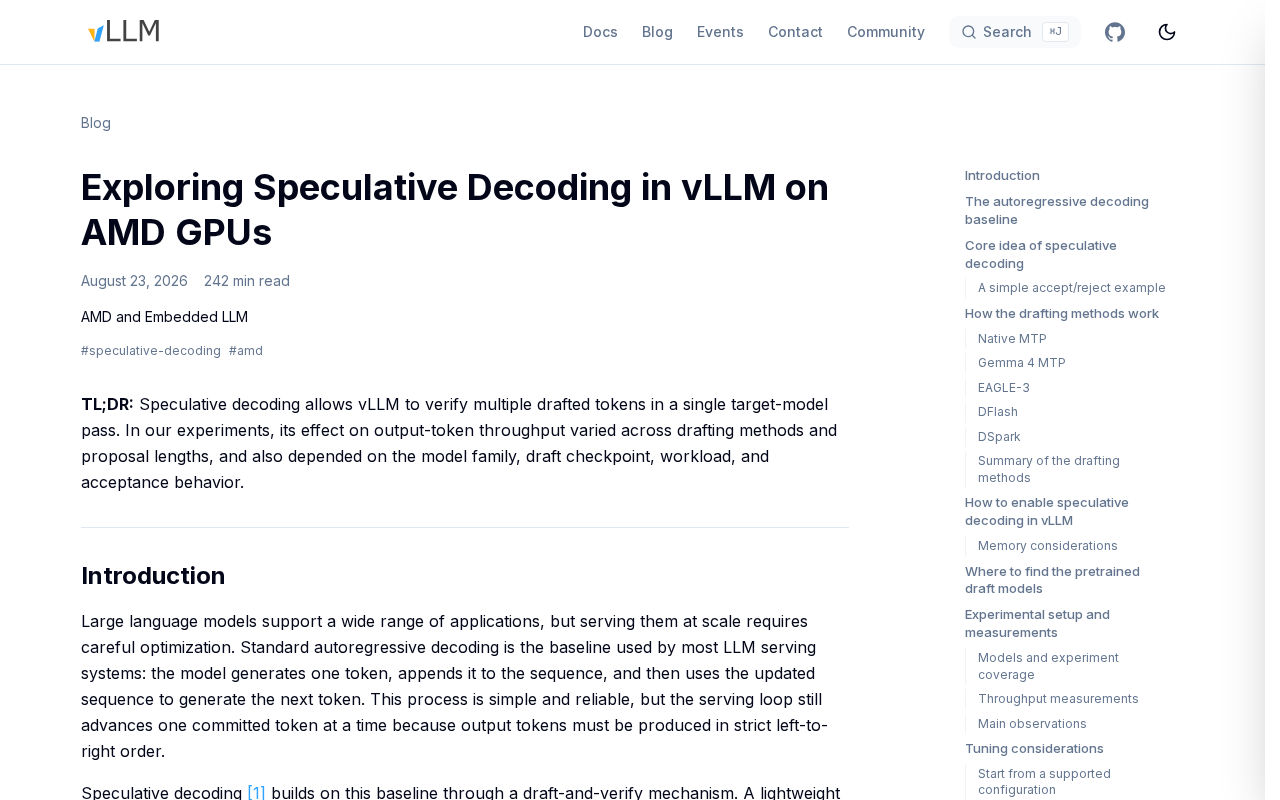
vLLM enables speculative decoding on AMD GPUs, delivering 1.5–3× faster LLM inference.
vLLM now supports speculative decoding on AMD GPUs, a milestone for AMD's AI inference ecosystem. The technique uses a lightweight draft model to predict candidate tokens that a larger target model verifies in parallel, achieving 1.5–3× speedups without sacrificing output quality. Adapting from CUDA to ROCm required addressing architectural differences like AMD's 64-wide wavefronts and re-optimizing attention, KV Cache, and kernel modules. This cross-platform advancement breaks NVIDIA's monopoly and accelerates AI infrastructure diversification.
Speculative Decoding Arrives on the AMD Platform
vLLM, one of the most popular large language model inference frameworks today, recently announced support for Speculative Decoding on AMD GPUs. This development marks a significant step forward in AMD's AI inference ecosystem and gives users a viable hardware alternative beyond NVIDIA.
Background on the vLLM Framework: vLLM is a high-performance LLM inference framework developed at UC Berkeley and open-sourced in 2023. Its core innovation is the PagedAttention mechanism, which manages the KV Cache in a manner similar to how operating systems handle virtual memory, pushing VRAM utilization close to the theoretical limit. Compared to traditional inference frameworks, vLLM can boost throughput by 2–24×, which quickly made it the go-to solution for LLM deployment across production environments such as ChatGPT-style applications and code generation tools. The framework supports advanced features like continuous batching and tensor parallelism, and is compatible with the Hugging Face ecosystem, significantly lowering the technical barrier to model deployment.
Speculative decoding is a technique that accelerates LLM generation by using a small model to predict and a large model to verify. The core idea is to leverage a lightweight draft model to quickly generate multiple candidate tokens, which the target (large) model then verifies in parallel. This approach can significantly improve generation throughput without compromising output quality.
A Deeper Look at Speculative Decoding: The mathematical foundation of speculative decoding stems from the sequential generation nature of autoregressive language models. Traditional decoding generates one token at a time, requiring N forward passes through the model. Speculative decoding exploits a key observation: although a smaller model is lower quality, it generates tokens quickly and is often accurate in straightforward contexts. The specific workflow is: 1) The draft model autoregressively generates k candidate tokens (e.g., k=4–8); 2) The target model performs a single parallel verification pass over these k tokens, computing the probability distribution at each position; 3) Tokens are checked from left to right, accepting consecutive correct tokens until the first mismatch; 4) A new token is resampled from the mismatch position. Because verification is parallelized, even accepting only a subset of tokens is faster than generating them one by one. Theoretically, if the draft model's accuracy is p, the expected speedup is approximately 1/(1-p^k).
A Critical Addition to AMD's GPU Inference Ecosystem
For a long time, NVIDIA GPUs have dominated the AI landscape thanks to the CUDA ecosystem. While AMD has been steadily closing the gap in hardware performance, its software ecosystem has remained a weakness. vLLM's support for the AMD platform — especially the adaptation of advanced optimization techniques like speculative decoding — shows that the open-source community is actively working to bridge this gap.
For enterprise users, this means greater flexibility when choosing inference hardware. AMD's MI-series GPUs can offer more competitive price-performance in certain scenarios, and now these cards can also benefit from inference optimizations on par with what's available on NVIDIA. This competitive landscape is poised to drive industry-wide technological progress and cost reductions.
AMD MI-Series GPU Positioning: AMD's MI (Machine Intelligence) series is a product line of accelerator cards designed specifically for data center AI/HPC workloads. The current flagship MI250X features 128 GB of HBM2e memory with peak FP16 performance of 383 TFLOPS. The MI300 series is AMD's latest generation — the MI300X packs up to 192 GB of VRAM per card and uses a Chiplet architecture integrating CPU and GPU. Compared to NVIDIA's A100/H100, the MI series holds an advantage in memory capacity, making it particularly well-suited for inference on very large models. Pricing is typically 15–30% lower than comparable NVIDIA products. However, ecosystem maturity remains a challenge: ROCm updates are less frequent, and AMD adaptations of some deep learning libraries lag behind their CUDA counterparts — which is precisely why vLLM's adaptation here is so significant.
Technical Implementation: Challenges and Value of Moving from CUDA to ROCm
Implementing speculative decoding on AMD GPUs is far from a simple code port. ROCm (AMD's GPU computing platform) differs from CUDA in numerous ways, including low-level architecture, memory management, and kernel optimization. The development team needed to re-optimize several key modules for AMD hardware:
Architectural Differences Between CUDA and ROCm: Although both CUDA and ROCm are general-purpose GPU computing platforms, their underlying design philosophies differ significantly. CUDA is built on NVIDIA's thread hierarchy (thread/warp/block/grid) with a fixed warp size of 32. ROCm is based on AMD's wavefront concept — on RDNA architectures the wavefront is 32, but on CDNA architectures (the MI series) it's 64, which directly affects kernel parallelism design. In terms of memory hierarchy, CUDA uses Unified Virtual Addressing (UVA), while ROCm's memory model is closer to the HSA standard, requiring explicit management of host-device data transfers. On the programming interface side, ROCm provides HIP (a CUDA-like C++ API) for code porting, but many CUDA-exclusive features (such as cooperative groups and dynamic parallelism) are either missing or behave differently in ROCm. Furthermore, CUDA's optimized libraries like cuBLAS and cuDNN have been refined over more than a decade, giving them a performance and stability lead over ROCm's counterparts (rocBLAS, MIOpen).
- Attention Computation: Adapting to ROCm's compute primitives to ensure efficient parallel verification of multiple candidate tokens during speculative decoding
- KV Cache Management: Optimizing cache allocation and reuse strategies for AMD GPU memory architectures
- Kernel Tuning: Adjusting compute kernel parameters based on AMD GPU wavefront characteristics
KV Cache Mechanism Explained: The KV Cache is a core optimization technique for Transformer inference. During autoregressive generation, computing each new token requires attention interaction with all previous tokens. Without caching, the Key and Value matrices for historical tokens must be recomputed, resulting in O(n²) complexity. The KV Cache stores previously computed K/V tensors in VRAM so that generating a new token only requires computing its own Q/K/V and performing attention with the cached historical K/V, reducing complexity to O(n). However, for LLMs with billions of parameters, the KV Cache consumes enormous amounts of VRAM: for LLaMA-70B, for example, a single sample's KV Cache at a context length of 4096 can reach several gigabytes. vLLM's PagedAttention manages the KV Cache in blocks (similar to OS paging), eliminating memory fragmentation and boosting VRAM utilization from the typical 20–40% in traditional frameworks to over 90%.
The Wavefront Compute Model: The wavefront is the fundamental execution unit on AMD GPUs, analogous to NVIDIA's warp. In AMD's CDNA architecture (MI100/250/300 series), a single wavefront contains 64 work-items that execute the same instruction synchronously in SIMD fashion. Each Compute Unit (CU) can schedule multiple wavefronts simultaneously to hide memory latency. This 64-wide design is highly efficient for regular computations like matrix multiplication, but code with heavy branching suffers from execution divergence due to the SIMD nature, reducing efficiency. For speculative decoding, developers must pay special attention to the parallelism patterns during the candidate token verification phase: how to map attention computations for multiple candidate tokens onto wavefronts, and how to balance compute loads across different candidate paths. These all require tuning specifically for the 64-wide characteristic — CUDA's 32-wide optimization strategies cannot simply be reused.
From a practical standpoint, speculative decoding is especially well-suited for latency-sensitive interactive scenarios. In applications like conversational AI assistants and real-time code completion, users expect rapid responses. With speculative decoding, both Time to First Token (TTFT) and overall generation speed see significant improvements, typically achieving a 1.5× to 3× speedup.
Why Optimizing Time to First Token Matters: Time to First Token (TTFT) is a critical metric for LLM interaction quality. In conversational systems, TTFT determines how quickly a user sees the AI start "typing" a response after submitting a question. In traditional inference, TTFT is dominated by the prefill phase: the entire input prompt must be processed at once to compute the KV Cache. For long prompts (such as those in RAG applications with extensive context), this can take hundreds of milliseconds or even seconds. While speculative decoding primarily optimizes the decode phase, reducing the number of decode steps indirectly shortens total response time. More importantly, speculative decoding's "parallel verification" property can be combined with techniques like continuous batching and chunked prefill to further optimize TTFT. In real-time applications (customer service chatbots, IDE code completion), every 100 ms reduction in TTFT produces a noticeable improvement in perceived fluency, directly impacting product experience and user retention.
The Synergistic Effect of the Open-Source Ecosystem
As an open-source project, vLLM's multi-hardware platform support is a powerful demonstration of open-source community collaboration. This kind of cross-platform optimization work benefits AMD users directly while also providing a reusable reference path for adapting to other non-mainstream hardware.
From a broader perspective, the virtuous cycle forming among hardware vendors, framework developers, and end users is driving the diversification of AI infrastructure. When inference optimization techniques are no longer monopolized by a single hardware platform, the entire industry enjoys a healthier competitive environment and faster innovation.
Trends in Open-Source AI Infrastructure: AI infrastructure is currently undergoing a shift from closed-source monopoly to open and diverse. On the hardware front, beyond AMD, Intel's Gaudi series, Huawei's Ascend, and Cambricon are all vying for inference market share. On the framework front, besides vLLM, TensorRT-LLM (NVIDIA), Text Generation Inference (Hugging Face), llama.cpp, and others each have their own strengths. This diversification produces two major effects: 1) Accelerated technical innovation, as breakthrough techniques like Flash Attention and Paged Attention rapidly spread and iterate within the open-source community; 2) Reduced supply chain risk, as enterprises are no longer locked into a single hardware vendor. The challenge, however, is fragmentation: different hardware requires different kernel optimizations, and incompatible framework APIs increase development and operations costs. In the future, standardized abstraction layers (similar to what ONNX Runtime attempts in the inference domain) may emerge to balance performance with portability.
Key Takeaways
- vLLM's support for speculative decoding on AMD GPUs marks a major milestone for AMD's AI inference ecosystem
- Speculative decoding achieves 1.5–3× speedups through draft model prediction + target model parallel verification, with no loss in output quality
- AMD's MI-series GPUs, with their large VRAM capacity and competitive pricing, are becoming a compelling alternative to NVIDIA
- Architectural differences between ROCm and CUDA (e.g., 64-wide wavefronts vs. 32-wide warps) require dedicated kernel optimization
- Cross-platform inference optimization breaks monopolies and drives AI infrastructure toward greater diversification and standardization
Related articles

AdCar Deep Dive: The Cross-Platform Marketing Innovation Combining Car Wraps, YouTube, and X
AdCar integrates car wrap advertising, YouTube, and X into a composite ad placement, offering low-cost, high-exposure creative marketing for SMBs and indie developers. An analysis of its product logic, micro-influencer economics, and scaling challenges.

Capslane: One API for YouTube Subtitle Extraction and Auto-Transcription
Capslane provides a unified API for YouTube subtitle extraction, supporting native subtitle retrieval and auto-transcription. Features JavaScript, Python SDKs and MCP integration for video analysis and AI applications. 50 free calls monthly.
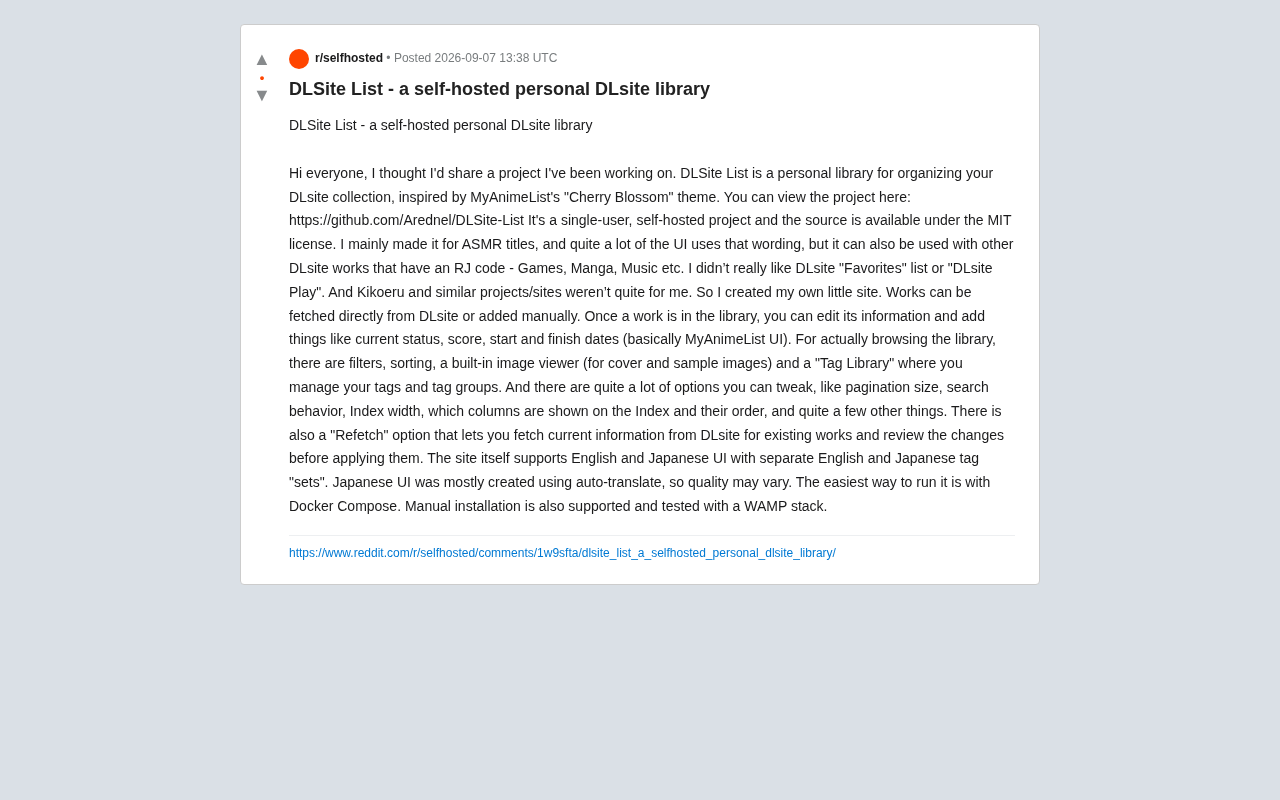
DLSite List: Complete Guide to the Open-Source Self-Hosted Digital Content Management System
DLSite List is an open-source self-hosted management system for DLsite digital content, supporting ASMR, games, manga, and RJ-numbered content scraping, categorization, and tracking. Complete guide to its features, architecture, and Docker deployment.