vLLM v0.30.0 Released: Fixes DeepGEMM Build Issue on CUDA 12.9

vLLM v0.30.0 fixes DeepGEMM build failures on CUDA 12.9 — upgrade recommended for affected users.
vLLM v0.30.0 is a stability-focused maintenance release that fixes a release build failure in the DeepGEMM component under CUDA 12.9 (PR #57554). DeepGEMM is a high-performance matrix multiplication library designed to accelerate LLM inference, and the CUDA 12.9 toolchain upgrade introduced a compatibility break that prevented official binaries from building correctly. The fix was cherry-picked into the release branch for a fast turnaround, and users on CUDA 12.9 are advised to upgrade immediately. Users on older CUDA versions can also upgrade safely with no breaking changes.
vLLM has released version v0.30.0, with the core update being a fix for the DeepGEMM release build failure under CUDA 12.9 (PR #57554). For developers relying on vLLM for large model inference deployment, this is a noteworthy stability fix worth paying attention to.
Release Highlights
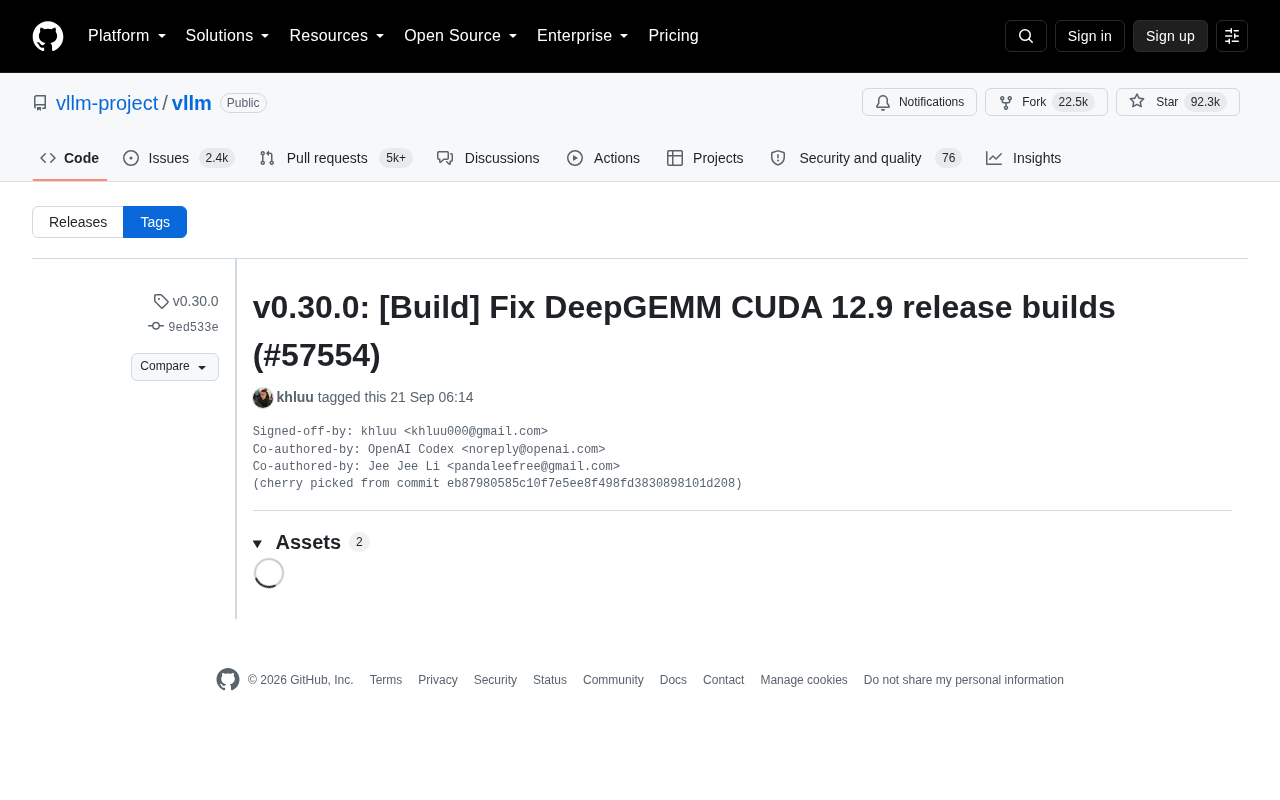
The key change in v0.30.0 is focused at the build level. According to the release notes, the issue was traced to the DeepGEMM component failing to build in release mode under CUDA 12.9. The fix was led by contributor khluu, with collaboration from OpenAI Codex and Jee Jee Li. It was merged into the release branch via a cherry-pick from the main branch (commit eb879805).
DeepGEMM is a high-performance GPU matrix multiplication (GEMM) implementation commonly used to accelerate the core computations in large language model inference. When the CUDA toolchain was upgraded to 12.9, a compatibility issue emerged in the build process, directly causing the official release binaries to fail to compile or run correctly in the new CUDA environment.
GEMM (General Matrix Multiplication) is one of the most fundamental computational primitives in deep learning inference. The linear layers of large language models and the QK^T computation in attention mechanisms are all essentially matrix multiplications. DeepGEMM is an open-source GEMM kernel library from the DeepSeekAd team, optimized specifically for FP8 precision and deeply tuned for NVIDIA Hopper architecture (H100/H800) Tensor Cores. It significantly improves throughput while maintaining computational accuracy. Once integrated into vLLM, DeepGEMM can be automatically selected on supported hardware as a replacement for general-purpose implementations like cuBLAS, reducing inference latency. Since DeepGEMM is deeply coupled with low-level CUDA PTX instructions and the compilation toolchain, build compatibility issues when the CUDA version changes are not uncommon.
Why This Fix Matters
vLLM is one of the most popular open-source large model inference engines, with over 92,000 stars and 22,500 forks on GitHub, and is widely adopted in production environments. Build-level issues may seem trivial, but their impact on real deployments is significant — if a release version fails to build under a specific CUDA version, users running that environment simply cannot obtain a working official package.
CUDA 12.9 is a relatively new version of NVIDIA's compute toolchain, and many teams looking to leverage the latest drivers and hardware features have adopted it. This fix ensures those users can successfully use the official vLLM release, avoiding the additional overhead of self-patching or downgrading their CUDA installation.
Cherry-pick is a Git version control operation that takes a specific commit from one branch and applies it to another, without merging the entire branch history. In large open-source projects, the main branch typically receives continuous new features and experimental changes, while release branches remain relatively stable. When a critical bug fix lands on the main branch, maintainers use cherry-pick to precisely "port" that fix to the release branch, avoiding the introduction of unstable new features into the official release. The vLLM team's cherry-pick of commit eb879805 into the v0.30.0 release branch is a perfect example of this agile maintenance strategy — users can receive a verified fix without waiting for the next full feature release.
Recommendations for Users
If you are deploying vLLM in a CUDA 12.9 environment, it is recommended to upgrade directly to v0.30.0 to get the fixed release build. For users still running older CUDA environments (such as 12.1 or 12.4), this fix introduces no breaking functional changes, but upgrading to the latest stable version remains a good practice for keeping dependencies in sync.
It is worth noting that based on the release notes, this update is a maintenance release focused primarily on build fixes, with no mention of major new features or inference performance improvements. The team's use of cherry-pick to quickly merge the fix into the release branch also reflects the vLLM project's agility in version maintenance.
Summary
vLLM v0.30.0 is a stability-focused release that addresses the DeepGEMM build failure under CUDA 12.9. While the scope of changes is limited, it is a necessary and timely fix for large model deployment teams using the latest CUDA toolchain. Keeping up with vLLM's version iterations helps maintain the best balance between inference framework performance and compatibility.
Related articles

Chain of Thought Isn't Just for AI: How Humans Can Use CoT to Improve Thinking Quality
Chain of Thought isn't just a prompt trick for large models. Starting from a Hacker News discussion, this article analyzes why CoT works for human thinking too, breaks down actionable ways to transfer it, and highlights the key differences between human CoT and machine CoT.
Cloudflare Teams Up with OpenAI: Closi…
Cloudflare Teams Up with OpenAI: Closing the Loop from Vulnerability Discovery to Defense with AI
Cloudflare uses OpenAI Daybreak to investigate security vulnerabilities and generate reviewable remediation plans, while developers use Codex to boost coding efficiency and quality.

Orca Multi-Agent Orchestration in Practice: A Guide to Parallel Collaboration with Claude and Codex
Orca is Stable AI's free open-source agent workbench supporting 34 agents like Claude Code and Codex in parallel. Learn its Git worktree isolation, multi-model orchestration, and mobile management.