vLLM v0.30.0rc2 Released: Fixes NIXL Notification Request Handling

vLLM v0.30.0rc2 fixes redundant receive reports for notification-only requests in the NIXL transport layer.
vLLM has released v0.30.0rc2, a release candidate whose core change fixes a bug in the NIXL (NVIDIA Inference Xfer Library) transport layer: in distributed inference scenarios, "notification-only requests" that merely pass a signal without actual data reception were incorrectly triggering the full receive report pipeline, wasting resources and potentially causing logic errors. The fix streamlines the communication path by skipping these redundant steps. NIXL primarily serves KV cache cross-node transfers in Prefill/Decode disaggregated architectures, and such low-level communication optimizations have real implications for throughput and stability at scale.
vLLM v0.30.0rc2 Released: Fixes NIXL Notification Request Handling
The vLLM project has recently released version v0.30.0rc2. As one of the most widely adopted LLM inference and serving engines in the industry, every vLLM release is closely watched by the AI engineering community. This release is a Release Candidate (RC) ahead of the official 0.30.0 stable release, and it contains a targeted bug fix in the NIXL transport layer.
What's in This Update
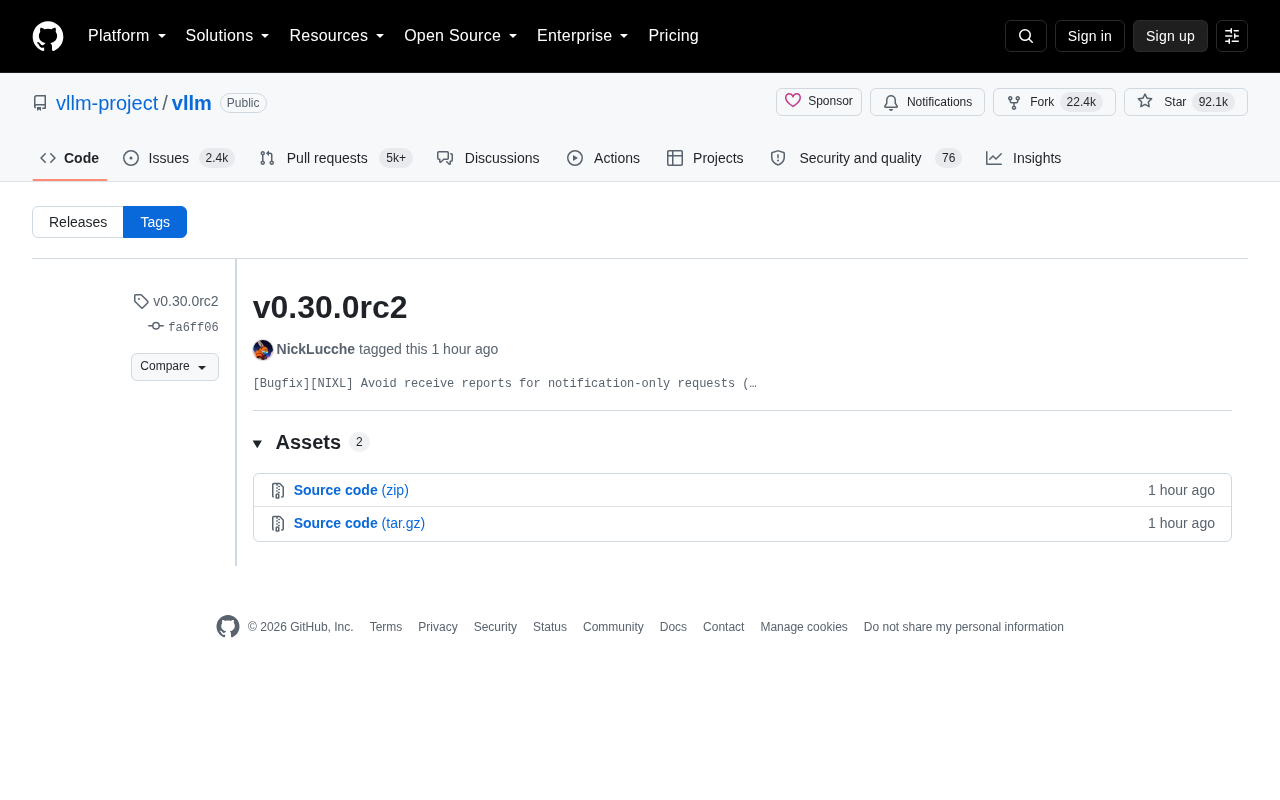
According to the GitHub release record, v0.30.0rc2 was tagged by maintainer NickLucche at commit hash fa6ff06. The key change in this version is a single bug fix:
[Bugfix][NIXL] Avoid receive reports for notification-only requests
In short, this fix optimizes how the NIXL transport component handles "notification-only requests" — requests that carry only a signal without involving actual data reception. By preventing these requests from triggering unnecessary receive reports, the fix helps reduce communication overhead and improve system stability in distributed inference and KV cache transfer scenarios.
What Is NIXL
NIXL (NVIDIA Inference Xfer Library) is a library designed to accelerate inference data transfers. In vLLM, it is commonly used to handle KV cache transfers across nodes in a disaggregated serving architecture, where Prefill and Decode stages are split across different GPUs or nodes. NIXL is responsible for efficiently moving intermediate state data — specifically KV caches — between these compute units.
The "notification-only requests" addressed in this fix are requests that simply pass a signal without any actual data payload being received. In earlier implementations, such requests could still go through the full receive report pipeline, wasting resources and potentially introducing logic errors. The new version streamlines the communication path by skipping these meaningless reporting steps.
Prefill/Decode disaggregated serving is an advanced deployment pattern in large model inference. Traditional inference runs both the Prefill stage — processing the input prompt and generating the KV cache — and the Decode stage — auto-regressively generating tokens — on the same set of GPUs in sequence, causing the two workloads to interfere with each other and making it difficult to optimize GPU utilization. Disaggregated serving separates these two stages onto different GPU nodes: once the Prefill node completes its computation, it must transfer the generated KV cache to the Decode node to continue inference. This cross-node data transfer is extremely sensitive to bandwidth and latency, and it's precisely where specialized transport libraries like NIXL play a critical role. NIXL typically leverages high-speed interconnects such as NVLink, InfiniBand, or RDMA to transfer data directly between GPU memory, bypassing the CPU to minimize the latency overhead of KV cache migration.
What Does a Release Candidate Mean
The "rc" in rc2 stands for Release Candidate, and the number 2 indicates this is the second candidate before the official 0.30.0 stable release. RC versions are generally feature-complete and close to the final release, and are primarily used for broader validation and feedback collection.
For production users, RC versions are suitable for early compatibility testing in staging environments, but it is generally recommended to wait for the stable release before deploying to critical workloads. For developers who want to participate in community testing or need a specific fix early, an RC version is a timely option.
Impact on Users
vLLM has surpassed 90,000 stars on GitHub with over 22,000 forks, making it one of the most popular open-source inference engines available. This high-frequency release cadence and rapid bug fixing is a testament to its active community.
If you are running disaggregated inference deployments that use NIXL, it is worth paying attention to the behavioral changes introduced by this fix and verifying that your KV transfer pipeline works correctly after upgrading. For most standard deployment scenarios, the impact of this change is limited — you can decide whether to upgrade to this release candidate based on your own timeline.
KV cache (Key-Value Cache) is a core optimization structure in Transformer-based inference. During auto-regressive decoding, at each step of generating a new token, the model needs to recompute the Key and Value matrices in the attention mechanism for all historical tokens. KV cache stores these previously computed intermediate results to avoid redundant computation, significantly reducing the per-step compute cost. In distributed or disaggregated deployments, KV cache data volumes can be substantial — reaching several gigabytes for long-context requests — meaning cross-node transfer efficiency directly impacts overall system throughput and end-to-end latency.
Summary
v0.30.0rc2 is a stability-focused release candidate whose core contribution is fixing how the NIXL transport layer handles notification-only requests. While the change may seem minor, in large-scale distributed inference environments, low-level communication optimizations like this can have a real impact on overall performance and reliability. Interested developers can visit the official vLLM GitHub repository for the full release notes and installation packages.
Related articles

Felix Rieseberg Personal Homepage
Felix Rieseberg's personal homepage sparks attention on Hacker News. This article covers the Slack engineer's technical background, the rise and fall of nativefier, and the value of a developer homepage as a tech calling card.

@ai-sdk/vue 3.0.306 Patch Release Syncs with [email protected] Update
@ai-sdk/vue 3.0.306 released, synced with [email protected]. A routine patch release for the Vercel AI SDK ecosystem with no public API changes; the Vue adapter layer stays version-aligned with the core package.

Gemini 4 Argon API Launches: The Era of Million-Token Output Begins
Google launches Gemini 4 Argon with sparse MoE architecture, up to 1M output tokens, and a 68.90% Vals Index score, available across API, AI Studio, and the Gemini app.