vLLM v0.31.0rc1 Released: Optimized CUDA 12.x Image Build Process

vLLM v0.31.0rc1 skips snapshot runtime on CUDA 12.x image builds, delivering a CI/build pipeline optimization.
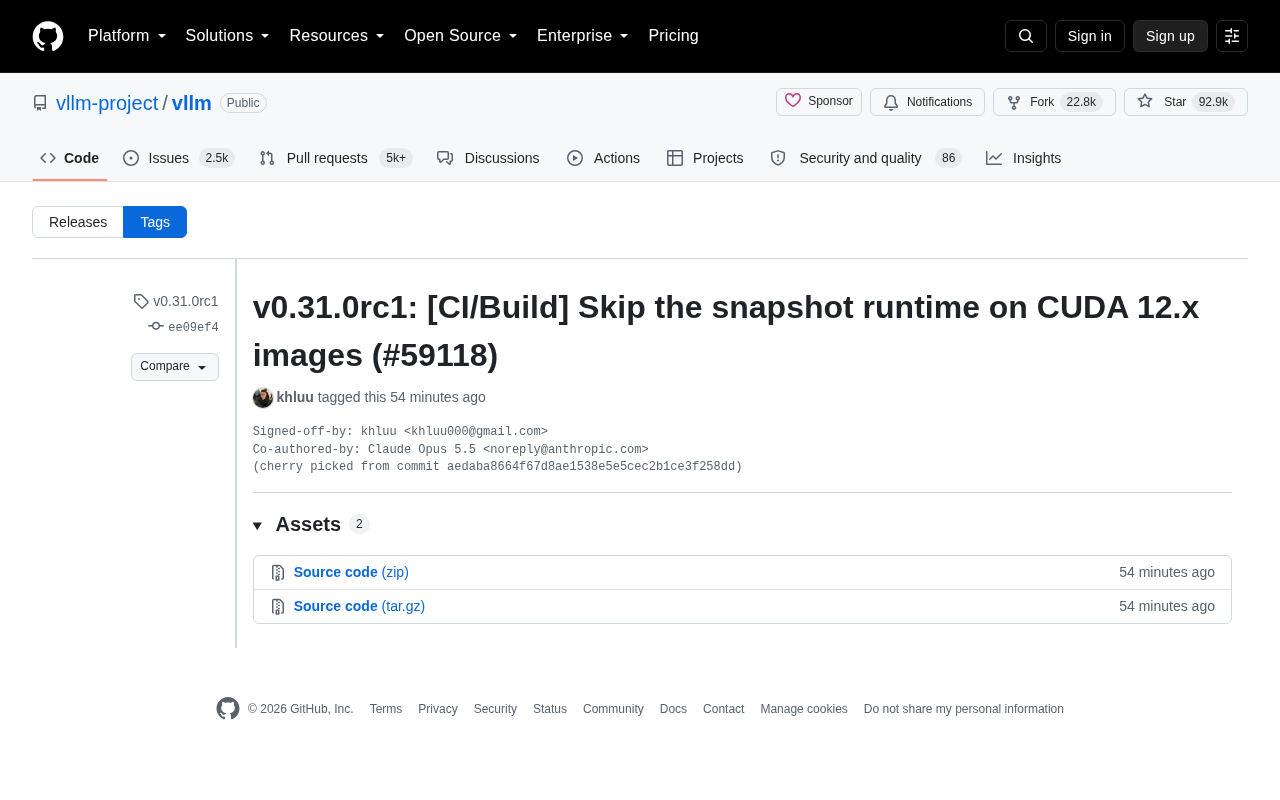
vLLM v0.31.0rc1 is an engineering maintenance release candidate focused on CI/build process improvements. Its core change (commit #59118) skips the snapshot runtime step during CUDA 12.x image builds to reduce build time and lower failure risk from environment inconsistencies. The commit was cherry-picked from the main branch into the release branch, following mature version management practices. Notably, the commit includes a Claude Opus 5.5 co-author attribution, highlighting AI coding assistants' growing role in open-source infrastructure. With ~92,900 Stars, vLLM's build stability affects a vast number of downstream users. Production users are advised to test first and wait for the official 0.31.0 stable release before upgrading.
vLLM has released v0.31.0rc1 (Release Candidate 1). As a widely adopted inference and serving engine for large language models, every vLLM iteration draws close attention from the deployment community. This release candidate focuses on CI/build process optimization — a polishing update on the engineering side.
Core Changes in This Release
According to the release notes, the key commit in v0.31.0rc1 is #59118, which introduces the change: "Skip the snapshot runtime on CUDA 12.x images" — meaning the snapshot runtime step is bypassed during the build process for CUDA 12.x series images.
While this change may seem minor, it has real implications for CI pipeline efficiency and stability. Building GPU-related container images is typically time-consuming. Skipping the unnecessary snapshot runtime step for specific CUDA versions reduces build time and lowers the risk of build failures caused by runtime environment discrepancies. For a project like vLLM that maintains multiple CUDA version images simultaneously, every improvement to the build process compounds into meaningful gains over time.
Notably, the commit attribution shows it was submitted by maintainer khluu, with a Co-authored-by: Claude Opus 5.5 co-author tag. This reflects a broader trend: AI coding assistants are becoming deeply involved in the day-to-day development of open-source infrastructure projects.
Snapshot Runtime refers to a step in the container image build process where the current state of the runtime environment is captured — typically used for consistency verification, cache acceleration, or rollback purposes. In GPU-related images, this step often involves time-consuming operations like CUDA driver version detection and library dependency scanning. When the runtime environment for a specific CUDA version (such as 12.x) is already stable enough, or when the snapshot step has compatibility issues on that version, skipping it both shortens CI pipeline time and avoids potential build interruptions. Cherry-pick is a Git operation that takes a specific commit from one branch and applies it to another. It is commonly used to selectively backport verified fixes from the main branch to a release branch, without pulling in other unverified changes.
Why a Release Candidate
The rc1 in v0.31.0rc1 indicates this is the first release candidate before the official 0.31.0 stable release. Release candidates are a common stability verification mechanism in open-source projects: before the final tag is applied, a feature-frozen, fix-focused version is released to the community for testing in real environments, surfacing potential issues.
The nature of the changes in this rc — primarily CI/build adjustments introduced via cherry-pick (picking commit aedaba8 from the main branch) — indicates that the relevant fix was already validated on the main development branch before being selectively backported to the release branch. This reflects a mature version management practice.
vLLM's Community Scale
The project's stats speak to vLLM's reach: the repository has accumulated approximately 92,900 Stars and 22,800 Forks. This places it at the top tier of open-source inference engines, and means that any release — even a minor build process tweak — can affect a large number of downstream users and enterprise deployments.
This is precisely why vLLM's continuous investment in CI/build optimization is far from trivial. The massive user base demands a highly efficient and reliable release process, and the stability of image builds directly determines whether users can smoothly pull and use the runtime environment for their target CUDA version.
vLLM's core technical advantage lies in its proposed PagedAttention mechanism — drawing inspiration from operating system virtual memory paging, it manages the KV Cache (key-value pair cache used during inference) in non-contiguous memory blocks, dramatically improving GPU memory utilization and supporting higher concurrent throughput. This allows vLLM to achieve several times the throughput of naive inference implementations on the same hardware, making it one of the go-to engines for industrial deployment. It is precisely this technical influence that makes its large user base highly sensitive to build process stability — any anomaly in CUDA image builds directly blocks downstream users' deployment pipelines.
Practical Impact for Users
For most users, a release candidate like v0.31.0rc1 — focused primarily on build process optimization — typically introduces no breaking changes at the feature level. However, if your workflow depends on vLLM's official CUDA 12.x images, it's worth monitoring the upcoming stable release to verify that images build and run as expected.
Since this is a release candidate rather than a stable release, production environment users are advised to proceed with caution: try it out in a test environment first, and wait for the official 0.31.0 stable release before evaluating an upgrade. Release candidates in open-source projects exist precisely to gather feedback — reporting issues to the community is itself a valuable form of participation.
Summary
vLLM v0.31.0rc1 is a typical engineering maintenance release, centered on optimizing the CUDA 12.x image build process. While the change itself doesn't introduce new features, it reflects two broader trends: first, the sustained engineering quality investment by leading open-source inference engines; and second, AI coding assistants (such as Claude) are increasingly participating in the collaborative development of real open-source projects. For teams focused on LLM inference deployment, keeping track of vLLM's release cadence helps ensure you're among the first to benefit from performance and stability improvements.
Related articles

Chain of Thought Isn't Just for AI: How Humans Can Use CoT to Improve Thinking Quality
Chain of Thought isn't just a prompt trick for large models. Starting from a Hacker News discussion, this article analyzes why CoT works for human thinking too, breaks down actionable ways to transfer it, and highlights the key differences between human CoT and machine CoT.
Cloudflare Teams Up with OpenAI: Closi…
Cloudflare Teams Up with OpenAI: Closing the Loop from Vulnerability Discovery to Defense with AI
Cloudflare uses OpenAI Daybreak to investigate security vulnerabilities and generate reviewable remediation plans, while developers use Codex to boost coding efficiency and quality.

Orca Multi-Agent Orchestration in Practice: A Guide to Parallel Collaboration with Claude and Codex
Orca is Stable AI's free open-source agent workbench supporting 34 agents like Claude Code and Codex in parallel. Learn its Git worktree isolation, multi-model orchestration, and mobile management.