VocalGrad Reveals Acoustic Perception Gaps in Audio Language Models

VocalGrad benchmark reveals state-of-the-art audio language models near chance on pure acoustic perception, far below humans.
VocalGrad proposes a benchmark separating acoustic perception from semantic reasoning via directional binary classification—judging whether an acoustic dimension increases or decreases. Humans score high, but state-of-the-art audio language models (LALMs) hover near random guessing, exposing structural flaws in low-level acoustic modeling. Linear probing reveals two failure modes: information retained in representations but unused by the LM head, and information decaying across layers until non-linearly decodable. High semantic task scores can mask perceptual gaps; evaluation must separate perception from reasoning.
Large audio language models (LALMs) perform impressively on tasks like speech recognition and emotion recognition, but do they truly "hear" the sound itself? A new study, VocalGrad, delivers a surprising answer: on pure acoustic perception tasks stripped of semantic reasoning, state-of-the-art models achieve accuracy nearly equivalent to random guessing, forming a massive gap with human annotators.
Why a Dedicated Acoustic Perception Benchmark Is Needed
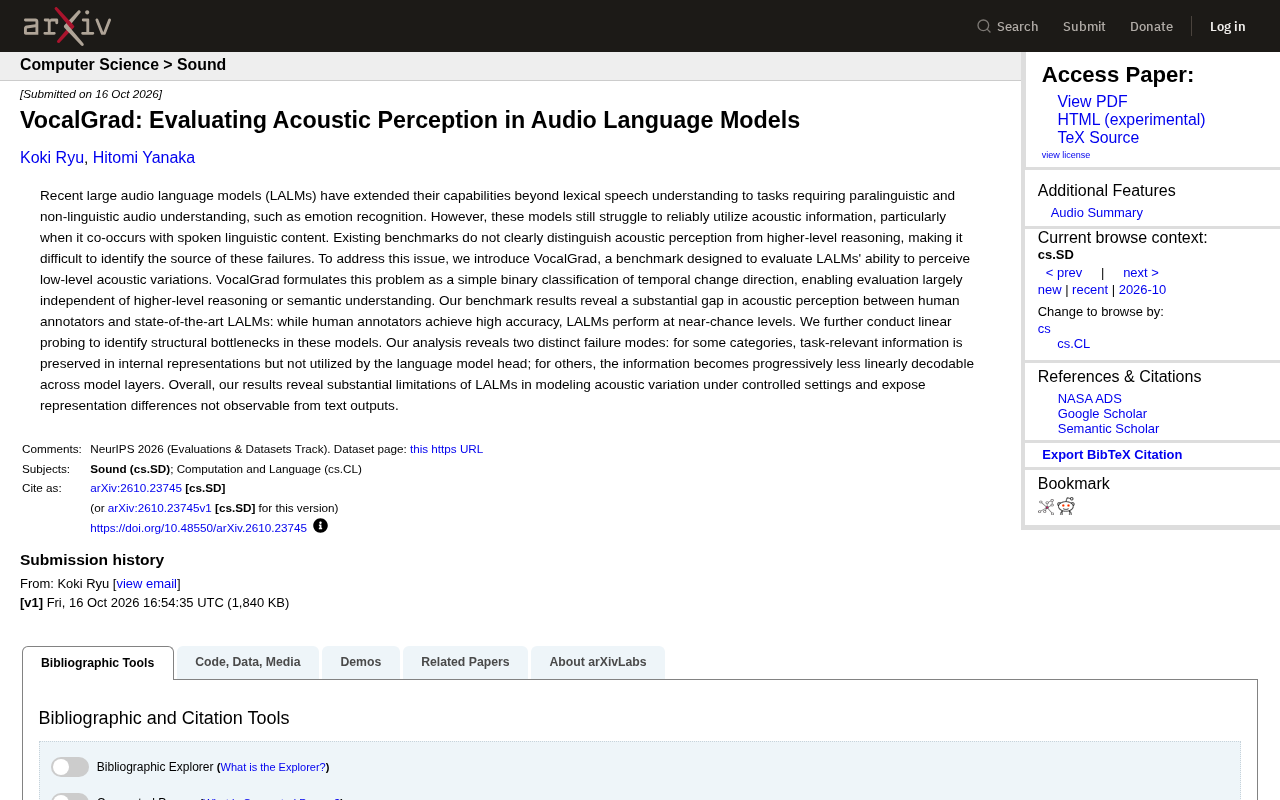
Most existing audio benchmarks mix semantic understanding with acoustic perception. When a model errs on emotion recognition, it's hard to tell whether it failed to capture pitch cues or whether the reasoning step broke down. VocalGrad's core idea is to simplify the problem: have the model judge whether some acoustic dimension of a sound is increasing or decreasing—a directional binary classification. This design deliberately bypasses semantic understanding and approximates a pure acoustic perception test.
According to the paper, human annotators achieve high accuracy on this task, while state-of-the-art LALMs hover at near-chance levels. This contrast directly exposes a structural deficiency in how models model low-level acoustic changes.
Directional binary classification converts a continuous change in an acoustic dimension into a binary judgment of "is this dimension increasing or decreasing in this segment"—for example, whether pitch rises or falls, whether loudness increases or decreases. The advantage of this design is that the answer does not depend on lexical semantics or commonsense reasoning, so the model cannot "guess" the correct answer from textual priors; meanwhile, labels are objective and can be generated automatically from acoustic measurements, making large-scale construction feasible. Compared with asking a model to describe a sound or perform emotion classification, directional judgments are closer to pure perception of low-level acoustic cues, more cleanly isolating the model's sensitivity to acoustic changes, and are therefore well suited as a probe-style task for diagnosing perceptual ability.
Two Distinct Failure Modes
The research team further analyzed the model's internal representations using linear probing and discovered two截然 different failure paths:
Representation exists but is unused. For some acoustic categories, task-relevant information is actually retained in the model's internal representations, but the language model head (LM head) does not use this information. In other words, the information is there, but the decoding pathway isn't connected.
Information decays layer by layer. For other categories, relevant information gradually becomes non-linearly decodable as it propagates through model layers. This means the model architecture itself is compressing or discarding these acoustic details.
These two patterns point to different directions for improvement: the former requires adjusting the utilization mechanism at the output end, while the latter involves design at the representation learning level. The paper emphasizes that these representational differences cannot be observed from text outputs—one must go deep into the model's internals to discover them.
Linear probing is a common technique for analyzing neural network internal representations: it trains a simple linear classifier (such as logistic regression) on top of the output features of a given model layer to test whether that layer's features linearly encode the information required for the target task. If the probe can perform classification with high accuracy, the information is indeed present in that layer's representation; otherwise, the information is no longer linearly decodable at that layer. The advantage of linear probing is its minimal structure—it introduces no additional representational capacity—so it reflects the quality of the model's own features relatively purely. In this study, probing revealed differences across layers in how well acoustic directional information is preserved, thereby distinguishing between "information exists but is not used downstream" and "information is lost during inter-layer propagation."
LM head (language model head) refers to the final decoding module in a large audio language model that maps internal representations to a probability distribution over text tokens. In the typical "audio encoder—language model—LM head" architecture, audio is first encoded into a feature sequence, then processed by the language model, and finally the LM head outputs the prediction for the next token. VocalGrad's directional binary classification task also ultimately requires the LM head to output answers like "increasing/decreasing," so even if intermediate representations retain sufficient acoustic information, if the LM head's decoding pathway has not learned to use these dimensions, the model will still hover near random guessing—this is precisely the mechanism behind the "representation exists but is unused" failure mode.
Implications for Audio Model Evaluation
VocalGrad's value is not just in producing a score. It reminds us that high scores on semantic tasks can mask gaps in perceptual ability in multimodal models. When models rely on textual priors or linguistic reasoning to "guess" answers, benchmarks overestimate their true capabilities. Only by evaluating perception and reasoning separately can we pinpoint whether the bottleneck lies in architecture, training data, or the decoding stage.
For researchers and engineers building audio applications, this means examining model performance on non-semantic acoustic dimensions more carefully, rather than looking only at aggregate metrics on downstream tasks.
Limitations and Future Directions
VocalGrad currently focuses on binary classification of temporal change direction, covers a limited set of acoustic dimensions, and cannot yet represent all acoustic perception abilities. But as a controllable, interpretable probe-style benchmark, it provides a reusable methodology for future research: first isolate perception, then gradually add reasoning complexity, in order to systematically diagnose the real weaknesses of audio language models.
One-line Summary
VocalGrad benchmark reveals that state-of-the-art audio language models perform near chance on pure acoustic perception, far below humans.
Paragraph Summary
VocalGrad proposes a benchmark that separates acoustic perception from semantic reasoning, using a directional binary classification task—judging whether an acoustic dimension is increasing or decreasing—to bypass semantic understanding and approximate a pure acoustic perception test. Results show that human annotators achieve high accuracy, while state-of-the-art audio language models (LALMs) hover near random guessing, exposing a structural deficiency in modeling low-level acoustic changes. Linear probing further reveals two failure modes: for some acoustic categories, information is retained in internal representations but not used by the LM head; for others, information decays layer by layer until it becomes non-linearly decodable. The study shows that high scores on semantic tasks can mask gaps in perceptual ability, and evaluation must separate perception from reasoning.
Related articles

Chain of Thought Isn't Just for AI: How Humans Can Use CoT to Improve Thinking Quality
Chain of Thought isn't just a prompt trick for large models. Starting from a Hacker News discussion, this article analyzes why CoT works for human thinking too, breaks down actionable ways to transfer it, and highlights the key differences between human CoT and machine CoT.
Cloudflare Teams Up with OpenAI: Closi…
Cloudflare Teams Up with OpenAI: Closing the Loop from Vulnerability Discovery to Defense with AI
Cloudflare uses OpenAI Daybreak to investigate security vulnerabilities and generate reviewable remediation plans, while developers use Codex to boost coding efficiency and quality.

Orca Multi-Agent Orchestration in Practice: A Guide to Parallel Collaboration with Claude and Codex
Orca is Stable AI's free open-source agent workbench supporting 34 agents like Claude Code and Codex in parallel. Learn its Git worktree isolation, multi-model orchestration, and mobile management.