Vogue World's Robot Runway Disaster: When Tech Meets Fashion in All the Wrong Ways

Vogue World's robot runway stunt backfired as tech clashed with the event's artisanal, high-fashion identity.
Vogue World invited robots onto the catwalk in a bid to fuse cutting-edge tech with fashion — and it spectacularly misfired. The robots performed lasso tricks to the controversial track *L'Amour Toujours*, creating a jarring cultural disconnect with the event's emphasis on Italian craftsmanship. Audience backlash wasn't a rejection of technology per se, but of hollow "tech for tech's sake" spectacle. The incident raises an important question for any industry flirting with AI and robotics: technology should serve the content and align with brand values, not overshadow them.
When Robots Hit the Fashion Runway
Vogue World — one of fashion's marquee events — is supposed to be a showcase of haute couture and artisanal craft. Yet this year's edition made headlines for an entirely unexpected reason: robots on the runway. Reports indicate that Vogue invited robots to walk the Vogue World catwalk in an attempt to merge cutting-edge technology with fashion performance. The result was widespread audience backlash.
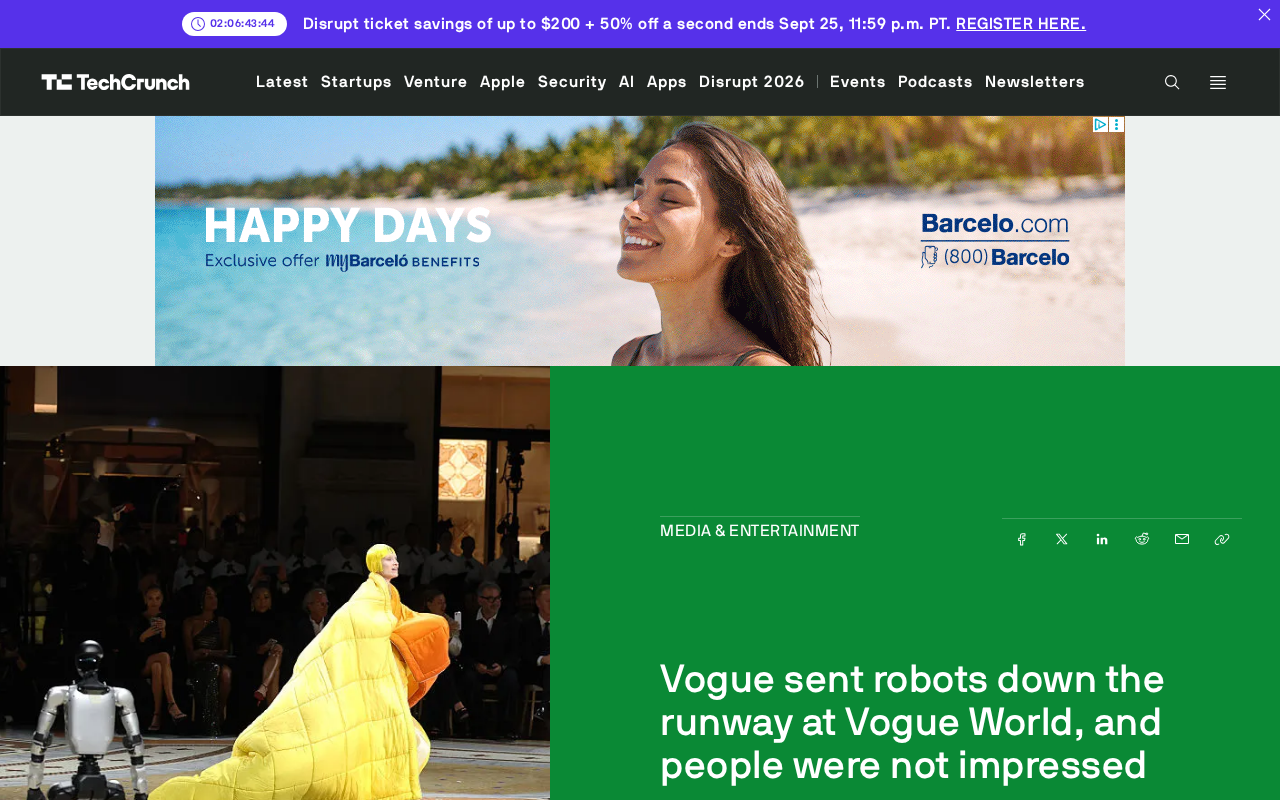
One sharply sardonic comment from the original coverage nailed the core complaint: "Nothing says Italian craftsmanship quite like a made-in-China robot swinging a lasso to L'Amour Toujours." The line perfectly captures the jarring disconnect — when a stage built on the reverence of handcraft and Italian artisanship suddenly features an industrially manufactured robot performing acrobatic tricks, the cultural and narrative dissonance becomes hard to stomach.
L'Amour Toujours is an electronic dance track released in 1999 by Italian DJ Gigi D'Agostino. In recent years, it has become deeply controversial after being widely remixed on TikTok and other platforms to accompany racist content, leading to bans or police investigations in several European countries. Its appearance at this runway show didn't just deepen the scene's sense of incongruity — it layered in an additional dimension of cultural sensitivity that amplified the audience's negative reaction. Understanding this context is essential to fully appreciating the biting irony of that original comment.
Why the Tech Gimmick Fell Flat
Bringing robots into a fashion show was presumably meant to generate buzz and signal a brand's awareness of future trends. In recent years, AI and robotics have been accelerating their penetration across industries, and fashion is no exception — from virtual models and AI-assisted design to smart wearables, the intersection of technology and fashion is nothing new.
But what made this particular attempt feel like a failure wasn't the technology itself — it was the severe mismatch between the performance and the occasion's tone. The core value of a fashion show lies in human expression, the texture of fabric, the art of the cut, and the painstaking labor of craftspeople behind every piece. A robot swinging a lasso like a variety show act neither showcased the aesthetic value of the clothing nor reinforced the "craftsmanship" theme the event sought to project.
The audience's backlash was, at its core, an aesthetic rejection of "technology for technology's sake." When the introduction of tech fails to serve the content — and instead steals the show — it stops being an asset and becomes a liability.
Vogue World is a large-scale cross-disciplinary event launched by Vogue magazine (under Condé Nast) in 2022, blending runway shows, performing arts, and urban culture. It has been staged in New York, London, Paris, and other cities, positioning itself as a comprehensive celebration of fashion and popular culture. The event is known for its high-profile celebrity lineups and experimental performance formats — which also means it carries significant expectations for brand aesthetics. It is precisely this "high-end crossover" positioning that made the robot acrobatics feel even more jarringly out of place.
Rethinking the Boundaries of Tech-Fashion Integration
This episode offers a valuable case study for any traditional industry looking to embrace emerging technology. The application of technology needs to resonate with the context, brand values, and audience expectations — not simply pile on novelty elements for the sake of grabbing attention.
For a field like fashion, which is deeply reliant on emotional and aesthetic resonance, robots and AI may be far better suited to working behind the scenes — in areas like design assistance, supply chain optimization, or personalized recommendations — rather than occupying center stage, a space that rightfully belongs to human models and the garments themselves.
At a broader level, this reflects a common misconception in tech adoption today: treating "we used new technology" as a selling point in itself, while ignoring whether that technology genuinely improves the user experience or the quality of the content. Whether on the fashion runway or in any other consumer-facing context, audiences ultimately care about whether the content moves them — not how sophisticated the robots behind it are.
Vogue World's experiment may have landed with a thud, but it raises a genuinely important question for the industry: in an era where AI and automation are sweeping through every sector, how can technology be integrated in a way that feels right — rather than clumsily replacing the human roles that have always been the bearers of emotion and craft? That is perhaps a question every brand exploring cross-sector tech applications needs to take seriously.
Related articles

Private Key Set to 4? CA's Elementary Mistake Leaves TLS Exposed
CA eMudra set private keys to tiny values like 4, making TLS certificates brute-forceable. A Computerphile video demonstrates the full process from extracting public keys to forging certificates, and explores the fragility of the PKI trust chain.

How Gen Turns Data into Decisions with ChatGPT Work
In an OpenAI user case, business leader Gen shares how ChatGPT Work turns data into decisions: within hours of launch, teams can judge whether integrations and onboarding flows work, shifting decision iteration from hundreds of trial-and-error attempts to a fast feedback loop.

ChatGPT vs. Claude In-Depth Comparison: Strong at Coding but Weak at Research — How to Bridge the Gap?
A user considers switching from ChatGPT to Claude, finding Claude stronger at coding but shallower at research. We analyze the differences and share tips to make Claude's research deeper.