Voice Agent Latency Optimization: Why Averages Are Lying to You

Average latency metrics mislead voice AI developers — tail latency, jitter stacking, and regional gaps are the real killers.
This article exposes three critical pitfalls in voice AI Agent latency optimization: averages masking destructive tail latency spikes, jitter in one pipeline stage poisoning overall experience, and single-region benchmarks hiding cross-continental performance gaps. It advocates measuring P95/P99 percentiles, optimizing for end-to-end consistency across the full STT-LLM-TTS pipeline, and testing under real geographic and concurrency conditions.
A Lesson Learned After Being Misled for a Month
In virtually every technical discussion about voice AI Agents, there's a widely accepted "golden rule": as long as you push TTS (Text-to-Speech) Time-to-First-Audio (TTFA) below 200 milliseconds, your voice assistant experience is solid.
TTFA is the core metric for measuring TTS system responsiveness — it's the time interval between when the system receives text input and when it outputs the first playable audio frame. Modern TTS systems typically use streaming synthesis architectures, meaning they begin outputting audio before the entire text segment is fully synthesized. This allows TTFA to be much shorter than the total synthesis time for the complete utterance. The 200ms threshold comes from research on natural conversational rhythm — turn-taking gaps in normal human conversation typically range from 200-500ms, and system latency below 200ms still has a chance of keeping total latency within natural conversational rhythm after other pipeline stages are added.
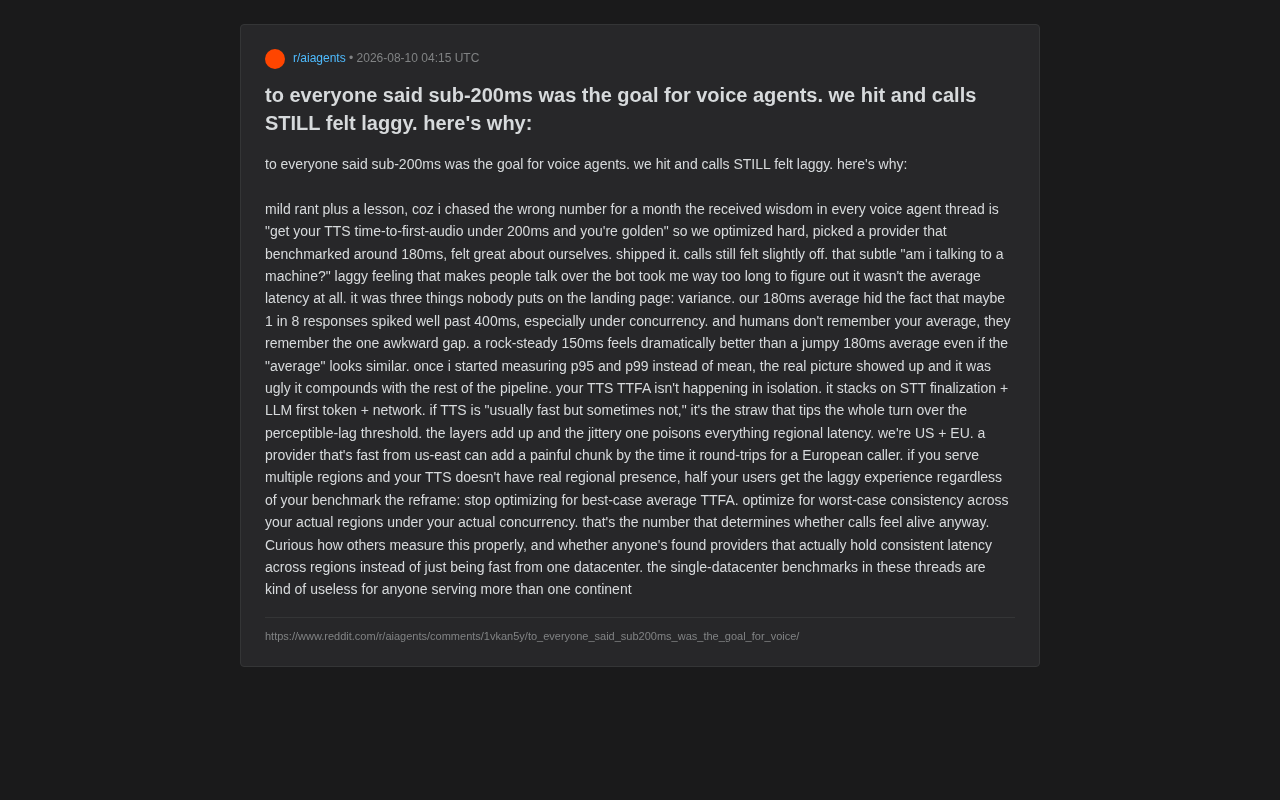
Recently, a developer shared a highly representative war story on Reddit. His team followed this advice meticulously, chose a provider whose benchmark scores showed approximately 180ms, and launched their product feeling confident. Yet calls still felt "a bit off" — that subtle lag that makes people want to interrupt, that subconscious suspicion of "am I talking to a machine?"
It took him a long time to realize: the problem wasn't average latency at all. The real culprits were three factors that almost never appear on provider landing pages.
The Lies Averages Tell: Variance Is the Voice Experience Killer
Users Remember the Worst Instance
An average of 180ms conceals a brutal truth: under high concurrency, roughly 1 in every 8 responses spikes above 400ms. And human auditory perception doesn't follow the "law of averages" — nobody remembers your average latency; people only remember that one awkward pause.
The author offers a counterintuitive yet extremely precise insight: a consistent 150ms delivers a significantly better experience than a jittery 180ms average, even though the latter's "average number" looks closer to the target.
Shifting from Mean to P95/P99 Percentiles
The real turning point came when he stopped focusing on the mean and started measuring P95 and P99 percentile latency. Once he switched to this perspective, the true picture emerged — and it was quite ugly.
P95 and P99 are percentile metrics in performance monitoring. P95 means 95% of requests have latency below that value; P99 means 99% are below it. Unlike mean or median, high-percentile metrics specifically capture the severity of tail latency. Google's Jeff Dean systematically explored this in his famous paper "The Tail at Scale": when a system needs to make parallel calls to multiple services, any single service's tail latency affects the end-user experience with exponential probability. In voice conversation scenarios, while calls aren't parallel, the cumulative effect across multiple turns is equally significant — in a 10-turn conversation, just one turn with noticeable lag will significantly degrade the user's subjective evaluation of the entire call.
This is an important reminder for all engineers building real-time interactive systems: averages systematically hide tail latency. In voice — a scenario extremely sensitive to timing — tail latency is the make-or-break metric. A single P99 stutter is enough to destroy the "talking to a real person" feel of an entire conversation.
The Latency Stacking Effect: The Jittery Link Poisons Everything
TTS Never Runs in Isolation
The second overlooked truth: TTS TTFA doesn't happen in isolation. It stacks on top of an entire pipeline:
- STT (Speech-to-Text) finalization
- LLM time-to-first-token
- Network transport overhead
- And only then, TTS time-to-first-audio
A complete voice AI Agent conversation turn consists of multiple strictly sequential stages: first, VAD (Voice Activity Detection) determines whether the user has finished speaking; then STT converts speech to text, where "finalization" refers to the moment the STT system confirms an utterance has ended and outputs the final transcription result, as opposed to intermediate partial results; next, the LLM receives the text and generates a response, with the key metric being TTFT (Time-to-First-Token); finally, TTS converts the text stream into audio output. A typical end-to-end latency budget might break down as: STT finalization 100-300ms + LLM TTFT 200-500ms + TTS TTFA 150-250ms + network overhead 50-100ms, totaling 500-1150ms. When any stage experiences jitter, total latency easily breaches the 1.5-second "unnatural feel" threshold.
These latencies compound. If your TTS is "usually fast but occasionally not," it becomes the last straw that breaks the entire conversation turn — the final push that sends total latency past the "perceptible lag threshold."
The "Poisoner" in the Weakest-Link Effect
In other words, the entire pipeline follows the weakest-link principle, and the component with the greatest jitter "poisons" the whole system. You might achieve stability in every other stage, but a single unpredictable spike from TTS collapses the user's experience for that entire turn.
In real-time communications, jitter is defined as the variation in latency — a statistical measure of delay differences between consecutive packets. The reason jitter is more destructive than consistently high latency lies in the human perception adaptation mechanism. When latency is stable, the brain automatically adapts to the rhythm after a few turns, forming new expectations (similar to the experience of international long-distance calls). But when latency fluctuates, the brain cannot establish stable expectations, and every pause exceeding expectations is perceived as a "glitch" or "non-human behavior." In audio/video communications, Jitter Buffers are typically used to smooth out variations, but this introduces additional fixed latency. For voice AI Agents, adding buffer means longer response times, so controlling jitter at the source — rather than compensating after the fact — is the correct strategy.
This also explains why single-point optimization of the mean is meaningless — what's truly needed is end-to-end consistency across the entire chain.
Regional Latency: Fooled by Benchmarks
Single Data Center Benchmarks Are Worthless
The third pitfall is geographic regional latency. The author's service covers both the US and Europe. A provider that screams fast from us-east adds a painful extra round of latency when requests need to cross the Atlantic for European users.
He states bluntly: those single data center benchmarks posted in technical discussion threads are basically useless for any team serving more than one continent. If your TTS doesn't have true regional deployment, then no matter how impressive your benchmark scores look, half your users will experience lag.
The Industry Gap in Multi-Region Consistency
Regional deployment of voice AI faces unique challenges. Unlike regular web services, voice streams are extremely latency-sensitive — cross-Atlantic network round-trip latency is approximately 70-90ms (one way), and a complete TTS request requiring an ocean crossing adds 140-180ms from the network layer alone. The ideal solution is deploying the full inference stack in every major region, but this means simultaneously maintaining GPU clusters, model replicas, and load balancers across multiple data centers — an extremely expensive proposition. Currently in the industry, some providers like Deepgram and ElevenLabs have begun offering multi-region nodes, but those achieving truly consistent global low latency remain rare. Another emerging direction is Edge Inference — deploying lightweight TTS models to CDN edge nodes or even on-device — but this often means compromises in audio quality and expressiveness.
The question this developer posed remains unanswered — he's looking for providers that maintain consistent low latency across multiple regions, not players who are "only fast in one data center." This actually points to a real gap in current voice AI infrastructure: cross-regional latency consistency remains a problem most providers haven't solved well.
Redefining Latency Optimization Goals for Voice Agents
The most valuable part of this experience is the reframe it proposes:
Stop optimizing for "best-case average TTFA" and start optimizing for "worst-case consistency under your real regional distribution and real concurrent load."
That's the number that determines whether a call feels like talking to a real person.
For teams currently building voice Agents, here are some immediately actionable recommendations:
- Measure P95/P99, not the mean — especially under production-level concurrency.
- Measure the entire pipeline end-to-end, don't just stare at the TTS stage alone.
- Test latency by region based on your real user geographic distribution — don't trust single data center benchmarks.
- Treat "consistency" as a first-class metric — stable and slightly slower often beats jittery and faster.
In the real-time voice interaction space, engineering intuition is often misled by attractive average numbers. True user experience hides in the tail latency and regional disparities that nobody wants to show.
Key Takeaways
Related articles

RAG Getting Started in Practice: From Principles to Building an Enterprise Knowledge Base
Bilibili RAG course highlights: from retrieval-augmented generation principles, document chunking and vectorization, to five accuracy factors and enterprise knowledge base boundaries, with fine-tuning vs RAG selection advice.

AI Model Selection Guide: DeepSeek vs. Qwen3 in Practice
How should AI developers choose models? Based on a Bilibili tutorial, this article breaks down the Function Calling differences between DeepSeek V3 and R1, Qwen3's programmatic thinking mode switching and agent capabilities, and outlines a multi-model learning path and practical selection logic.

Anchoring, Loss Aversion, and Nudges: 5 Psychological Tactics Retailers Use to Make You Spend
Behavioral economics reveals how retailers use anchoring, framing, loss aversion, and nudge theory to manipulate your spending decisions. This article breaks down 5 common psychological tactics and offers counterstrategies like slowing down decisions and setting your own anchors to see through the pricing design behind discounts.