VoiceGecko: A Fully Local, Open-Source Voice-to-Text Tool

VoiceGecko is an open-source, fully local desktop voice-to-text tool prioritizing privacy and speed.
VoiceGecko is an open-source desktop dictation tool that runs entirely on your local device, requiring no cloud processing. Users simply press a hotkey, speak, and get instant text in their clipboard. Built likely on Whisper-based models, it offers strong privacy protection and low-latency transcription, making it ideal for developers, AI power users, privacy-conscious professionals, and content creators seeking efficient voice input.
As AI speech recognition technology becomes increasingly widespread, most mainstream solutions still rely on cloud-based processing—introducing both latency issues and privacy concerns for sensitive users. VoiceGecko, a recently launched open-source tool on Product Hunt, offers a different approach: a fully local, open-source, instant desktop voice-to-text experience.
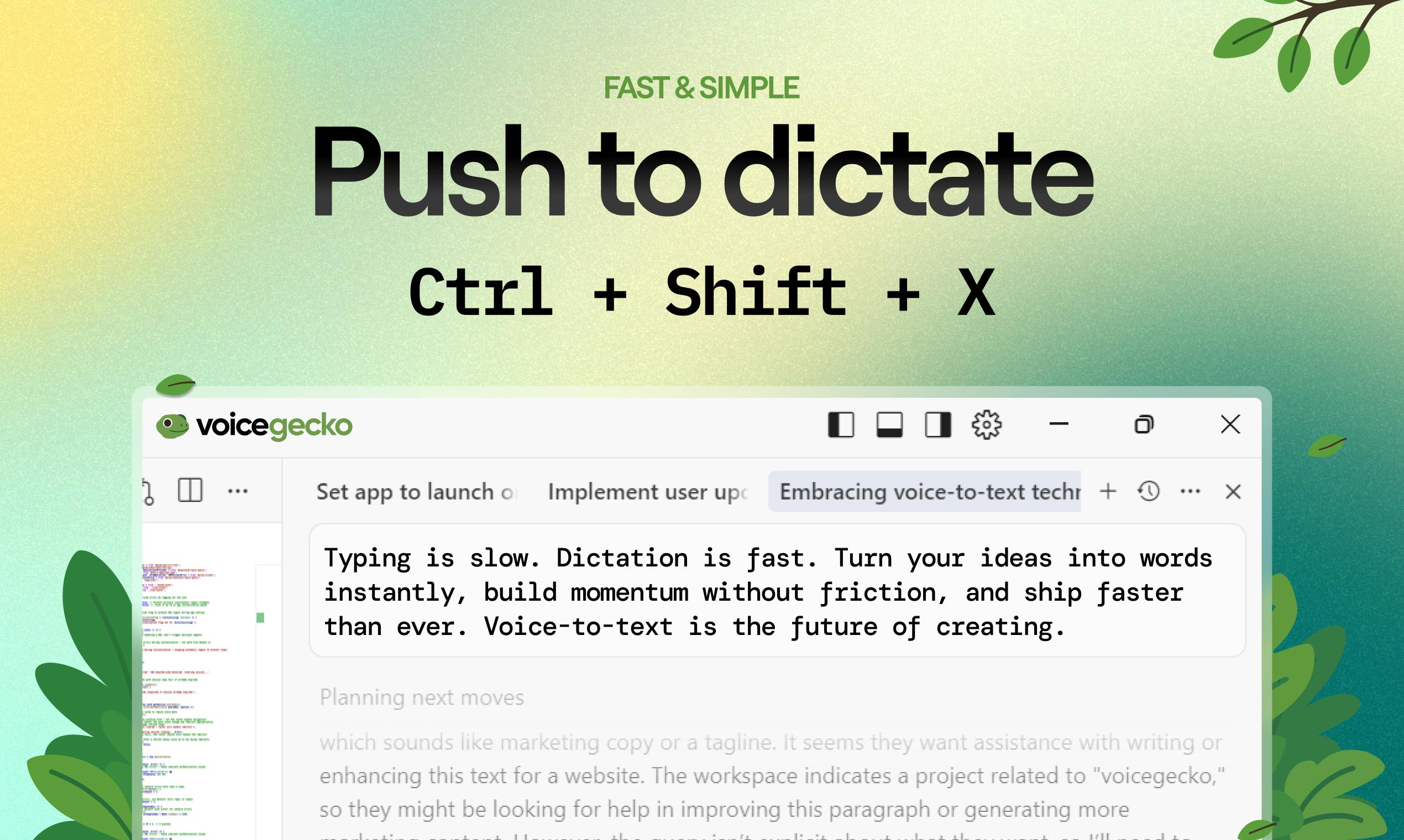
What Is VoiceGecko: A Desktop Dictation Tool Built for Efficiency
VoiceGecko's core philosophy can be summed up in one sentence: press a hotkey, start speaking, and text instantly appears in your clipboard. This minimalist interaction flow eliminates the cumbersome startup and copy steps of traditional voice input tools, making voice-to-text a truly "always available" capability.
According to its official Product Hunt listing, VoiceGecko is suitable for a variety of everyday scenarios: composing emails, writing code, crafting AI prompts, and quick "brain dumps" for capturing ideas. What these scenarios share in common is that users need to quickly convert thoughts into text, and typing often becomes the efficiency bottleneck. Research shows that the average person speaks at about 150 words per minute, while typical typing speed is only 40-80 words per minute—meaning voice input has a 2-4x raw speed advantage. VoiceGecko attempts to break through this bottleneck using voice as a more natural input method.
The product was built by developer Luke and has currently received 72 upvotes on Product Hunt, ranking 17th for the day. It's categorized under Developer Tools and Audio, which also reveals its target audience: developers who want to integrate voice input into their coding and technical workflows.
Local Speech Recognition: The Dual Advantage of Privacy and Speed
VoiceGecko's most noteworthy differentiating feature is its local runtime model. Unlike cloud-based speech recognition services (such as Google Cloud Speech-to-Text, Amazon Transcribe, Azure Speech Services, etc.), VoiceGecko processes voice entirely on the user's device.
From a technical perspective, the local speech recognition capability is likely built on OpenAI's Whisper model (open-sourced in 2022) or its derivative optimizations. Whisper is a general-purpose speech recognition model trained on 680,000 hours of multilingual and multitask supervised data. The community has developed multiple high-performance inference solutions around Whisper, such as whisper.cpp (C/C++ implementation) and faster-whisper (based on CTranslate2). These solutions have significantly lowered the hardware barrier for local deployment, making real-time speech transcription possible on ordinary laptops.
This design delivers two direct benefits:
Voice Data Privacy Protection
When voice data doesn't need to be uploaded to third-party servers, users' conversations, code logic, AI prompts, and other sensitive information never leave the local device. For developers and enterprise users handling trade secrets or compliance requirements, this is a critical consideration.
The privacy risks of cloud-based speech recognition are not hypothetical. In 2019, multiple tech giants were exposed for sending users' voice clips to human reviewers for quality assessment, including sensitive private conversations. The EU's GDPR and U.S. state privacy laws (such as California's CCPA) impose strict requirements on the collection and processing of voice data. For enterprise users, using cloud speech services may involve complex compliance considerations such as cross-border data transfers and third-party data processing agreements, especially in regulated industries like healthcare, legal, and finance. Local processing fundamentally avoids these compliance risks—voice data from capture through transcription to deletion remains entirely within the user's controlled device.
Low-Latency Instant Response
Local processing also means a low-latency voice-to-text experience. Without the overhead of network round trips, speech transcription can be nearly real-time. Cloud-based speech recognition typically involves audio encoding/compression, network transmission (round-trip latency usually 50-200ms), server queuing, model inference, and result return—total latency can reach hundreds of milliseconds or even seconds. Local processing simplifies these steps into a single on-device inference, with latency primarily depending on local hardware computing power.
The official claim of "instantly get accurate text" reflects this advantage. For coding work that requires maintaining a flow state, any minor delay can interrupt one's train of thought, making local instant feedback especially valuable. Psychological research shows that response delays exceeding 1 second cause users to perceive "waiting," thereby affecting cognitive continuity.
The Value and Significance of Open-Source Voice Tools
Beyond running locally, VoiceGecko's other major label is open source. Open source means anyone can view, audit, modify, and contribute to its code.
For a tool that handles voice data, the transparency that open source provides is particularly important—users can verify for themselves whether the software truly processes data only locally without secretly uploading information. This "verifiable trust" is something closed-source commercial software cannot offer. Security researchers and community members can audit network calls and data storage logic in the code to ensure no hidden data exfiltration channels exist.
Additionally, open source opens the door to community collaboration. Developers can customize features according to their needs, such as integrating specific transcription models, supporting more languages, or embedding it into their own workflow tools. The open-source voice tool ecosystem that VoiceGecko inhabits is rapidly developing—beyond the Whisper family, there are also Vosk (supporting 20+ languages for offline recognition), Kaldi (a widely used speech recognition toolkit in academia), and other open-source solutions. At the desktop application level, similar projects include Buzz (a graphical desktop client for Whisper) and MacWhisper. VoiceGecko's differentiation lies in its focus on the minimalist interaction paradigm of "hotkey trigger + clipboard output," which better aligns with developers' keyboard-first workflows.
As the open-source ecosystem of underlying speech recognition models (such as OpenAI's Whisper series) continues to mature, local wrapper tools like VoiceGecko fill the gap between "powerful models" and "user-friendly experiences." Open-source licenses (such as MIT, Apache 2.0) allow developers to freely integrate these tools into commercial products, further driving ecosystem growth.
Who Should Use VoiceGecko?
Given its feature positioning, the following user groups would likely benefit most from VoiceGecko:
- Developers: Quickly input code comments or commit messages via voice to reduce hand fatigue. Long coding sessions can lead to Repetitive Strain Injury (RSI), and voice input as a supplementary method can effectively distribute the physical burden.
- Heavy AI Users: Those who frequently write lengthy prompts can dictate instead of type, dramatically improving efficiency when interacting with large language models. As models like GPT-4 and Claude support increasingly longer context windows, prompt length continues to grow, making dictation's speed advantage ever more apparent.
- Privacy-Conscious Professionals: Those who don't want voice data passing through the cloud, including lawyers, healthcare practitioners, financial analysts, and other professionals handling privileged information.
- Content Creators: Writers who need to quickly capture ideas and draft copy. Many authors and journalists already use voice-to-text to overcome "blank page fear"—the immediacy of voice helps maintain creative flow.
Local-First AI Tools Are Becoming a New Trend
Although VoiceGecko is still a relatively niche new product (with 0 comments and no large-scale community discussion yet), the "local-first" AI tool philosophy it represents deserves attention.
Local-first is a software design philosophy first systematically articulated by the Ink & Switch research lab in 2019. Its core principle is: data is primarily stored on the user's device, applications remain fully functional offline, and network connectivity is merely an optional sync channel. In the AI domain, local-first implementation has been enabled by several technological advances: model quantization techniques (such as GGML/GGUF formats) can compress models with billions of parameters down to a few GB; Apple Silicon's (M-series chips) unified memory architecture and Neural Engine provide powerful hardware support for local inference; and NVIDIA's consumer-grade GPUs are continuously improving their AI inference performance.
In the generative AI wave, the vast majority of applications are built on top of cloud-based large models, but VoiceGecko reminds us that as edge device computing power improves and open-source models mature, pushing AI capabilities down to local devices is becoming a realistic choice that balances privacy, speed, and cost. In the long run, local AI also offers cost advantages—one-time hardware investment replaces ongoing API call fees, yielding significant economic benefits for high-frequency use cases.
For users who want to boost productivity without sacrificing privacy, VoiceGecko offers a lightweight, open, and worth-trying local voice-to-text solution. As an early-stage product, its recognition accuracy, multilingual support, cross-platform compatibility, and other real-world performance aspects still await validation by more users. It's worth noting that local model accuracy is typically proportional to model size—larger models require more computational resources, and users need to make trade-offs between speed and accuracy based on their hardware capabilities.
Key Takeaways
Related articles

GitHub Daily · Aug 28: Agent Skills Dominate the Charts — Everyone's Building Tools Now
GitHub Trending Aug 28: Agent Skills dominate the chart as developers build capability packs for AI assistants. gods-eye-view brings satellite intelligence to browsers, archify auto-generates architecture diagrams.
Deep Dive into DeepSeek Harness: Old Patterns, New Ecosystem
A deep analysis of DeepSeek Harness Agent framework from a software engineering perspective, comparing it with Claude Code and Pi, revealing its server-side Agent positioning and TypeScript ecosystem advantages.
Warren: Isolated Runtime Infrastructure Built for AI Coding Agents
Warren is an open-source infrastructure project providing isolated workspaces, resource limits, real-time observability, and Git delivery for AI coding agents running securely in your own environment.