Voiskey: The AI Voice Input Tool That Actually Understands Context
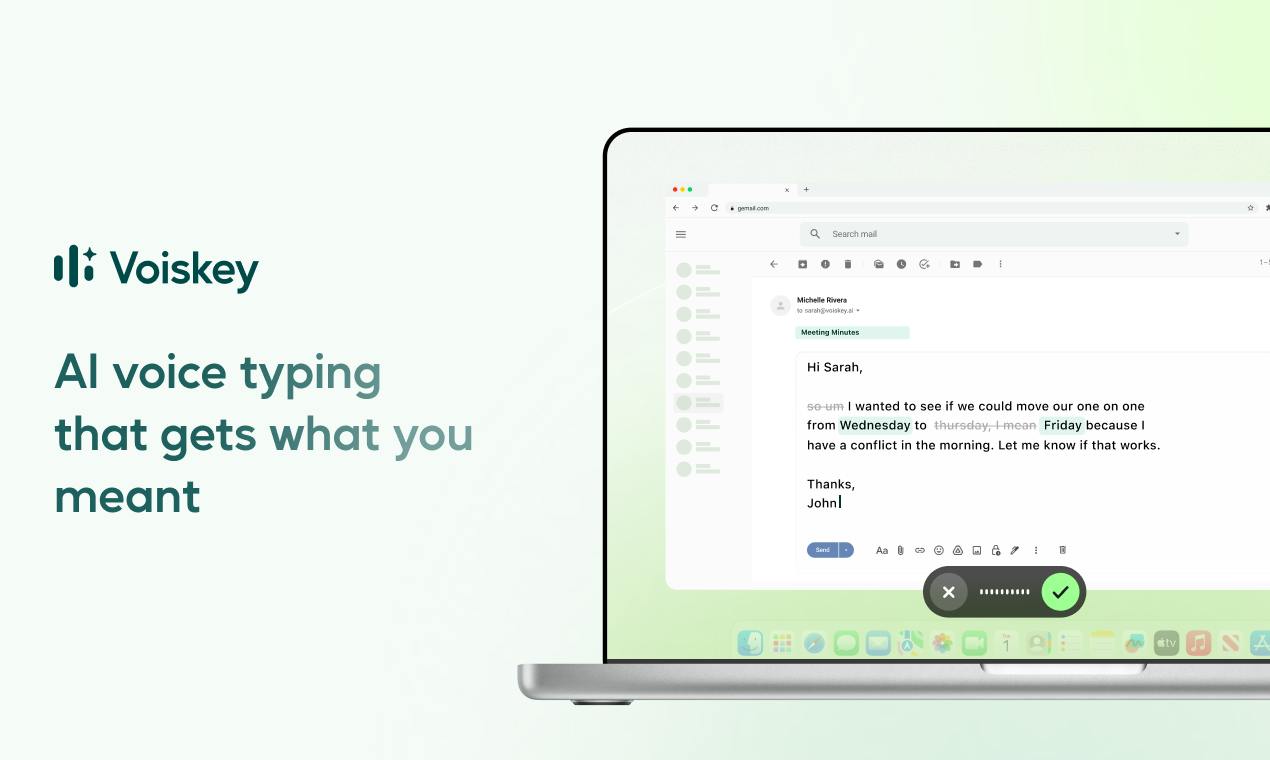
Voiskey is an AI voice input tool that rewrites spoken words into context-appropriate, ready-to-send text.
Voiskey is an AI voice input tool that reached #3 on Product Hunt, going beyond speech recognition to understand user intent and rewrite rough spoken input into clean, contextually appropriate text. Its standout feature is context-awareness — the same utterance is automatically adjusted in tone for friends, colleagues, or AI assistants. Available on iOS, macOS, Android, and Windows with 100+ language support, it positions itself as a system-level input layer with a free-to-start plus Pro subscription model.
On Product Hunt, an AI voice input tool called Voiskey climbed to #3 for the day, earning 200 upvotes and 67 comments. Its core pitch is straightforward: rather than simply transcribing what you say, it "reshapes" your words based on the recipient and the context before delivering the output.
From "What You Said" to "What You Meant"
Traditional speech-to-text tools solve a recognition problem — converting sound waves into corresponding text. Voiskey tries to go one step further. In the team's own words, it "starts from what you meant, not just what you said."
This means you can speak a rough, casual, or even logically scattered thought into your device, and Voiskey will organize it into clean, ready-to-send text. For many users, the frustration with voice input has never really been about accuracy — it's that even correctly transcribed speech still requires heavy manual editing before it's usable in a professional context. That "last mile" gap is exactly what Voiskey is targeting.
This capability relies on a large language model (LLM) for deep semantic understanding, rather than a traditional automatic speech recognition (ASR) pipeline working alone. Conventional ASR systems like Google Speech-to-Text or Apple Dictation focus on acoustic modeling — mapping audio signals to word sequences, which is fundamentally a classification problem. Voiskey's approach layers an LLM on top of ASR output to semantically reconstruct the recognized text: filling in omitted subjects, untangling jump-cut logic, and replacing filler words and verbal tics. This "Speech-to-Intent" product paradigm has been gaining traction in productivity tools in recent years, with its technical feasibility largely enabled by the emergent capabilities of models like GPT-4 — tasks that were previously unstable using rules or smaller models, particularly cross-context text rewriting.
Automatic Tone Adjustment by Context
Voiskey's most interesting design choice is that it adjusts how your words are expressed based on where they're going and who's reading them. The same spoken input becomes casual and relaxed when sent to a friend, professional and appropriate when sent to a colleague, and more technical and structured when directed at an AI assistant.
This "context-awareness" delivers real practical value. People naturally shift their language style across different social relationships and work situations, but voice input tends to flatten those differences, producing uniformly blunt, unfiltered text. Voiskey emphasizes that through all these adjustments, "you still sound like you" — attempting to strike a balance between automatic polish and preserving personal voice.
In the field of natural language processing, this capability is typically referred to as Style Transfer or Register Adaptation. "Register" describes the language variety people use in specific social contexts, encompassing word choice, syntactic complexity, level of formality, and more. Academic research on text style transfer has a long history, but the engineering challenge lies in changing tone while preserving the original semantic content — avoiding "over-rewriting" that shifts the meaning. The technical challenge behind Voiskey's promise to "keep you sounding like you" is anchoring the content space while moving through style space. This requires the model to retain some memory or calibration of a user's personal vocabulary habits; otherwise, outputs tend to regress toward the average style of training data, ironically erasing individual characteristics.
Speed and Platform Coverage
Voiskey officially claims its input speed is 5× faster than typing, with text arriving already cleaned up and ready to send. Speed has always been voice input's core advantage over keyboard typing, and paired with automatic cleanup, it theoretically compresses the time between "having an idea" and "hitting send" even further.
In terms of platform coverage, Voiskey is quite comprehensive — currently available on iOS, macOS, Android, and Windows, with support for over 100 languages. This consistent cross-platform experience, combined with its positioning as something that "sounds right in every app," signals an ambition to serve as a system-level input layer rather than a feature confined to a single notes or email application.
Business Model and Launch Promotion
Voiskey operates on a free-to-start model, with a paid Pro tier offering more complete functionality. As a launch promotion, the team is offering one month of free Pro access to users who join during the release window.
With 200 upvotes and 67 comments on Product Hunt, the product has attracted solid early attention and landed in the day's top three. It's categorized under Productivity, Artificial Intelligence, and Audio — a clean and coherent positioning.
A Few Observations
The voice input space is already crowded, with built-in system dictation features and a range of third-party apps all competing for users. Voiskey's differentiation is a bet on "contextual understanding" and "automatic rewriting" — and it does address a genuine gap in existing tools. That said, automatic rewriting is a double-edged sword: when it works well, it boosts efficiency; when it goes too far, it can distort meaning or strip away personal voice. Whether the promise to "keep you sounding like yourself" actually holds up is something that only sustained real-world use can verify.
For users who frequently need to produce various types of text messages quickly and find themselves dreading the chore of editing raw transcribed speech, Voiskey's combination of cross-platform support, multilingual coverage, and context-adaptive output is worth trying — especially with a free trial on offer.
Related articles
LynnReal-Omni: 32B Unified Video Diffusion Model Goes Open Source with Multi-Task Coverage in Four Steps
LynnReal-Omni is a 32B unified video diffusion model on MiniMax H3, covering text-to-video, pose guidance, style transfer, restoration in 4 steps. Flash version generates 540p video in 377ms on one H100.

Anthropic Co-Founder: AI 'Kill Switch' May Need to Be Mandatory by Law
Anthropic's co-founder tells the BBC that AI 'kill switches' may need to be legally mandated. We analyze the industry logic, technical challenges, and the tension between regulation and innovation.

The AI Data Center Boom Is Colliding With Cities Scarred by Heavy Industry
The AI data center boom is clashing with post-industrial communities. Philadelphia's case reveals structural conflicts between AI growth, energy use, water, and environmental justice.