Volkswagen Mission Efficiency: The World's Lowest-Drag EV Breaks Multiple Efficiency Records
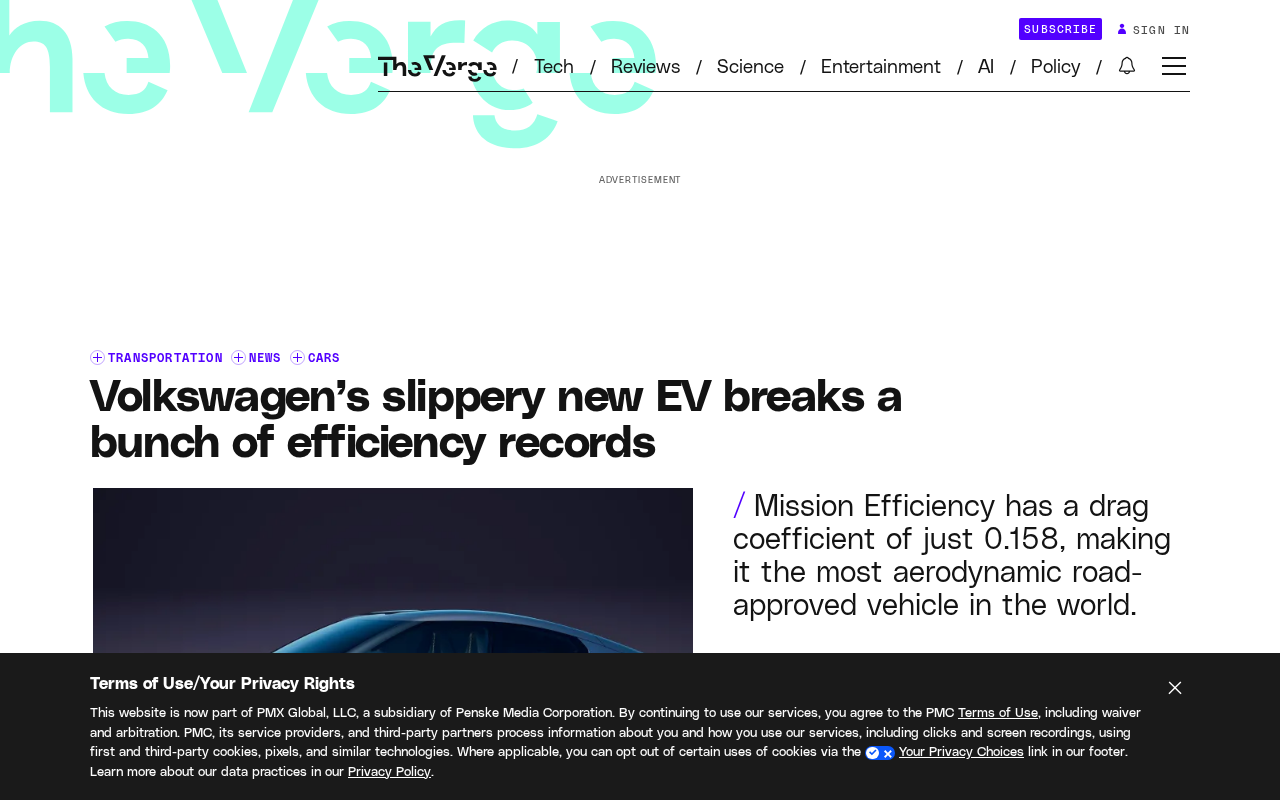
Volkswagen's Mission Efficiency prototype claims the world's lowest drag coefficient, reimagining EV range through aerodynamics.
Volkswagen has unveiled Mission Efficiency, a near-production electric fastback prototype claiming the world's lowest drag coefficient — its shape strikingly similar to Tesla's Cybercab, a natural outcome when aerodynamics drives every design decision. Built on the MEB+ platform and using powertrain components from the upcoming ID. Polo and ID. Cross, the prototype is far from a pure concept. Volkswagen's strategic intent is clear: use systematic efficiency engineering — especially low-drag design — to boost real-world range without piling on battery capacity, with potential to extend these learnings to high-volume entry-level models.
Volkswagen Unveils the World's Most Aerodynamic EV
At first glance, this car could easily be mistaken for a Tesla Cybercab — but it's actually Volkswagen's Mission Efficiency, a prototype claimed to have the lowest drag coefficient of any electric vehicle in the world. This near-production-ready 2+2 electric fastback is built on Volkswagen's MEB+ platform, integrating front-wheel-drive components from the upcoming ID. Polo and ID. Cross models.
True to its name, the Mission Efficiency's core mission is to break efficiency records. At a time when range anxiety remains a major pain point for EV buyers, Volkswagen is using this aerodynamically extreme prototype to demonstrate just how far efficiency optimization can go.
Platform and Technical Foundation
Mission Efficiency is built on Volkswagen's MEB+ platform, a key pillar of the brand's electrification strategy. Notably, this prototype isn't a pure concept showpiece — it's described as "near-production" status, with components sourced from the powertrain systems of the soon-to-launch ID. Polo and ID. Cross.
This reflects Volkswagen's pragmatic approach: grounding extreme efficiency technology in an existing production platform means the aerodynamic and efficiency learnings are more likely to trickle down to mainstream models quickly, rather than remaining confined to an unreachable laboratory stage. For everyday consumers who care about real-world range and energy consumption, this kind of technology transfer matters far more than a pure performance demonstration.
MEB (Modularer E-Antriebs-Baukasten, or Modular Electric Drive Matrix) is Volkswagen Group's foundational architecture developed exclusively for battery electric vehicles, first launched in production with the ID.3 in 2019. MEB+ is the upgraded version, primarily enhancing fast-charging capability (supporting higher charging power), improving battery thermal management, and creating integration space for higher-output motors. The platform currently underpins multiple EV models across Volkswagen, Škoda, SEAT/Cupra, and other Group brands, offering strong economies of scale. Because MEB+ uses a front-drive or all-wheel-drive layout with a flat battery pack mounted in the floor, it achieves a lower center of gravity and flexible wheelbase adjustment — providing an excellent structural foundation for aerodynamic optimization. Designers don't need to accommodate a driveshaft tunnel or a front engine bay, freeing them to pursue more aggressive, low-drag body shapes.
The Efficiency Logic Behind Extreme Aerodynamics
For electric vehicles, aerodynamics is one of the most critical variables determining real-world range. At highway speeds, the energy consumed to overcome air resistance often accounts for the largest share of total consumption. Lowering the drag coefficient (Cd value) means the same battery capacity can deliver greater range — or alternatively, a smaller, lighter, and less expensive battery can achieve the same range target.
Positioning Mission Efficiency around "the world's lowest drag" speaks directly to the core of EV efficiency competition. It also explains why the car looks so similar to Tesla's aerodynamically focused Cybercab — when engineers all prioritize aerodynamics above everything else, the resulting body shapes naturally converge: low, elongated, and tapering toward the tail in a teardrop profile.
The drag coefficient (Cd) is a dimensionless number that describes how much aerodynamic resistance an object experiences when moving through a fluid — the lower the value, the less air resistance. Most mainstream production passenger cars have a Cd between 0.25 and 0.35, while efficiency-focused models like the Mercedes-EQS have pushed the production benchmark to 0.20. Because aerodynamic drag scales with the square of velocity, its impact on energy consumption increases dramatically at higher speeds. Increasing highway speed from 100 km/h to 120 km/h, for example, raises aerodynamic power demand by roughly 73%. As a result, even reducing Cd from 0.23 to 0.20 can deliver a meaningful range improvement at highway speeds — particularly significant for EVs designed with long-distance travel in mind.
Implications for the Industry
Volkswagen's move reflects a broader strategic shift among legacy automakers in their EV transition: instead of simply stuffing in larger batteries, they're improving competitiveness through systematic efficiency engineering. The coordinated optimization of aerodynamics, lightweighting, and powertrain efficiency can meaningfully improve range without increasing battery costs.
The fact that components from entry-level models like the ID. Polo and ID. Cross appear in this high-efficiency prototype signals Volkswagen's intent to democratize efficiency technology — bringing it to high-volume segments rather than reserving it for flagship vehicles. If these design principles successfully make it into production, future Volkswagen EVs could deliver notably better range and real-world energy consumption.
Note: Due to limited information in the original source material, specific figures for the drag coefficient record broken and the range achieved by Mission Efficiency are pending further official disclosure from Volkswagen.
Summary
Mission Efficiency is Volkswagen's bold statement in the EV efficiency race. Built on the proven MEB+ platform and incorporating production-bound powertrain components, it stakes its claim on having the world's lowest drag coefficient as its central proposition — demonstrating how legacy automakers are using aerodynamics as a competitive weapon in the second chapter of electrification. For consumers who care about real-world range and energy efficiency, engineering efforts focused on aerodynamics like this may be worth watching more closely than raw range figures alone.
Related articles

Xi Jinping Proposes Open Source AI Cooperation Zone Among BRICS Nations
Xi Jinping proposed an open source AI cooperation zone at the BRICS summit. Analyzing the strategic intent, open source rationale, and global AI governance implications.
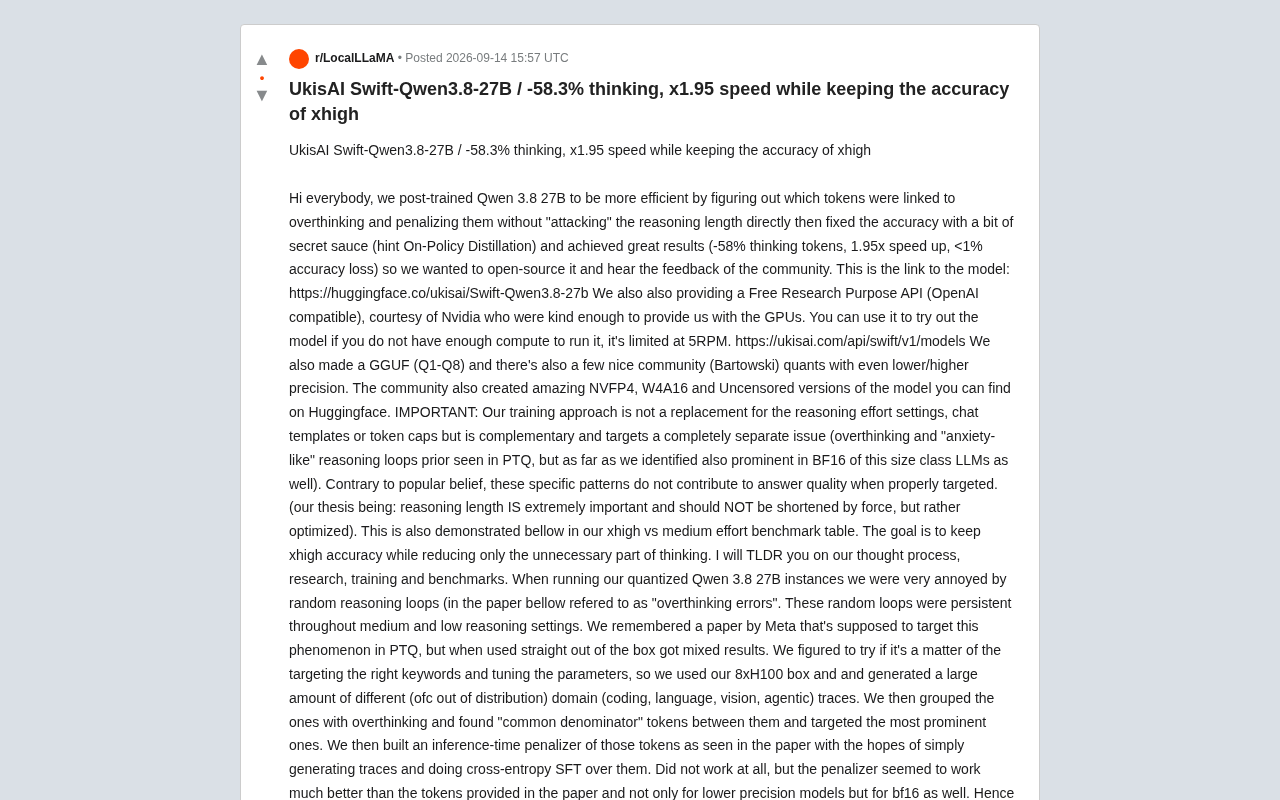
Swift-Qwen3.8-27B: 58% Fewer Thinking Tokens, Nearly 2x Faster Inference
UkisAI open-sources Swift-Qwen3.8-27B, cutting thinking tokens by 58% and boosting inference speed 1.95x via overthinking token penalties and on-policy distillation — with under 1% accuracy loss.

Netflix Partners with Sega: Crazy Taxi Movie and New Sonic Animated Series on the Way
Netflix announces three Sega game adaptations: a Crazy Taxi movie, a new Sonic animated series with edge, and a live-action film based on RGG Studio's Stranger Than Heaven.