Voltage Glitching Crack: Reviving the A100 in Mining Cards

A hardware hacker uses voltage glitching to crack a mining card and unleash hidden A100-lineage chip compute.
Blogger Kate used voltage glitching to bypass chip feature locks in a mining card and unleash hidden compute from an A100-lineage chip, sparking heated discussion on Hacker News. The article explains how mining cards use fuse blowing or firmware restrictions to differentiate product lines, and the principle of voltage glitching as a fault injection attack—creating a voltage drop within the nanosecond-scale verification window to cause security logic errors. Kate documented the process of locating attack timing and tuning parameters, but the technique is highly customized, requiring microsecond-level timing control and composite hardware skills, with limited reproducibility. The discussion also covers memory, cooling, and power delivery bottlenecks after unlocking, as well as the practical value and risks of mining card modification amid AI compute shortage.
A graphics card that was supposedly meant only for cryptocurrency mining secretly houses a chip with the same lineage as the A100—a scenario that sounds like an urban legend is now being turned into reality by hardware hackers using voltage glitching. In a technical blog post, blogger Kate documented how she bypassed chip restrictions through voltage fault injection to unlock the computing power locked inside a mining card. The article garnered 262 upvotes and 107 comments on Hacker News, sparking widespread discussion about hardware security and AI compute reuse.
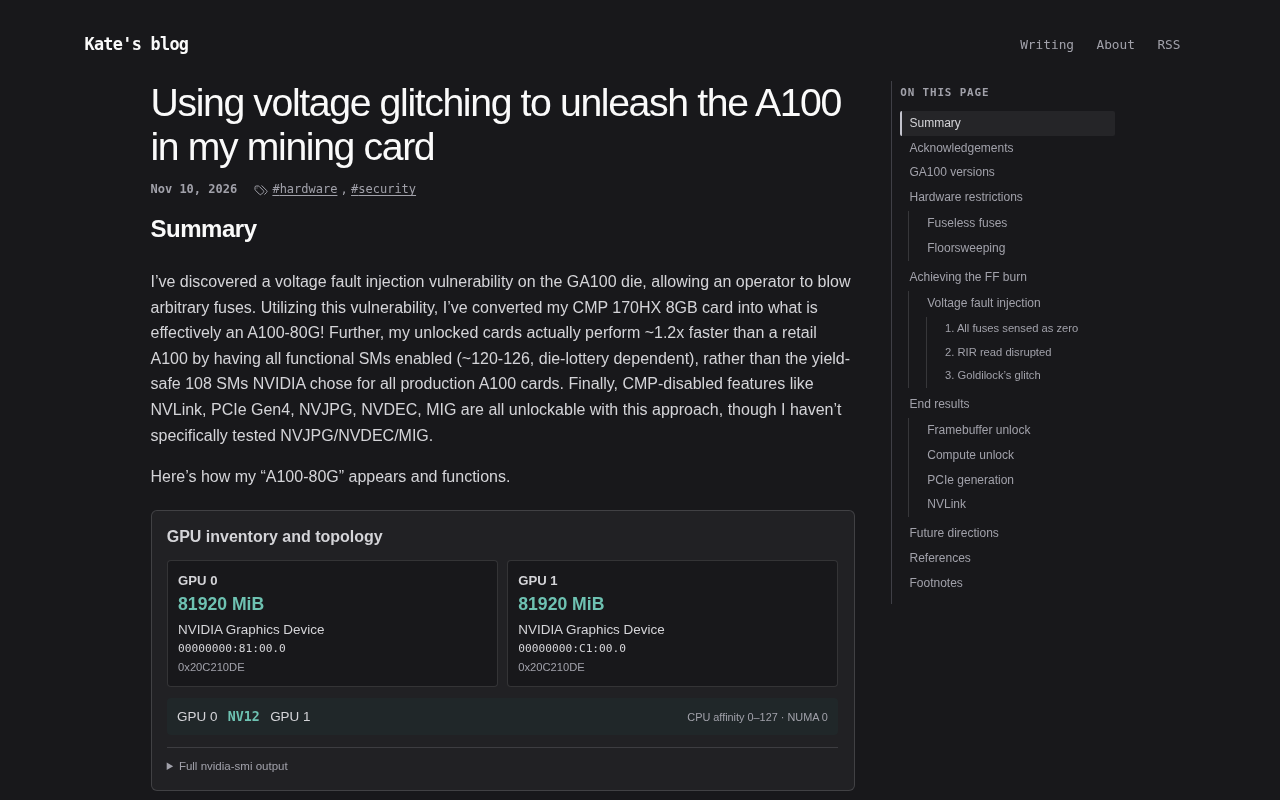
The "Hidden" Chip Inside Mining Cards
Cryptocurrency mining cards are typically based on cut-down versions of consumer or data center GPUs, with manufacturers using fuse blowing, frequency locking, or firmware restrictions to differentiate product lines. But physical hardware-level blocking is often harder to circumvent than software locks—and this is precisely where voltage glitching comes into play.
According to Kate's blog, the GPU inside her mining card is physically related to the A100, but certain features have been disabled by the manufacturer through some mechanism. This "same chip, different fate" practice is not uncommon in the semiconductor industry: to meet market demands at different price points, chips cut from the same wafer are binned, with some units permanently disabled.
The core idea of voltage glitching is to create a transient voltage drop at a critical moment during chip startup or verification, causing the security check logic to malfunction and thereby bypassing restrictions. This attack method has precedents in embedded security and game console cracking, but applying it to data center-grade GPU mining card modification remains a rather hardcore operation.
Fuse mechanisms are a common physical locking method in chip binning. Chips are designed with a set of programmable fuses; after factory testing, manufacturers selectively blow certain fuses based on chip quality and product positioning, permanently disabling some compute units (such as SM clusters), memory controllers, or high-speed interconnect interfaces. Unlike firmware locks, fuse blowing is an irreversible physical modification that is difficult to restore through software flashing. But voltage glitching works precisely because it acts at the moment when fuse values are read and verified—if a fault is injected during the execution of verification logic, the chip may misread the fuse state and "mistakenly believe" it is a full-spec chip. This attack does not modify the fuses themselves but deceives the readout circuit, making it repeatable, though re-injection is required on each startup.
How Voltage Glitching "Fools" the Chip
In principle, voltage glitching is a type of fault injection attack. Chips perform a series of self-checks and permission verifications during operation. If the supply voltage can be glitched within the nanosecond-scale window when verification instructions execute, logic gates may output incorrect results—for example, a verification branch that should return "deny" is skipped, or a locked feature bit is misjudged as enabled.
Kate's blog details how she located the attack timing, built the glitch injection circuit, and repeatedly tuned parameters. This kind of work requires timing control accurate to the microsecond level, and a single misstep can cause the chip to fail to boot or even be permanently damaged.
In the Hacker News comments, some developers noted that such techniques have long been established in the security research community, but applying them to mining cards to unleash A100-level compute is quite a clever approach. Others raised questions: even if unlocked successfully, are the mining card's memory capacity, cooling design, and power delivery specifications sufficient to support A100-level workloads? This involves stability and longevity issues after hardware modification.
Fault Injection Attacks are a class of active attack paradigms in which attackers apply anomalous physical conditions—voltage drops, clock glitches, electromagnetic pulses, laser irradiation, or high temperatures—to cause the chip to produce computational errors at specific moments, thereby bypassing security policies. Among these, voltage glitching has the lowest implementation cost, typically requiring only a fast switching circuit (such as a MOSFET) in series with the power supply line, with a microcontroller pulling the voltage low for several nanoseconds at a precise moment. The key to a successful attack is the "timing window": self-checks, key verification, or permission checks during chip power-on typically last only tens to hundreds of nanoseconds, and the glitch must fall exactly within this window for the verification logic to output an incorrect result. Because timing drifts across different chips and temperatures, attackers usually need to build trigger circuits with adjustable delays and scan the parameter space through repeated trials.
The Real Demand Behind Compute Reuse
Why this news has attracted attention is closely related to the current background of AI compute shortage. As a representative data center GPU, the A100 has long been in short supply for AI training and inference scenarios, with prices remaining high. If mining cards could be modified to unleash compute close to the A100, it would undoubtedly be attractive to budget-constrained developers and small teams.
However, it should be viewed rationally: voltage glitching cracks are highly customized hardware attacks with limited reproducibility. They require operators to possess composite skills in electronic engineering, reverse analysis, and embedded debugging, and the specific situation may differ for each card. Some voices in the comments also reminded that unlocked chips may lose manufacturer warranty, and stability and energy efficiency need to be re-evaluated.
From a broader perspective, such experiments reveal the fragility of hardware product tiering strategies and reflect strong market demand for cost-effective AI compute. When GPUs through official channels are priced high, hardware modification in gray areas will naturally attract explorers.
Hardware differences between the A100 and mining cards go far beyond the number of compute units. The A100 has 40GB or 80GB of HBM2e memory, memory bandwidth exceeding 1.5TB/s, and supports NVLink multi-card interconnect; mining cards typically feature GDDR6 memory with significantly reduced capacity and bandwidth, and often have the NVLink interface cut. Even if disabled compute units are unlocked through voltage glitching, bottlenecks in the memory subsystem will still severely limit large model training and inference performance. In addition, the A100's power delivery design is optimized for sustained high loads, while mining cards' VRM (voltage regulator module) and cooling solutions are designed for mining workloads (typically memory-intensive with low compute unit load), so prolonged full-load operation may cause power delivery overheating or throttling. Therefore, even if an unlocked mining card approaches A100 compute, it still has fundamental gaps in energy efficiency, stability, and memory capacity, making it more suitable for small-scale experiments or specific inference scenarios rather than replacing data center-grade training.
The Intersection of Hardware Security and AI Compute
Kate's blog is essentially a hardware security research record, not a tutorial for the general public. It reminds us that the physical security boundaries of chips are not impregnable, and classic attack methods like voltage glitching remain effective on new hardware.
For AI practitioners, what is more worth considering is the diversified paths of compute supply. Mining card modification, refurbished second-hand GPUs, and cloud compute rental each have pros and cons, and while hardware-level cracking is technically interesting, it remains far from large-scale application. The discussion on Hacker News also shows two attitudes: one side appreciates the spirit of exploration, while the other questions its practical value and risks.
Regardless of stance, this blog provides a unique window into the intersection of hardware security and AI infrastructure. When compute becomes a scarce resource, the technological game around it will only become more fascinating.
One-line Summary
A hardware hacker uses voltage glitching to crack a mining card and unleash hidden A100-lineage chip compute.
Paragraph Summary
Blogger Kate used voltage glitching to bypass chip feature locks in a mining card and unleash hidden compute from an A100-lineage chip, sparking heated discussion on Hacker News. The article explains how mining cards use fuse blowing or firmware restrictions to differentiate product lines, and the principle of voltage glitching as a fault injection attack—creating a voltage drop within the nanosecond-scale verification window to cause security logic errors. Kate documented the process of locating attack timing and tuning parameters, but the technique is highly customized, requiring microsecond-level timing control and composite hardware skills, with limited reproducibility. The discussion also covers memory, cooling, and power delivery bottlenecks after unlocking, as well as the practical value and risks of mining card modification amid AI compute shortage.
Related articles

Abnormal Error Rate Spike in Claude Mythos 5.2 and Fable 5.2
Claude Mythos 5.2 and Claude Fable 5.2 show an abnormal spike in request error rates, marked as investigating on the official status page. This article covers the incident overview, practical impact on developers, and recommended responses.

ReAct Runtime Context Trimming: Why Claude Code Acts at 70%
A deep dive into ReAct runtime context trimming: why Claude Code compresses at ~70% usage, why tool calls dominate, why messages must be dropped in pairs, and why codebases don't need RAG.

AI Agent vs LLM: How Cursor and Claude Code Actually Work
An in-depth analysis of the essential difference between AI Agents and LLMs: LLMs generate code suggestions, while Agents modify files and run tests via tool calls. Using a Spring Boot bug fix as an example, it breaks down the workflows, permission control, and verification mechanisms of Cursor and Claude Code.