Volvo Fleet Management Platform Vulnerability Analysis: The Security Risk of One-Click Takeover of All Vehicles

Critical Volvo/Eicher fleet platform flaws could let attackers take over all users and vehicles.
Security researchers disclosed serious access control vulnerabilities in the Volvo and Eicher joint fleet management platform that could enable attackers to take over all user accounts and vehicles with a single exploit. This article analyzes the root causes, common connected vehicle platform vulnerabilities including IDOR and JWT flaws, and provides security recommendations for enterprises and manufacturers.
Incident Overview
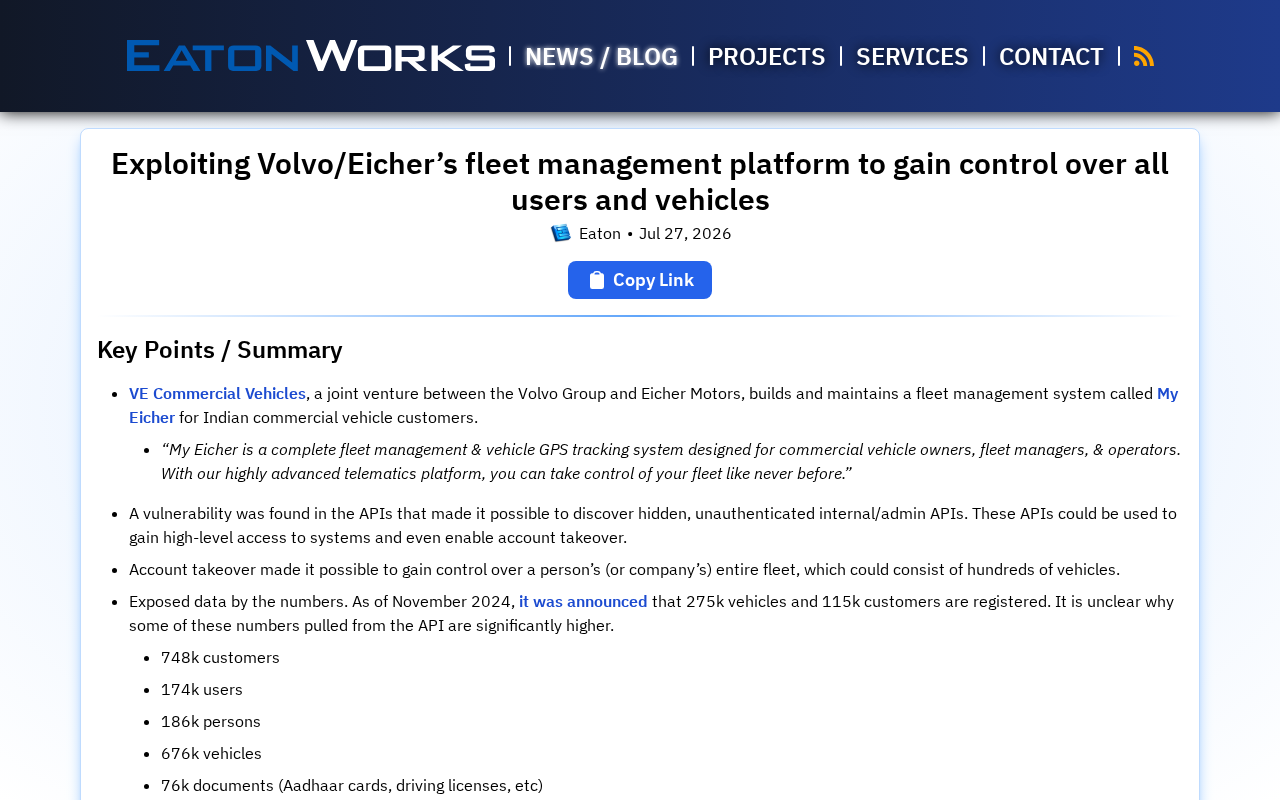
Recently, security researchers disclosed a series of critical security vulnerabilities in the fleet management platform jointly operated by Volvo and Eicher. By exploiting these vulnerabilities, an attacker could gain control over all user accounts and vehicles on the platform — undeniably a high-severity risk case in the IoT and connected vehicle security domain.
Volvo Group and India's Eicher Motors established the joint venture VE Commercial Vehicles (VECV) in 2008, focusing on the R&D, manufacturing, and sales of medium and heavy-duty commercial vehicles, primarily serving India and emerging markets. Eicher is one of India's largest commercial vehicle manufacturers, while Volvo Group is the world's second-largest heavy truck manufacturer. Their joint fleet management platform provides telematics services for tens of thousands of commercial vehicles under their umbrella, covering GPS tracking, remote diagnostics, fuel consumption analysis, and driver behavior monitoring. This joint venture background means the scale of affected vehicles is enormous, spanning logistics, public transportation, and construction engineering across multiple countries and regions.
As commercial vehicles increasingly connect to the cloud for remote management, diagnostics, and dispatching, fleet platforms have become core infrastructure for modern logistics and transportation enterprises. However, once such platforms harbor authentication or access control flaws, the impact extends far beyond a single device — it can potentially affect an entire fleet or even an entire operational network.
Why Fleet Management Platforms Are High-Value Attack Targets
Centralized Management Brings Centralized Risk
The core value of a Fleet Management Platform lies in centralization: enterprises can monitor the location, status, fuel consumption, driver behavior, and other data of hundreds or even tens of thousands of vehicles in real time through a unified backend, and issue remote commands.
The technical foundation of this centralized management is the Telematics system — a technology framework that integrates telecommunications and informatics. In the commercial vehicle sector, each vehicle is typically equipped with a Telematics Control Unit (TCU) that continuously reports real-time data to the cloud platform via cellular networks (4G/5G), including GPS coordinates, engine parameters (collected via OBD-II or J1939 bus), fuel consumption, tire pressure, braking status, and more. At the same time, the cloud platform can send commands to vehicles through downlink channels, such as remote lock/unlock, speed limit settings, and engine start/stop control. This bidirectional communication architecture means that once the platform is compromised, attackers can not only steal sensitive location and operational data but may also execute remote physical control over vehicles.
While this centralization improves operational efficiency, it also means that once the platform is breached, an attacker gains not just a single point of access, but lateral control spanning all assets. The Volvo/Eicher platform vulnerability is a textbook case — researchers claimed they could "take over all users and vehicles," indicating the vulnerability likely resides in the platform's authentication layer or multi-tenant isolation mechanism.
Multi-tenancy is a typical cloud platform architecture pattern where multiple customers (tenants) share the same platform infrastructure, but their data and operational logic are logically isolated from each other. In fleet management scenarios, different logistics companies and transportation enterprises each operate as a tenant, managing their own vehicles and drivers. Multi-tenant isolation is typically implemented through row-level security policies, mandatory tenant ID validation, and API gateway access control policies. Once the isolation mechanism fails, Company A's administrator could view Company B's vehicle data or even control their vehicles. This type of cross-tenant privilege escalation is one of the most dangerous vulnerability types in fleet management platforms, as it propagates the impact of a single point of intrusion to all customers on the platform.
The Unique Dangers of Attacks on Commercial Vehicles
Unlike passenger vehicles, Volvo and Eicher hold massive market shares in the commercial vehicle and truck sectors. These vehicles carry critical operations including freight transportation, public transit, and construction projects. If an attacker could remotely control or interfere with vehicles, the consequences could extend beyond data breaches to encompass physical safety risks and supply chain disruptions.
Analysis of Common Vulnerability Types in Connected Vehicle Platforms
Although the full technical details of this disclosure are not yet complete, based on the description of "taking over all users/vehicles," such vulnerabilities typically stem from several common categories:
Broken Access Control
This is the number one security risk in the OWASP Top 10. In multi-tenant platforms, if APIs fail to properly verify whether a requester has the right to access a specific resource, attackers can often escalate privileges simply by modifying the user ID or vehicle ID in the request — known as IDOR (Insecure Direct Object Reference) — to access other people's data.
IDOR (Insecure Direct Object Reference) is one of the most common and damaging logic vulnerabilities in web applications. The principle is straightforward: when an application uses user-controllable identifiers (such as numeric IDs or UUIDs) to directly reference internal objects (such as user profiles or vehicle records) without verifying on the server side whether the current requester is authorized to access that object, an attacker can simply change the ID parameter in the request from their own value to someone else's to access or manipulate another user's resources. For example, an API request to /api/vehicle/1001 returns your own vehicle information — changing 1001 to 1002 retrieves another vehicle's information. In fleet management platforms, if vehicle IDs or user IDs are sequential integers, attackers can even write scripts to enumerate all IDs in bulk, achieving full enumeration and takeover of all platform resources.
Authentication Bypass Vulnerabilities
If the platform's authentication logic is flawed — for example, lax JWT token validation, hijackable password reset flows, or hardcoded administrator credentials — attackers can directly impersonate any user or even an administrator.
JWT (JSON Web Token) is the most popular stateless authentication scheme in modern web and API applications. It consists of three parts: the Header (declaring the algorithm type), the Payload (carrying user identity and permission information), and the Signature (signing the first two parts using a secret key). The server verifies the signature to confirm the token's authenticity and integrity. However, common JWT security flaws include: setting the signing algorithm to "none" to bypass verification; downgrading from an asymmetric algorithm (RS256) to a symmetric algorithm (HS256) and using the public key as the secret to forge tokens; insufficient key strength allowing brute-force attacks; and failing to validate critical claims in the token (such as expiration time exp, audience aud, etc.). In connected vehicle platforms, JWT flaws could allow an attacker to forge an administrator-level token, thereby gaining complete control over the entire platform.
Unauthorized Exposure of API Endpoints
Many connected vehicle platform backend APIs are designed without adequate consideration of security boundaries, resulting in internal management interfaces being exposed externally. Researchers can often discover "god mode" endpoints capable of bulk operations by enumerating and analyzing these endpoints.
Systemic Security Concerns in the Automotive Connected Vehicle Industry
This is not the first time a connected vehicle platform has been found to have critical vulnerabilities. In recent years, security researcher Sam Curry and others have systematically disclosed API vulnerabilities across multiple major automakers including BMW, Mercedes-Benz, Toyota, and Kia, many of which similarly enabled remote vehicle location, unlocking, or even starting.
Sam Curry is a well-known American security researcher specializing in web application and API security. Between 2022 and 2023, he and his team systematically assessed the connected vehicle platforms of over a dozen major automakers and discovered numerous critical vulnerabilities. These included: exploiting API flaws in the Kia dealer portal to remotely unlock, start any Kia vehicle, and obtain owner personal information using only a license plate number; accessing millions of customers' personal data and vehicle telemetry information through BMW and Mercedes-Benz internal API endpoints; and gaining administrator access to Toyota's global financial services platform through a supplier system. These findings revealed an unsettling industry reality — virtually all major automakers' connected vehicle APIs have security issues of varying degrees, and many vulnerabilities have extremely low exploitation thresholds, requiring no specialized automotive hacking skills, only conventional web security expertise.
This series of incidents reveals a common problem: automakers, in their rush to embrace digitalization and connectivity, have not kept their software security capabilities in step. Traditional car manufacturers excel at mechanical engineering and manufacturing, but often lack sufficient expertise and investment in modern software security domains such as cloud platforms, API security, and identity authentication.
Security Recommendations for Enterprises and Users
For enterprises operating vehicle fleets, incidents like these serve as a reminder that supplier platform security should not be blindly trusted. The following measures are recommended:
- Principle of Least Privilege: Configure minimum necessary permissions for different role accounts to reduce the blast radius when a single account is compromised.
- Enforce Multi-Factor Authentication (MFA): Mandate MFA for all management consoles to increase the difficulty of account takeover.
- Continuous Security Monitoring: Establish alerting mechanisms for anomalous API calls, bulk operations, and login behaviors.
- Regular Security Assessments: Conduct independent security audits of third-party fleet management platforms in use.
For manufacturers, the key is to "shift security left" — introducing threat modeling and security reviews at the product design stage and establishing robust vulnerability disclosure and response mechanisms (such as Bug Bounty programs) to encourage the security community to help identify issues.
"Shift Left Security" is a core concept in modern software security engineering, derived from the visual representation of the Software Development Life Cycle (SDLC) — on a left-to-right timeline, the design phase sits at the far left, while deployment and operations sit at the far right. Traditional security practices often only perform penetration testing and security audits after development is complete, at which point the cost of fixing discovered vulnerabilities is extremely high. Shift Left Security advocates moving security activities forward into the design and coding phases, including: performing threat modeling during architectural design (e.g., using the STRIDE methodology to identify six threat categories — Spoofing, Tampering, Repudiation, Information Disclosure, Denial of Service, and Elevation of Privilege); using Static Application Security Testing (SAST) tools during the coding phase to automatically detect code defects; and integrating Dynamic Application Security Testing (DAST) and Software Composition Analysis (SCA) into CI/CD pipelines. Research shows that the cost of finding and fixing a security defect during the design phase is only 1/100th of the cost in a production environment.
Conclusion
As Software-Defined Vehicles (SDV) become an industry trend, vehicles are essentially becoming "networked computers on wheels." Software-Defined Vehicle (SDV) represents a fundamental paradigm shift underway in the automotive industry. Under the SDV architecture, a vehicle's core functions — including powertrain control, chassis tuning, cabin interaction, and even autonomous driving — are primarily implemented in software, while hardware provides computing power and execution capabilities. A modern high-end vehicle contains over 100 million lines of code, far exceeding a Boeing 787 aircraft (approximately 6.5 million lines). This software intensity creates an enormous attack surface: every connected interface, every OTA (Over-the-Air) update channel, and every third-party API integration could become an attack vector.
To address these challenges, the United Nations introduced two mandatory regulations in 2021 — UN R155 (Cybersecurity Management System) and UN R156 (Software Update Management) — requiring all new vehicles sold in markets including the EU, Japan, and South Korea to pass cybersecurity certification. The ISO/SAE 21434 standard also provides a systematic cybersecurity engineering framework for the automotive industry. However, regulatory coverage and enforcement still lag behind, especially in the commercial vehicle sector and emerging markets.
This means that traditional cybersecurity threats will fully permeate the mobility and logistics sectors. The Volvo/Eicher fleet platform vulnerability once again sounds the alarm for the entire industry — security must be a first principle of connected vehicle architecture, not an afterthought.
It should be noted that this article is based on analysis of limited publicly disclosed information. The specific technical details of the vulnerabilities and the manufacturer's remediation status remain to be further confirmed.
Related articles

Transitioning to AI Agent Development: A Complete Three-Stage Learning Path for Programmers
Why do programmers keep failing at AI Agent development? This guide breaks down a 3-stage learning path: ReAct & Tool Calling fundamentals, LangChain engineering, and production-grade project delivery.

Getting Started with Agent Skills: A Complete Guide from Prompts to Intelligent Skills
Deep dive into AI Agent Skills' four components (skill.md, references, scripts, assets), explaining how Skills differ from prompts and how to build reusable intelligent skill systems.

Codex Beginner's Guide: Installation, Configuration & Connecting Chinese LLM APIs
Complete guide to installing OpenAI Codex, how it differs from Claude Code, and how to connect Chinese LLMs like DeepSeek via API keys with full setup steps and limitations.