Voyag: Joint Detection of In-Vehicle Voice Multi-Intent and Execution Relation Classification

Voyag jointly predicts in-vehicle multi-intent slots and execution relations in a single forward pass; sequential and parallel recall beat rules but aggregate gains are limited.
In-vehicle voice assistants need to understand execution relations between multiple intents, not just identify intent counts. The arXiv paper Voyag proposes completing typed selection of ten vehicle intent slots and three-class relation judgment (parallel, sequential, mutually exclusive) for co-activated intent pairs simultaneously in a single encoder forward pass. Based on the mmBERT-base encoder with a relation head of only 1.61M parameters, it fuses resource requirement profiles and symmetrized outer-product conflict features, constrained by a mutual-exclusion consistency penalty. On a synthetic Chinese benchmark, slot accuracy reaches 0.9893, relation classification macro F1 is 0.8473, and end-to-end single-forward macro F1 is 0.8464. Compared with a two-stage rule pipeline, aggregate gains are not significant, but the learned head has clear advantages in sequential and parallel recall; the mutual-exclusion recall of 0.6062 indicates conflict detection remains a weakness, and validation on real cabin data is a future direction.
In-vehicle voice assistants are shifting from single-command execution toward multi-intent understanding, but recognizing how many intents a user has expressed is only the first step. More critical is determining how these intents should be executed together—whether in parallel, in sequence, or mutually exclusive and requiring arbitration. A paper from arXiv proposes Voyag, which completes intent slot prediction and execution relation classification simultaneously in a single forward pass, offering a new technical path to this challenge.
Multi-Intent Interaction: The Overlooked Dimension of Execution Relations
Traditional in-vehicle voice systems typically simplify multi-intent handling to "identify one by one, execute in sequence," but in real scenarios the relationships between intents are far from this simple. For example, "turn on the air conditioning and lower the volume" requires parallel execution, while "first navigate to the office then play music" has strict ordering requirements. More complex still, some intents are naturally mutually exclusive—such as simultaneously requesting "open the window" and "close the window"—and the system must arbitrate rather than blindly execute.
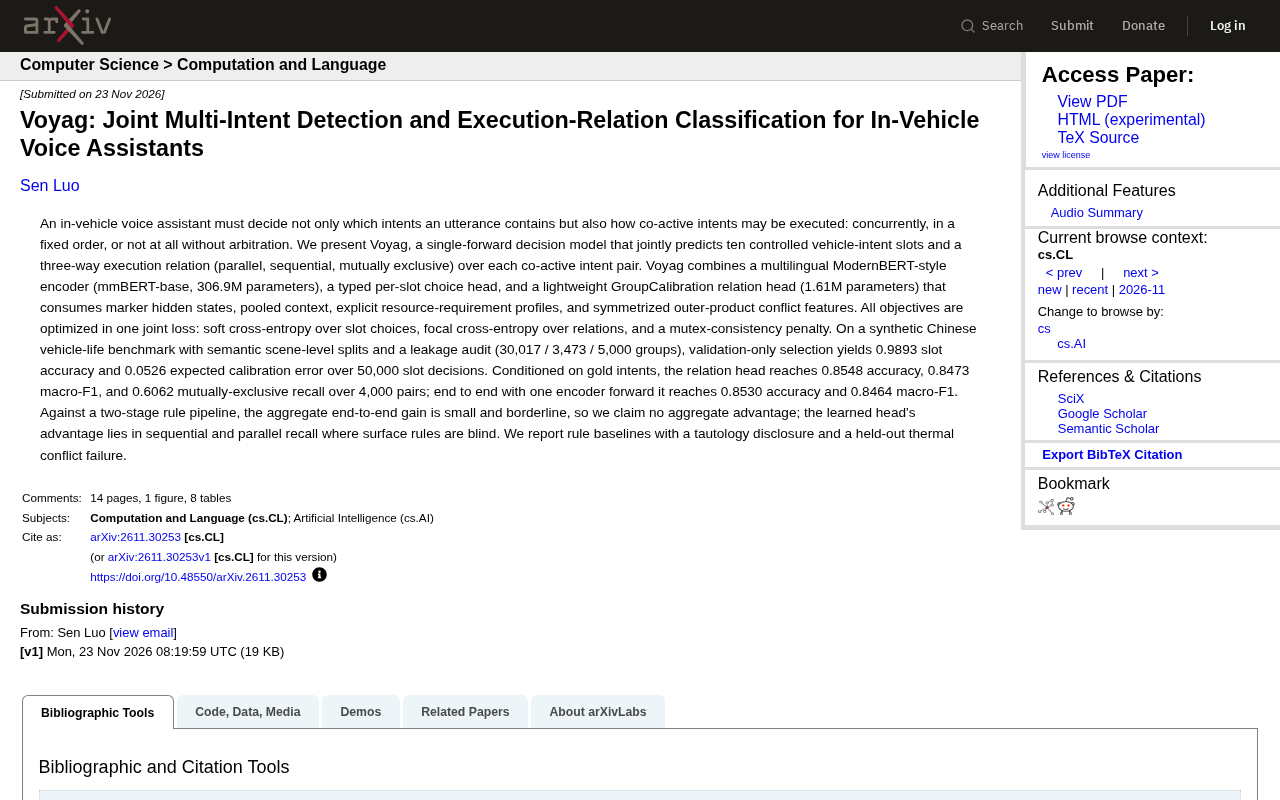
Voyag's starting point is precisely this gap: most existing research focuses on intent detection itself, lacking modeling of execution relations between co-activated intents. The paper defines the problem as a joint task—given an in-vehicle utterance, simultaneously predict ten controlled vehicle intent slots and a three-class execution relation (parallel, sequential, mutually exclusive) for each pair of co-activated intents.
Model Architecture: Joint Decision in a Single Forward Pass
Voyag's core design compresses multi-task learning into a single encoder forward pass. It uses a multilingual ModernBERT-style encoder (mmBERT-base, 306.9M parameters) to extract utterance representations, then branches into two lightweight heads.
Typed Slot Selection Head
The first head handles selection of ten intent slots using a typed per-slot selection mechanism. Each slot corresponds to a vehicle function category (such as air conditioning, navigation, media, etc.), and the model must determine whether that slot is activated by the current utterance. This design avoids the unclear inter-slot coupling in traditional multi-label classification, making each intent prediction relatively independent and interpretable.
GroupCalibration Relation Head
The second head handles relation classification for co-activated intent pairs, with only 1.61M parameters, reflecting a "lightweight but precise" design philosophy. This head consumes four types of features: token hidden states, pooled context, explicit resource requirement profiles, and symmetrized outer-product conflict features. Resource requirement profiles are a key prior here—different vehicle functions occupy hardware resources differently (such as audio channels, screen display, network connectivity), and conflict features capture potential contradictions between intent pairs.
All objectives are optimized through a joint loss: soft cross-entropy on slot selection, focal cross-entropy on relation classification, and a mutual-exclusion consistency penalty. The mutual-exclusion consistency penalty ensures the model remains logically self-consistent when predicting mutually exclusive relations, avoiding contradictory outputs such as "A and B are mutually exclusive but B and A are parallel."
Benchmark Testing: Quantitative Performance on Synthetic Data
The paper constructs a synthetic Chinese vehicle-life benchmark with semantic scene-level splits and leakage auditing, at a scale of 30,017/3,473/5,000 groups (train/validation/test). When selecting models using only the validation set, it achieves 0.9893 slot accuracy and 0.0526 expected calibration error across 50,000 slot decisions, indicating the model is not only accurate in prediction but also reasonably reliable in confidence.
Relation classification performance is even more noteworthy. Given golden intents, the relation head achieves 0.8548 accuracy, 0.8473 macro F1, and 0.6062 mutual-exclusion recall on 4,000 intent pairs. In end-to-end single encoder forward mode, accuracy is 0.8530 and macro F1 is 0.8464, a small gap from the golden-intent condition, indicating that joint training does not significantly harm relation classification performance.
Comparison with Rule Baselines: Where the Advantages Lie
The paper honestly reports comparison results with a two-stage rule pipeline: the end-to-end aggregate gain is small and borderline, so the authors explicitly state they do not claim aggregate superiority. This disclosure is commendable—it is uncommon in academic papers to proactively downplay one's own advantages.
The real difference lies in fine-grained scenarios. The learned relation head outperforms surface rules on sequential and parallel recall, while rule-based methods are nearly "blind" in these scenarios. Rule pipelines rely on keywords and pattern matching; when intent expressions imply ordering (such as "first... then...") or require inferring parallel feasibility, rules often fail. Additionally, the paper discloses a held-out hot-conflict failure case, indicating that resource conflict scenarios remain difficult.
Implications and Limitations
Voyag's value lies in explicitly incorporating execution relation classification into multi-intent modeling and achieving usable performance with a lightweight relation head. Its design ideas of resource requirement profiles and conflict features have reference value for practical in-vehicle system development—the physical resource constraints of vehicle functions are natural prior knowledge that deserves structured utilization.
Limitations are equally obvious: the benchmark is synthetic Chinese data, and noise, accents, and multi-person conversation scenarios in real in-vehicle environments have not been validated; the end-to-end aggregate advantage is not significant, meaning that in scenarios where rule systems already suffice, replacement costs may exceed benefits. The mutual-exclusion recall of 0.6062 also indicates that conflict detection still has considerable room for improvement. If future work can incorporate real cabin data and optimize conflict features, this direction deserves continued attention.
One-line Summary
Voyag jointly predicts in-vehicle multi-intent slots and execution relations in a single forward pass; sequential and parallel recall outperform rules but aggregate gains are limited.
Paragraph Summary
In-vehicle voice assistants need to understand execution relations between multiple intents, not just identify intent counts. The arXiv paper Voyag proposes completing typed selection of ten vehicle intent slots and three-class relation judgment (parallel, sequential, mutually exclusive) for co-activated intent pairs simultaneously in a single encoder forward pass. The model is based on the mmBERT-base encoder, with a relation head of only 1.61M parameters, fusing resource requirement profiles and symmetrized outer-product conflict features, and constraining the joint loss with a mutual-exclusion consistency penalty. On the synthetic Chinese benchmark, slot accuracy reaches 0.9893, relation classification macro F1 is 0.8473, and end-to-end single-forward macro F1 is 0.8464. Compared with a two-stage rule pipeline, aggregate gains are not significant, but the learned head has clear advantages in sequential and parallel recall; the mutual-exclusion recall of 0.6062 indicates that conflict detection remains a weakness, and validation on real cabin data is a future direction.
Related articles

Nightmare Mode: Engineering Practices for Simulating Disk Failures
Starting from the Hacker News Nightmare mode discussion, this article analyzes typical forms of simulated disk failures, fault injection implementation approaches, and how to integrate fault drills into the development process to improve distributed system fault tolerance.

Datasette-charts-pie Plugin Released: New Options for Pie and Sunburst Charts
Datasette-charts-pie 0.1a0 is released, adding pie, donut, sunburst, and rose charts to Datasette. The author dislikes pie charts but built the plugin to test the plugin architecture.

Diablo II: A Classic Retrospective That Changed Gaming History
From game history writing and tech community discussion, a retrospective on Diablo II's random drops, numerical systems, and multiplayer design—analyzing why this classic ARPG is still discussed by developers today.