Vulnerability Fixing Too Hard? Iterative LLM Pipeline Enables Automated Code Repair
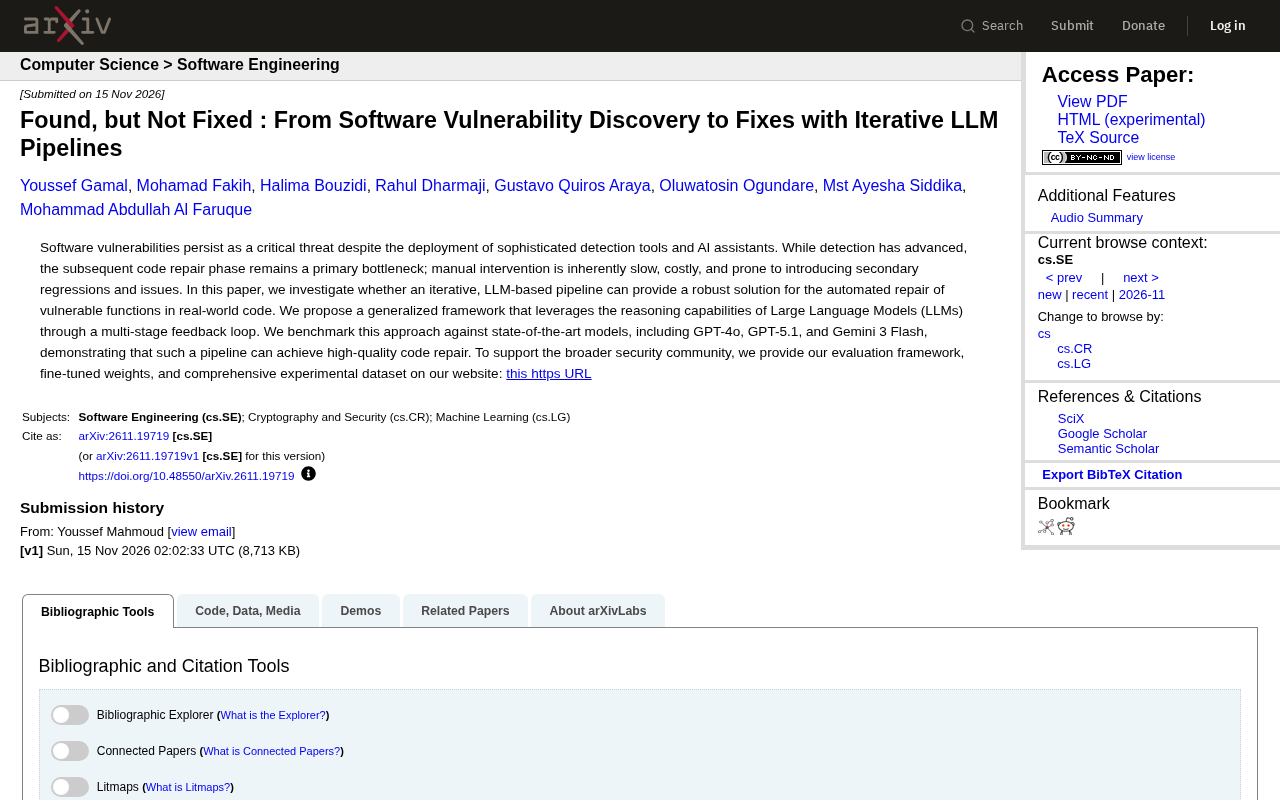
The study proposes an iterative LLM pipeline to move automated vulnerability repair from detection to practical deployment.
The study notes that although vulnerability detection is maturing, code repair remains the weakest link—manual fixes are slow, costly, and regression-prone. It proposes an iterative multi-stage feedback pipeline based on LLMs that reviews and optimizes fixes each round. Experiments with GPT-4o, GPT-5.1, and Gemini 3 Flash show high-quality repairs across models, and the team released the evaluation framework, fine-tuned weights, and dataset.

Software vulnerability detection tools are getting more powerful by the day, from static analysis to AI-assisted scanning, and the ability to find vulnerabilities is far beyond what it once was. Yet an awkward reality remains: finding a vulnerability is only the first step—the real challenge is fixing it. A recent study points out that despite continuous advances in detection technology, the code repair stage remains the biggest bottleneck—manual fixes are slow, costly, and prone to introducing new regression issues. This study proposes an iterative pipeline based on large language models, attempting to make automated repair truly practical.
Vulnerability Repair: The Weakest Link in the Security Chain
Security teams invest substantial resources in vulnerability scanning and detection, but when a vulnerability report lands on the table, fixing it often requires manual intervention from developers. This process is not only time-consuming and labor-intensive, but more critically, manually modifying code easily introduces new defects, creating a vicious cycle of "fix one, create two."
The research paper states bluntly: detection has moved ahead, but repair lags far behind. This imbalance leaves a large number of known vulnerabilities exposed to risk over the long term. Attackers don't need sophisticated techniques—they just need to target those "discovered but unfixed" vulnerabilities to find a way in.
Iterative LLM Pipeline: Letting the Model "Check Its Own Work"
To address these pain points, the researchers propose a general framework whose core idea is to leverage the reasoning capabilities of large language models to build a multi-stage feedback loop. Simply put, the model doesn't just generate repair code once and call it done—it iteratively reviews and optimizes its own output.
The design intent of this multi-stage feedback mechanism is clear: a single generation can hardly guarantee repair quality, but by letting the model adjust based on feedback in each round, it can gradually approach a usable repair solution. This is similar to the process of a developer writing code, running tests, reading errors, and revising—except this loop is handed over to the model to execute automatically.
The research team compared this pipeline with current mainstream state-of-the-art models, including GPT-4o, GPT-5.1, and Gemini 3 Flash. Experimental results show that this iterative pipeline can achieve high-quality code repair, indicating that framework-level design can effectively compensate for the shortcomings of individual model capabilities.
Multi-stage Feedback Loop is a paradigm that has been widely validated as effective in code generation and repair tasks in recent years. Unlike traditional "one-shot generation," this paradigm lets the model receive signals from compiler output, static analysis warnings, or test case results in each round, and adjust the next round's output accordingly. In vulnerability repair scenarios, this iterative structure is especially important because security patches must not only pass functional tests but also satisfy security property constraints (such as eliminating specific CWE categories). Research shows that the granularity and timing of feedback signals directly determine convergence speed and repair quality, and introducing multi-round self-reflection can significantly improve repair success rates without changing model parameters.
The GPT-4o, GPT-5.1, and Gemini 3 Flash mentioned in the paper represent different capability tiers of current large language models. GPT-4o is OpenAI's multimodal model, with balanced performance in code understanding and generation; GPT-5.1 belongs to a newer generation of reasoning-enhanced models, with stronger multi-step reasoning capabilities in complex logic tasks; Gemini 3 Flash is Google's lightweight high-speed model, focusing on low latency and cost efficiency. The significance of incorporating these three models into a unified pipeline for comparison lies in verifying the generality of the framework design—that is, the benefits of the iterative pipeline do not depend on a specific model but can be reproduced across models of different capability tiers, thereby demonstrating that engineering optimizations at the framework level can partially offset differences in model capabilities.
Open-Source Evaluation Framework and Dataset
You may not have noticed that the research team did not keep their results confined to the paper. They released the evaluation framework, fine-tuned model weights, and the complete experimental dataset at https://sites.google.com/view/llm4cve.
For the security community, this is more valuable than the paper itself. Automated vulnerability repair is a field that requires extensive validation in real-world scenarios, and public datasets and evaluation frameworks mean other researchers can directly reproduce results, compare different methods, and even continue improving on this basis. The release of fine-tuned weights also gives engineering teams the possibility of direct trial use without having to train from scratch.
Fine-tuned Model Weights refer to additional parameter updates made by the research team on top of general large models using proprietary data from the vulnerability repair domain. Unlike prompt engineering, fine-tuning changes the internal parameter distribution of the model, making it better suited to the input-output patterns of a specific task. In vulnerability repair scenarios, fine-tuning data typically includes vulnerable code snippets, corresponding repair patches, and related CVE/CWE metadata. Publicly releasing fine-tuned weights means engineering teams can directly load these parameters for inference or continue fine-tuning, greatly reducing the migration cost from research to application. At the same time, open weights also provide a guarantee for academic reproducibility—other researchers can compare the effects of different repair strategies on the exact same model foundation.
How Far from Research to Deployment
This study demonstrates a clear direction: the value of LLMs in code security is not limited to "finding vulnerabilities"—they also have room to play in the harder stage of "fixing vulnerabilities." The design idea of the multi-stage feedback loop is not complex, but it captures the core of the repair task—the need for repeated verification and gradual convergence.
Of course, there is still a distance from paper to production environment. The complexity of real codebases, the maintainability of repair solutions, and the compliance review of security patches cannot all be fully resolved by model iteration alone. But at least this study provides a reproducible, comparable starting point and offers security teams a new tool idea: rather than leaving developers to face the pressure of vulnerability repair alone, it is better to run an iterative LLM pipeline first and focus human energy on the places that truly require judgment.
There are already enough vulnerability discovery tools; the next step is to shift attention to repair. This is exactly where the value of this study lies.
One-line Summary
This study proposes an iterative LLM pipeline to move automated vulnerability repair from detection to practical deployment.
Paragraph Summary
The study points out that although vulnerability detection technology is maturing, code repair remains the weakest link in the security chain—manual repair is slow, costly, and prone to introducing regressions. To address this, the researchers propose an iterative multi-stage feedback pipeline based on large language models, allowing the model to review and optimize repair solutions based on feedback in each round rather than generating once. Experiments compared GPT-4o, GPT-5.1, and Gemini 3 Flash, and results show that the pipeline can produce high-quality repair results across different models, indicating that framework design can effectively compensate for the shortcomings of a single model. The research team also released the evaluation framework, fine-tuned weights, and complete dataset, providing a reproducible research foundation for the community.
Related articles

Abnormal Error Rate Spike in Claude Mythos 5.2 and Fable 5.2
Claude Mythos 5.2 and Claude Fable 5.2 show an abnormal spike in request error rates, marked as investigating on the official status page. This article covers the incident overview, practical impact on developers, and recommended responses.

ReAct Runtime Context Trimming: Why Claude Code Acts at 70%
A deep dive into ReAct runtime context trimming: why Claude Code compresses at ~70% usage, why tool calls dominate, why messages must be dropped in pairs, and why codebases don't need RAG.

AI Agent vs LLM: How Cursor and Claude Code Actually Work
An in-depth analysis of the essential difference between AI Agents and LLMs: LLMs generate code suggestions, while Agents modify files and run tests via tool calls. Using a Spring Boot bug fix as an example, it breaks down the workflows, permission control, and verification mechanisms of Cursor and Claude Code.