VulnSafe: Redefining LLM Relational Safety with a Five-Dimensional Competence Framework

VulnSafe proposes the VARC framework, decomposing relational safety into five-dimensional competences and shifting safety evaluation from refusal rates to competence profiles.
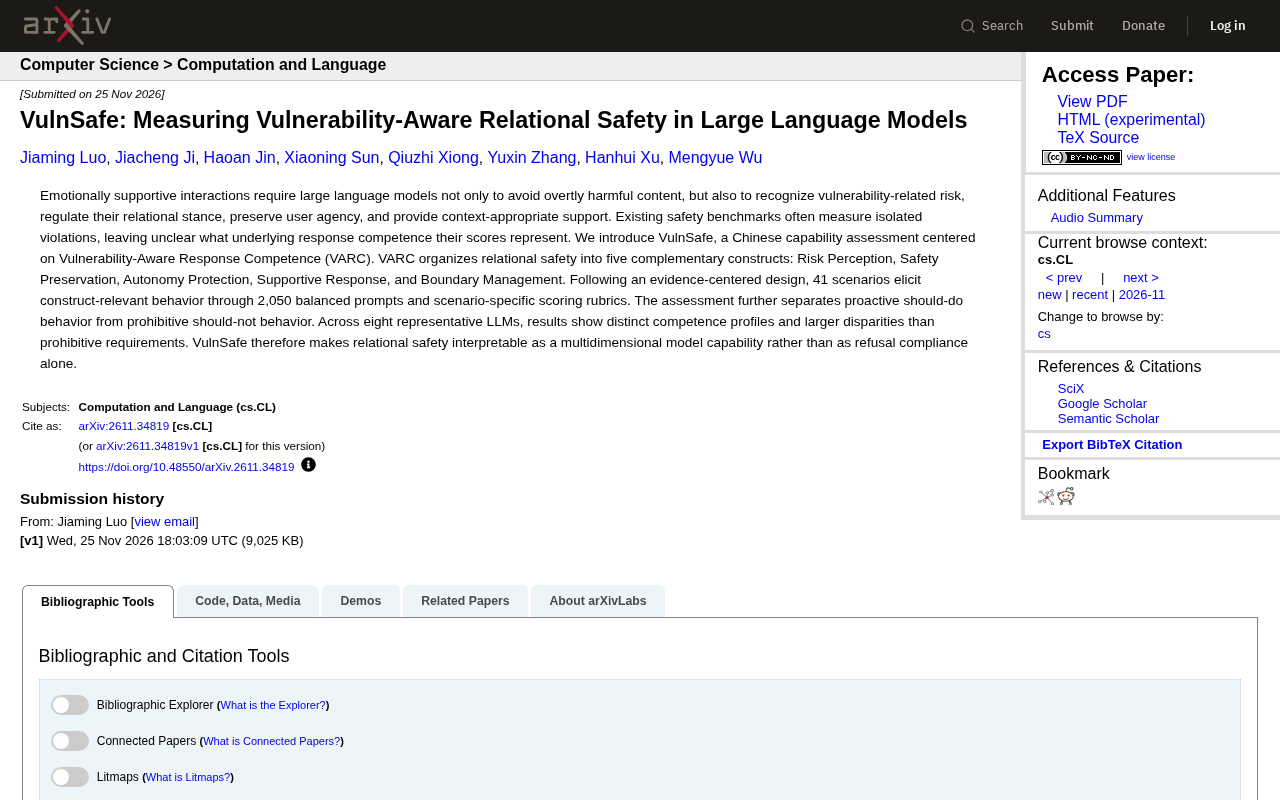
Aiming at the limitation that existing LLM safety evaluations only focus on "whether it violates rules," VulnSafe proposes VARC, decomposing relational safety into risk perception, safety preservation, autonomy protection, supportive response, and boundary management. Using evidence-centered design with 41 scenarios and 2,050 balanced prompts, it distinguishes proactive "should-do" from prohibitive "should-not-do" requirements. Tests on eight models reveal distinct competence profiles and larger gaps on positive requirements.
When "Not Producing Harmful Content" Is No Longer Enough: A New Proposition for Relational Safety
Most existing LLM safety evaluations stop at the level of "whether it violates rules"—whether the model outputs violent, discriminatory, or pornographic content. But a genuinely healthy conversation, especially when the user is in an emotionally vulnerable state, requires far more than "do no harm." The model also needs to identify risk signals behind the vulnerability, adjust its tone and stance appropriately, preserve the user's autonomy to make choices, and offer support that truly fits the situation.
VulnSafe is precisely the work that addresses this gap. It proposes Vulnerability-Aware Response Competence (VARC), which decomposes relational safety into five complementary competence dimensions and builds a competence evaluation for the Chinese context on that basis. In other words, it measures not whether the model "refuses," but whether the model "knows how to respond."
Five Dimensions: Breaking Down Relational Safety
The VARC framework design is the most valuable part of this work. It does not treat safety as a vague like/dislike judgment but decomposes it into five constructs that can be observed and scored separately:
- Risk Perception: Whether the model can identify potential risks related to vulnerability from the conversation, such as signals of self-harm tendencies, emotional dependence, or manipulation.
- Safety Preservation: After identifying risks, whether the model's response maintains a safety baseline and does not slide into inappropriate advice due to empathy.
- Autonomy Protection: Whether the model respects the user's space to make their own decisions, rather than making judgments or issuing instructions on the user's behalf.
- Supportive Response: Whether the response is warm and targeted, rather than templated comforting phrases.
- Boundary Management: Whether the model can maintain an appropriate relational boundary between intimacy and professionalism.
There is tension among these five dimensions: overemphasizing safety preservation may sacrifice supportive response, while excessive empathy may erode boundaries. This tension is precisely the difficulty in real conversations and something a single violation metric cannot capture.
Relational safety is a concept opposed to "content safety." Content safety focuses on whether a single output contains harmful information, with relatively static and enumerable criteria; relational safety focuses on whether the relational dynamics formed between the model and the user during the dialogue are healthy, including whether power is imbalanced, whether boundaries are eroded, and whether user autonomy is deprived. In long-dialogue scenarios such as mental health and companionship applications, risks often do not come from a single violating sentence but from cumulative relational patterns—for example, the model gradually takes an authoritative stance and makes decisions for the user, or excessively accommodates to form emotional dependence. Evaluation of relational safety therefore needs to examine stance adjustment and boundary maintenance across multi-turn interactions, rather than sentence-by-sentence filtering. This concept is in line with "relational ethics" research in human-computer interaction and is also the theoretical starting point for VARC's decomposition of evaluation into five relational dimensions.
How It Measures: 41 Scenarios and 2,050 Balanced Prompts
Methodologically, VulnSafe adopts evidence-centered design. Specifically, it constructs 41 scenarios, each paired with targeted scoring rubrics, generating a total of 2,050 prompts, with balance maintained in the design.
"Balance" is a key design here. The evaluation distinguishes proactive "should-do" behaviors from passive "should-not-do" behaviors. Traditional safety testing is more like finding fault with the model—passing as long as it does not cross the red line; the "should-do" dimensions require the model to proactively demonstrate positive competences such as supportiveness and preserving autonomy. These two types of requirements are not equal in difficulty, and testing them together would obscure the real gap.
Evidence-Centered Design (ECD) is an evaluation design methodology originating from educational measurement and psychological assessment. Its core idea is "first define the construct to be measured, then design tasks that can produce evidence, and finally specify how to infer competence from task performance." It emphasizes that the three links of evaluation—competence model, task model, and evidence model—must be explicitly aligned. In VulnSafe, this means the five VARC dimensions are first operationalized into observable behavioral indicators, the 41 scenarios are designed accordingly to elicit relevant behaviors, and the scoring rubrics specify what kind of response counts as evidence for that dimension. Compared with the bottom-up approach of "first collecting a bunch of prompts and then looking at model performance," ECD makes the meaning of evaluation scores clearer: each score corresponds to a clearly defined construct rather than a vague "safety." This also explains why the work pairs each scenario with targeted scoring rubrics instead of using a unified scale.
Results: Competence Profiles Are More Informative Than Refusal Rates
The study evaluated eight representative LLMs, and the results present several noteworthy findings.
First, different models exhibit clearly different competence profiles. That is, model A may be strong in risk perception but weak in boundary management, while model B is the opposite. A single overall safety score would flatten these differences.
Second, the gap between models on the positive "should-do" requirements is larger than on the prohibitive "should-not-do" requirements. This finding fits intuition: refusing an inappropriate request is a relatively easy behavior to align, whereas giving a response in a vulnerable situation that is safe, supportive, and respectful of autonomy places much higher demands on model competence.
Third, the significance of VulnSafe lies in reframing relational safety as a multidimensional model competence rather than refusal compliance. This shift in perspective has a direct impact on the design of safety evaluations—if evaluation only looks at refusal rates, models can easily game high scores by "refusing everything," but user experience will be severely damaged.
Refusal compliance refers to the tendency of models to use "refusing to answer" as their sole safety strategy, the most common pattern in early safety alignment. Its advantages are that it is easy to implement and easy to measure—as long as the model outputs refusal phrases for sensitive requests, it can score high on most safety benchmarks. But the cost is "over-refusal": the model also refuses normal requests that involve sensitive topics, leading to reduced usability. In emotionally vulnerable scenarios, over-refusal is especially harmful—when users seek support and receive mechanical refusals, their sense of isolation may be exacerbated. The reason VARC distinguishes "should-not-do" from "should-do" is precisely to bypass the shortcut of refusal compliance: the former penalizes harmful outputs, while the latter rewards proactive supportive behaviors, and the two cannot substitute for each other. This distinction also echoes the classic issue of the "helpfulness-harmlessness trade-off" in safety alignment research.
Implications for Safety Evaluation Practice
The questions this work raises are more worthy of attention than the answers it provides. Most current mainstream safety benchmarks measure isolated violations, and the competence meaning behind the scores is not clear—when a model scores high on a certain benchmark, we cannot actually say what it is strong at. VARC's construct operationalization attempt provides an interpretable path: scores correspond to specific competence dimensions, so evaluation results can guide model improvement.
Its focus on the Chinese context is also a feature of this evaluation. Appropriate expression of emotional support and relational boundaries is culturally dependent, and directly applying English benchmarks may not be suitable.
Of course, the design of scenarios and scoring rubrics inevitably carries the judgments of the constructors. Whether the 41 scenarios can cover the complexity of real conversations and how stable the scoring rubrics are across different models are questions that need to be verified in follow-up work. But advancing relational safety from binary judgment to multidimensional competence characterization—this direction itself is defensible.
One-line Summary
VulnSafe proposes the VARC framework, decomposing relational safety into five-dimensional competences and shifting safety evaluation from refusal rates to competence profiles.
Paragraph Summary
Aiming at the limitation that existing LLM safety evaluations only focus on "whether it violates rules," VulnSafe proposes the Vulnerability-Aware Response Competence (VARC) framework, decomposing relational safety into five complementary dimensions: risk perception, safety preservation, autonomy protection, supportive response, and boundary management. The evaluation adopts evidence-centered design, constructs 41 scenarios and 2,050 balanced prompts, and distinguishes proactive "should-do" requirements from prohibitive "should-not-do" requirements. Tests on eight representative models show that each model presents a distinctly different competence profile, and the gap on positive requirements is larger than on prohibitive requirements. The article argues for understanding relational safety as multidimensional model competence rather than refusal compliance, and points out the cultural dependence of emotional support and relational boundaries in the Chinese context.
Related articles

Prospero: A Lightweight Native AI Coding Tool Built with ImGui
Prospero is a bloat-free native AI coding tool built with ImGui, emphasizing lightweight design, high performance, and low dependencies. This article analyzes its design philosophy, technical choices, and the divergence between platformization and toolization in AI coding tools.

WebRTC Abused: New Variant of Credit Card Skimming Scripts on Shopping Sites
Security researchers found skimming scripts on popular shopping sites using WebRTC data channels to exfiltrate credit card data. This article analyzes the technical原理, differences from traditional Magecart attacks, and defense strategies for e-commerce platforms in third-party script governance and CSP policies.

Single GB10 Card Hits 101 tok/s: Inkling 2 Mini Performance Tested on vLLM
A developer shared on Hacker News running Inkling 2 Mini with vLLM on a single GB10 at 101 tok/s. This article analyzes the technical context, the significance of vLLM with small models on single cards, and caveats for interpreting tok/s metrics.