Wabi's Pivot: From AI App Generator to Messaging-Style Personal Assistant

Wabi pivots from app generator to a messaging-style personal AI agent combining chat, dynamic UI, and persistent tasks.
AI app-building tool Wabi is undergoing a strategic transformation: shifting from a single-purpose "prompt-to-interface" generator to a personal AI agent that unifies conversational interaction, on-demand UI generation, and persistent task management. The core logic is that as app generation becomes commoditized, competitive focus moves to interaction paradigms and user retention — where messaging-style experiences naturally excel. Rather than ending at one-off generation, Wabi now treats the conversation stream as its container, making dynamic app interfaces a means of continuously serving user goals. This path represents a clear direction in generative AI product evolution, though the personal AI agent space is intensely competitive, and whether Wabi can build defensible advantages in task coherence, generation quality, and differentiated UX remains to be seen.
Wabi's Strategic Pivot
AI app generation tool Wabi is repositioning itself — moving away from its original identity as a "prompt-driven app builder" toward a more ambitious form: a personal AI agent that generates interfaces on demand. This shift isn't simply a feature addition; it's a fundamental fusion of chat, apps, and persistent tasks, aiming to redefine how users interact with AI tools.
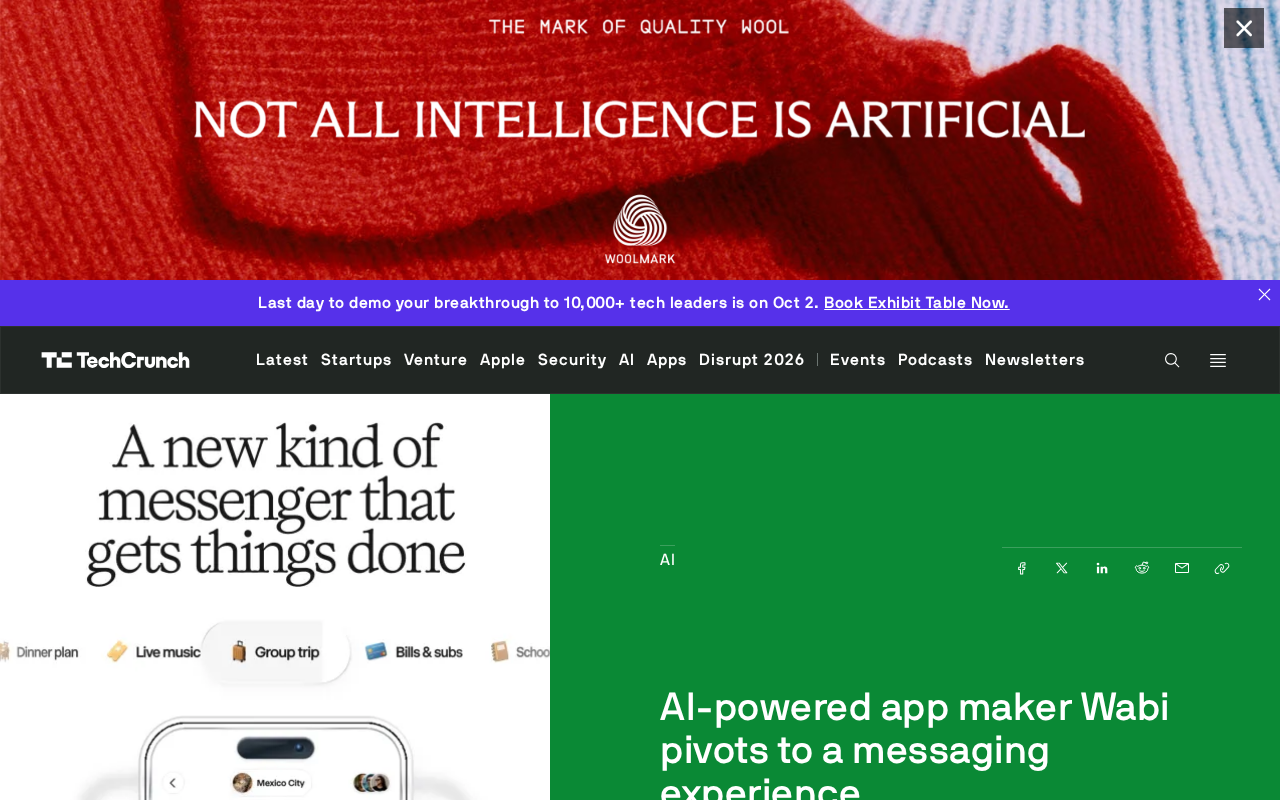
For a product known for generating apps, pivoting toward a "messaging experience" is a fascinating strategic choice. It reflects a broader trend in the AI tools space: single-purpose utility tools are converging toward conversational, agentic forms. Users no longer need to switch between dozens of standalone apps — instead, they accomplish tasks through a single, unified conversational entry point.
From App Builder to Personal Agent
Wabi's original product logic was straightforward: users input a natural language prompt, and the system instantly generates a usable application interface. This "text-to-app" capability isn't rare in the generative AI wave, but intense competition makes it nearly impossible to build lasting advantages on generation speed and UI quality alone.
The repositioned Wabi centers on the "personal AI agent" concept. The emphasis is no longer on one-off app generation, but on continuous service around user needs — creating interfaces on demand, handling ongoing tasks, and wrapping all of it in a messaging-like conversational experience. In other words, app generation shifts from being the product's "end goal" to a means toward a larger purpose.
This repositioning reflects a reassessment of user behavior. Compared to opening a dedicated builder tool and deciding what app to create, people find it far more natural to simply type a request into a chat box. Embedding generative capability within a message stream lowers the barrier to use and makes the tool feel more organically present.
Agentic AI is one of the central concepts driving the current evolution of AI products. Its fundamental difference from traditional "question-and-answer" AI lies in autonomy and continuity. Q&A-style AI treats each interaction in isolation, requiring users to manually chain each step; agentic AI maintains cross-session context memory, autonomously breaks down complex goals, calls external tools (such as search, code execution, and database read/write), and proactively follows up when tasks remain incomplete. Representative products include OpenAI's GPT Actions, Anthropic's Claude Projects, and various AutoGPT-derived frameworks. The technical core of this paradigm is "Tool Use / Function Calling" combined with a "task planning loop (ReAct or Plan-and-Execute loop)," upgrading models from single-pass generators to continuously running task executors. Embedding app generation within this paradigm means Wabi's underlying architecture must support state persistence, multi-step planning, and dynamic UI rendering — a level of technical complexity far beyond simple prompt-to-interface generation.
Unifying Chat, Apps, and Tasks
The heart of Wabi's transformation is integrating three capabilities that were previously fragmented:
- Chat: A unified interaction entry point, letting users express intent conversationally;
- Apps: Functional interfaces generated on demand to support specific operations;
- Persistent Tasks: Not just one-time responses, but long-running tasks that can be tracked, maintained, and advanced over time.
Combining these three signals Wabi's ambition to evolve from a "tool" into an "assistant." Tools wait passively to be invoked; assistants actively understand context, generate appropriate interfaces on demand, and continuously follow up on task progress. This agentic product philosophy is one of the most closely watched directions in the AI space right now.
On-demand UI Generation is the key technical differentiator that sets Wabi apart from purely text-based AI assistants. Traditional chatbots return only text, requiring users to mentally translate information into action. Dynamically generating interactive UI components — such as forms, charts, kanban boards, or data filters — lets users directly manipulate data within the conversation flow, dramatically shortening the "understand → decide → execute" chain. Early explorations of this approach include Vercel's v0 (text-to-React-component generation) and low-code frameworks like Streamlit, but embedding this within a real-time conversational stream is a significantly harder challenge: the system must complete intent understanding, component selection, code generation, and secure rendering within milliseconds, while ensuring semantic consistency between generated results and conversational context. If the generated interface deviates from the user's actual intent, repeated corrections severely damage the experience — making this one of the most difficult engineering and interaction design problems in this category of products.
Opportunities and Challenges in the Pivot
On the opportunity side, messaging-style experiences carry natural user stickiness. Instant messaging is one of the highest-frequency app formats in daily life, and embedding an AI agent within this interaction paradigm can meaningfully boost daily active use and retention. The "on-demand UI generation" capability also differentiates Wabi from pure-text chatbots — it can dynamically surface interactive functional modules within a conversation, an experience that language models alone struggle to deliver.
The challenges are equally clear. Personal AI agents represent the most fiercely contested space right now, with both tech giants and startups competing for this entry point. Whether Wabi can differentiate itself on generation quality, task coherence, and interaction fluency will determine how far it can go. Beyond that, evolving from a utility-type product to an agent-type product places significantly higher demands on underlying technical architecture, context management, and task persistence.
The competitive landscape of personal AI agents currently runs on two parallel tracks: "big-tech infrastructure + vertical startups." At the infrastructure layer, OpenAI (GPTs / Assistants API), Google (Gemini Extensions), and Anthropic (Claude Projects) are all building their own agent platforms, and continuously improving model capabilities are steadily narrowing the technical advantage window for startups. At the vertical application layer, products like Notion AI, Cursor, and Perplexity carve out specific workflow entry points through deep scenario specialization. The core pressure Wabi faces is this: its differentiated "UI generation" capability needs to find a high-frequency, genuinely essential anchor within users' real workflows — otherwise it risks becoming a "wow once, never return" demo tool. Task coherence (maintaining task state across multiple conversation turns without loss) and the trustworthiness of generated results (users willing to hand real workflows over to it) are the two most critical indicators determining whether an agent-type product can convert novelty into daily reliance.
Implications for the Industry
Wabi's transformation is a case study worth watching closely. It illustrates a clear evolutionary path for generative AI product forms: from single-point utility tools toward conversational, agentic, integrated experiences. When interface generation is no longer remarkable on its own, competitive focus shifts to "how AI can serve user goals continuously and naturally."
For developers and product teams, Wabi's choice is a reminder: AI capabilities themselves are commoditizing rapidly, and true differentiation increasingly depends on interaction paradigm innovation and sharp product positioning. Wrapping powerful generative capabilities inside an entry point that users are familiar with and willing to return to daily may ultimately prove more valuable than simply stacking more features.
Publicly available information on Wabi remains limited, and the specifics of its post-pivot performance, user reception, and technical implementation details are still worth monitoring. But the direction it represents — AI tools evolving into personal agents — is undoubtedly a trend worth tracking closely in the months ahead.
Related articles

Felix Rieseberg Personal Homepage
Felix Rieseberg's personal homepage sparks attention on Hacker News. This article covers the Slack engineer's technical background, the rise and fall of nativefier, and the value of a developer homepage as a tech calling card.

@ai-sdk/vue 3.0.306 Patch Release Syncs with [email protected] Update
@ai-sdk/vue 3.0.306 released, synced with [email protected]. A routine patch release for the Vercel AI SDK ecosystem with no public API changes; the Vue adapter layer stays version-aligned with the core package.

Gemini 4 Argon API Launches: The Era of Million-Token Output Begins
Google launches Gemini 4 Argon with sparse MoE architecture, up to 1M output tokens, and a 68.90% Vals Index score, available across API, AI Studio, and the Gemini app.