Waiting Reveals Exactly Two Risk Moments: Endogenous Identification in Prediction-Driven Allocation

Under risk-dependent attrition, each additional observation period identifies two more moments, but timing regret is unavoidable.
This article interprets a study on the trade-off between waiting and intervention in prediction-driven allocation. When preventive intervention resources are limited, waiting can reveal risk but high-risk individuals leave first, causing endogeneity. The paper proves that observation length τ exactly identifies 2τ moments of latent risk—each additional period identifies two more moments—but these moments are insufficient to identify allocation welfare. Under fixed observation length, timing regret is unavoidable regardless of sample size, and an exact certificate is provided for determining the unique optimal date. Matching experiments show bootstrap averaging and early stopping improve decisions, while regret weighting yields no gain, indicating better statistical fit does not equal better allocation welfare. Longer observation often resolves timing ambiguity, but the optimal date may have already passed.
When Waiting Becomes a Strategy: The Trade-off Between Risk Revelation and Intervention Opportunity
In settings where preventive intervention resources are limited—whether it's managing high-risk populations in public health, preventing customer churn in financial risk control, or retaining users in platform operations—decision-makers face a dilemma: acting immediately may target the wrong people, while waiting for more information may mean missing the window. A study titled Waiting Buys Exactly Two Moments: Endogenous Identification in Prediction-Driven Allocation characterizes this trade-off using a rigorous econometric framework.
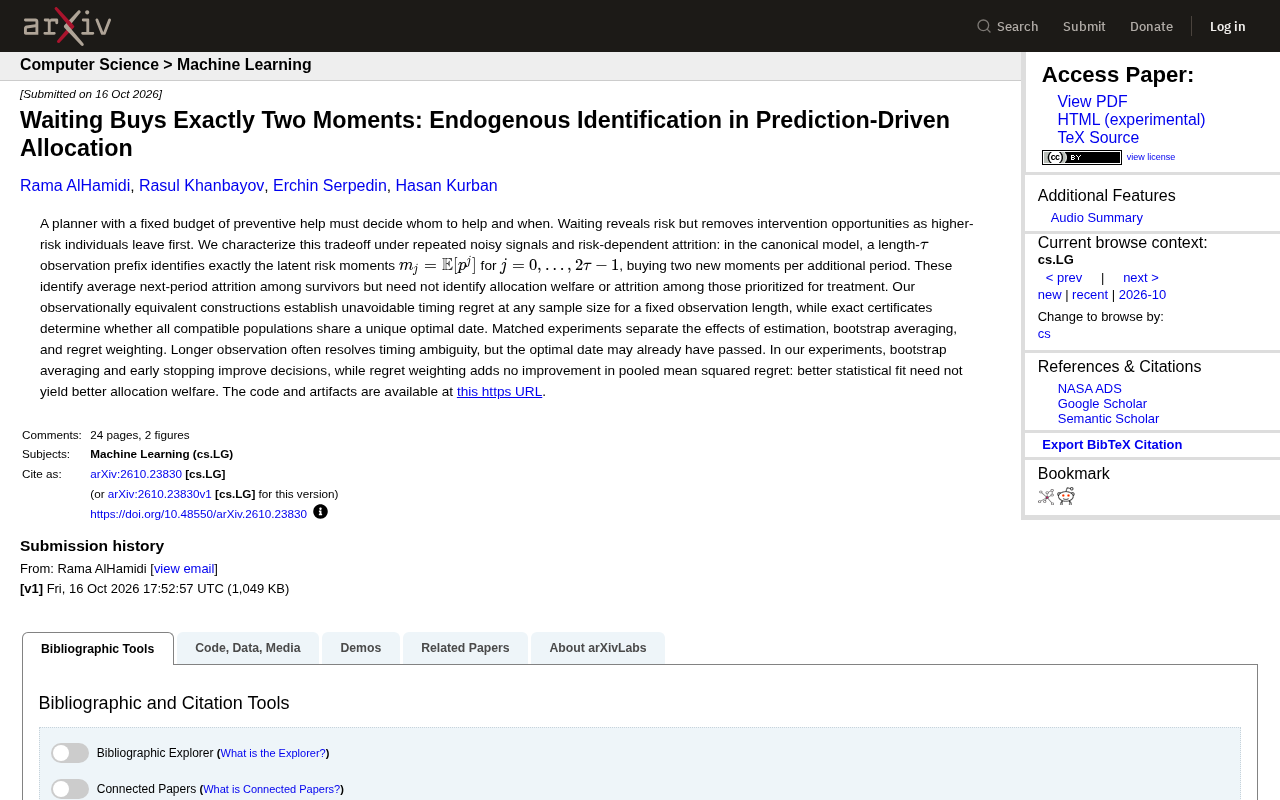
The paper's core setup is: a planner has a fixed budget for preventive assistance and must decide whom to help and when. Waiting can reveal individual risk signals, but high-risk individuals often "leave" first (churn, default, onset of illness), thereby removing intervention opportunities. This risk-dependent attrition makes the observed sample non-random, creating an endogeneity problem.
Key Finding: Each Additional Observation Period Reveals Two More Moments
Identification Results Under the Canonical Model
In the canonical model, if the observation length is τ periods, exactly the moments of the latent risk m_j = E[p^j] (j = 0, …, 2τ−1) can be identified. In other words, each additional observation period "buys" two new moments. This result is both elegant and powerful: it clarifies what the data can tell us and delineates what it cannot.
These moments suffice to identify the average attrition rate in the next period among survivors, but they do not necessarily identify allocation welfare or attrition among the priority intervention population. This means that even if attrition patterns are statistically identified, decision-makers may still be unable to determine which allocation strategy maximizes welfare.
Moments in probability theory and statistics are expected values that describe features of a random variable's distribution, such as the mean (first moment) and variance (second central moment). The moments ( m_j = E[p^j] ) in this paper are power expectations of the latent risk probability ( p ), encoding information about the risk distribution. Identifying the first ( 2\tau ) moments means certain functionals of the risk distribution can be recovered, but this is typically insufficient to uniquely determine the entire distribution—especially when the focus is on nonlinear functionals such as allocation welfare. This explains why moment identification does not directly equate to welfare identification.
Timing Regret Is Unavoidable
By constructing observationally equivalent populations, the paper proves that: under a fixed observation length, no matter how large the sample size, timing regret cannot be avoided. That is, there always exist scenarios fully compatible with the data but with截然 different optimal intervention dates. The authors further provide an exact certificate for determining whether all compatible populations share a unique optimal date.
Observationally equivalent refers to two different data-generating processes producing exactly the same distribution of observed data. In causal inference and structural econometrics, if two models are observationally equivalent, they cannot be distinguished from data alone. The observationally equivalent populations constructed in this paper imply the existence of scenarios fully compatible with the sample data but with截然 different optimal intervention dates, so no data-based decision rule can guarantee selecting the truly optimal timing—making timing regret unavoidable.
Better Statistical Fit Does Not Equal Better Allocation Welfare
Through matching experiments, the paper isolates the effects of three mechanisms: estimation, bootstrap averaging, and regret weighting. The experimental results are intriguing:
- Bootstrap averaging and early stopping improve decisions;
- Regret weighting brings no improvement in aggregate mean squared regret.
The authors therefore conclude: better statistical fit does not necessarily yield better allocation welfare. This conclusion carries a direct warning for practitioners—optimizing prediction accuracy and optimizing decision effectiveness are two distinct objectives and should not be conflated.
Another practical insight is: longer observation periods typically resolve timing ambiguity, but the optimal date may have already passed. This constitutes a fundamental temporal constraint: the value of information and the loss of opportunity are in a race.
Bootstrap averaging is a method for estimating parameter or decision uncertainty through resampling, often used to improve decision robustness: making decisions on multiple bootstrap samples and then averaging can reduce variance. Early stopping in this paper's context is not the regularization technique from machine learning, but rather a strategy of terminating the waiting period early in the observation sequence and making intervention decisions sooner. Regret weighting is a method of adjusting decision weights to focus on reducing regret, but experiments show it fails to improve aggregate mean squared regret.
Implications for Prediction-Driven Decision-Making
The value of this research lies in formalizing the often-overlooked dimension of "when to decide." In today's world where machine learning is widely used for resource allocation, most work focuses on "predicting who," while this paper reminds us: the observation window itself is a design variable that needs optimization. The code and artifacts are open-sourced on GitHub (KurbanIntelligenceLab/waiting-buys-two-moments), facilitating reproduction and extension.
For teams building prediction-driven allocation systems, the paper offers three actionable insights: first, clarify which moments your observation length can identify, and avoid overpromising on non-identifiable quantities; second, be cautious about the default strategy of "wait for more data before deciding," because waiting itself changes the sample composition; third, when evaluating decision strategies, use allocation welfare rather than prediction metrics as the ultimate yardstick.
Related articles

Workbuddy for Absolute Beginners: How a Desktop AI Agent Fits Into Real Workflows
A beginner's guide to the Workbuddy desktop AI agent: installation, claiming credits, file management, and building automated workflows—compared with CodeX for fit and cost, helping professionals shift from AI question-askers to AI managers.

OpenAI's New Agent Stack: Computer Use, Decisions API, and Ultra-Fast Workflows
OpenAI Dev Day unveiled a new agent stack: Computer Use outperforms humans, Decisions API delivers ultra-low-latency classification via Luna, Agents API opens the same Computer Use capabilities, and GPT-6.1 Sol costs only one-seventh of Astra. Core updates, benchmark data, and developer insights.

Liang Wenfeng Open-Sources DeepInfo Inference Framework, Takes On U.S. Ban
DeepSeek open-sources its DeepInfo inference framework after its models, featuring GPU/CPU cross-pipelining, small-model prediction with large-model verification, and full Huawei Ascend and NVIDIA chip support—facing the U.S. federal ban head-on. This article analyzes its significance for AI deployment and open-source strategy.