Walter Isaacson on Curiosity and Creativity in the Age of AI

Isaacson argues that the more powerful AI becomes, the more irreplaceable human curiosity, judgment, and cross-disciplinary thinking are.
The article distills biographer Walter Isaacson's key points from a Google conversation. Using da Vinci, Einstein, and Jobs as examples, he notes that great innovators share not just talent but curiosity, observation, and the ability to connect fields—traits even more valuable in the AI era. AI excels at pattern recognition and can generate options, but it cannot replace human judgment or ethical choice, and over-reliance can breed mental laziness. He urges treating AI as a dialogue partner rather than an answer machine, and shifting learning from memorizing facts to asking questions and thinking critically. The conversation offers no how-to guide but a clear signal: curiosity, judgment, and creativity are the prerequisites for mastering AI.
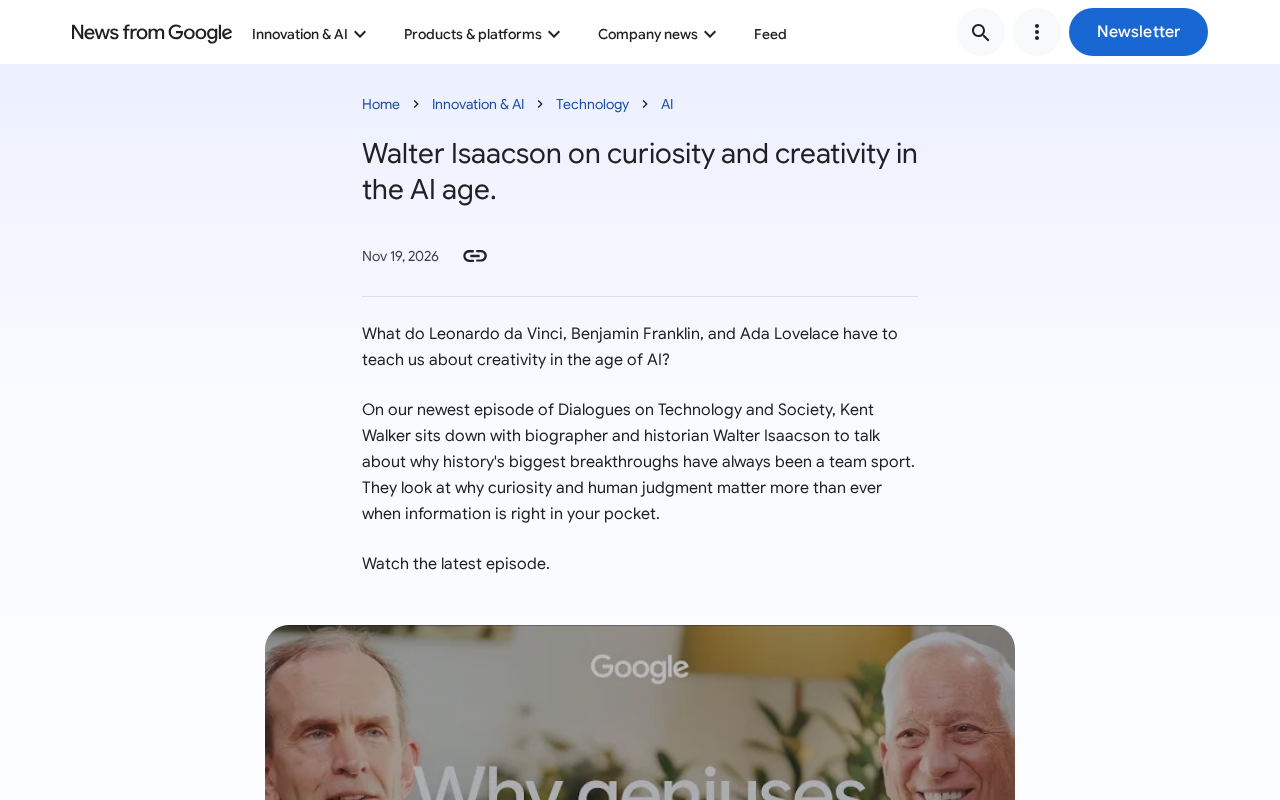
AI is reshaping how we get answers, but biographer Walter Isaacson reminds us that true innovation comes from distinctly human qualities: curiosity, judgment, and the ability to connect ideas across disciplines. In a conversation at Google, he draws on the experiences of history's great innovators to explore how humans should position themselves in the age of AI.
Common Traits of History's Great Innovators
Citing figures like Leonardo da Vinci, Einstein, and Steve Jobs, Isaacson points out that they were not simply geniuses but people with intense curiosity, keen observation, and the ability to connect different fields. These traits become even more valuable in the AI era, because machines can deliver answers quickly, but asking good questions and judging the value of those answers still requires humans.
He emphasizes that innovation often happens at the intersection of disciplines, and that AI can serve as a tool for expanding one's horizons, helping people explore the unknown faster—provided the user has the will to explore actively.
Leonardo da Vinci, Einstein, and Steve Jobs are often labeled "geniuses," but what Isaacson repeatedly stresses in his biographical research is their working methods—observable and imitable. Leonardo left behind extensive notebooks, recording anatomical observations, studies of water flow, and painting techniques side by side, habitually using analogy to build connections between different phenomena; Einstein's "thought experiments" were essentially imagined, deducible scenarios constructed when experimental conditions were unavailable; Jobs was known for "standing at the intersection of the humanities and technology," turning seemingly unrelated experiences—calligraphy classes, Zen meditation—into product aesthetics. What these traits share is that active observation precedes passive reception, along with the ability to transfer knowledge from unfamiliar fields to one's own problems. That is precisely why Isaacson argues these abilities are not a privilege of talent but a cognitive style that can be cultivated through habit—and why he brings up these cases again in the context of AI.
AI Is a Tool; Human Judgment Remains Central
Isaacson believes AI excels at pattern recognition and data processing but cannot replace human judgment and ethical choice. In creative work, AI can generate many options, but humans must decide which ones are meaningful and align with their values. This kind of judgment comes from experience, empathy, and accountability for consequences—something current AI struggles to replicate.
He warns that over-reliance on AI output can lead to mental laziness; truly creative users treat AI as a dialogue partner, not an answer machine.
Pattern recognition refers to the technical approach of extracting statistical regularities from large datasets and making predictions based on them. It defines the capability boundary of today's large language models: they are good at identifying "what is common in the corpus" but cannot directly judge "what is right in a specific context." This is the technical basis for Isaacson's distinction between "generation" and "judgment." Generative AI can produce large numbers of candidate solutions at low cost, but the meaning of those solutions, the ranking of values, and accountability for consequences rest with humans. This is especially true of ethical choices—they require an agent who can be held accountable and can weigh others' feelings, whereas models have neither responsibility capacity nor genuine intent. Understanding this distinction helps avoid two pitfalls: overestimating AI's "understanding" and dismissing its value in expanding options and exposing blind spots simply because it cannot judge.
Curiosity-Driven Learning
Given how easily AI makes knowledge accessible, Isaacson suggests shifting the focus of learning from memorizing facts to cultivating the ability to ask questions and think critically. He cites historical examples showing that many breakthroughs stem from persistently questioning common phenomena—a habit of inquiry that must be deliberately protected in education and personal growth.
For content creators and tech professionals, this means using AI to spark inspiration and test hypotheses rather than to replace independent thinking. Staying curious and actively exploring cross-disciplinary knowledge is how to remain competitive in the AI era.
Critical thinking in educational contexts generally refers to the ability to actively examine claims, evidence, and reasoning—including identifying assumptions, evaluating source reliability, and distinguishing correlation from causation. In the AI era, the object of this ability has shifted: it used to apply mainly to texts written by others, but now also to fluent answers generated by AI. Model outputs often sound confident and are well structured, yet may contain factual errors or fabricated citations, which makes "asking for the basis" more valuable than "memorizing conclusions." This echoes Isaacson's advice to shift the focus of learning toward asking questions. Specifically, the ability to ask questions involves two levels: turning vague confusion into testable questions, and asking "under what conditions would this answer not hold?" Both depend on sustained practice rather than the convenience of information access.
Takeaways from the Conversation
This conversation offers no specific how-to guide, but it sends a clear signal: the more powerful AI becomes, the more humans need to strengthen their distinctive cognitive abilities. Curiosity, judgment, and creativity are not substitutes for AI—they are the prerequisites for mastering it.
(Video content from Google's official interview program; screenshots from RSS sources.)
Related articles

Prompt Engineering for Beginners: From Writing Prompts to Engineering Thinking
Starting from the essence and four functions of prompts, this article systematically explains the six-step process, four success criteria, learning value, and practical limitations of prompt engineering to help you build a complete understanding.

Anthropic Launches Nasdaq IPO: AI Giant's Listing and Risk Disclosures
Anthropic officially launches its Nasdaq IPO under ticker ANT, with market valuation expected to potentially exceed SpaceX's record. The prospectus devotes nearly 100 pages to AI risks, while first-half revenue grew over 14x but net losses widened sharply, reigniting the AI bubble debate.

Rust cURL Clone Uses 4,832 unsafe Blocks—Is the Memory Safety Myth Broken?
A Rust cURL clone uses 4,832 unsafe keywords, challenging Rust's memory safety narrative. We analyze what unsafe really means, compare Fil-C, and examine rewrite motives.