Want a Large Model Development Role? These 6 Core Technologies Are What Actually Matter

Six core LLM technologies — RAG, Agent, Workflow, fine-tuning, distillation, and MoE — are what actually get you hired.
A Bilibili AI instructor analyzed real hiring data to identify what it takes to land a large model development role. His key insight: most popular LLM courses are consumer-facing tool tutorials (Ollama, Dify) that lack distributed support and don't meet enterprise needs. The six technologies that truly matter for job seekers are RAG development, Agent development, Workflow development (including dynamic routing), fine-tuning, distillation and quantization, and MoE architecture with from-scratch training. He advises candidates to scan actual JDs for high-frequency tech keywords and validate skills through complete projects.
If you're looking to break into large model development, the first question is usually: what exactly do I need to learn to land the job? A Bilibili AI instructor cut straight to the point by grounding his answer in real hiring market data — and his message is clear: stop wasting time on tool courses. What actually determines whether you get hired comes down to six core technologies.
LLM Job Openings Are Still Growing Fast
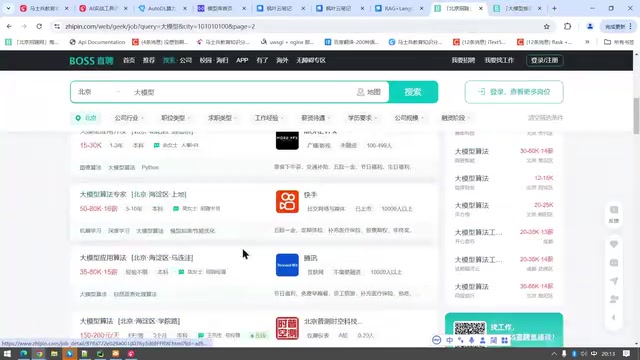
This instructor recommends going directly to platforms like BOSS Zhipin or Liepin and searching for the broad keyword "大模型" (large model), rather than narrower terms like "large model algorithm" or "large model development." The reason: any development or algorithm role involving large models will fall under the "large model related" category, and using a broader search term gives you full coverage.
Based on his tracking since the beginning of the year, these openings "increase almost every single week." Even more interesting is that the education bar isn't that high — a bachelor's degree satisfies the majority of postings, and bachelor's-level candidates account for over 50% of eligible applicants. He cited a specific Xiaomi job listing that explicitly required skills like VLM (Vision-Language Models), demonstrating that enterprise hiring requirements are concrete and learnable.
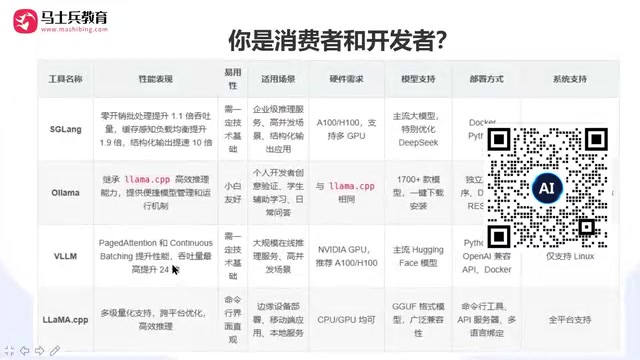
Consumer Perspective vs. Developer Perspective
The instructor started by debunking a common misconception: the massive volume of large model courses online essentially falls into two categories — consumer-facing and developer-facing — and they differ completely in difficulty and purpose.
Consumer-facing content typically requires no coding. You invoke large models by clicking buttons or dragging components, using tools like Ollama or Dify. These are very accessible for general users, but the instructor was clear: this is not what development roles are built on.
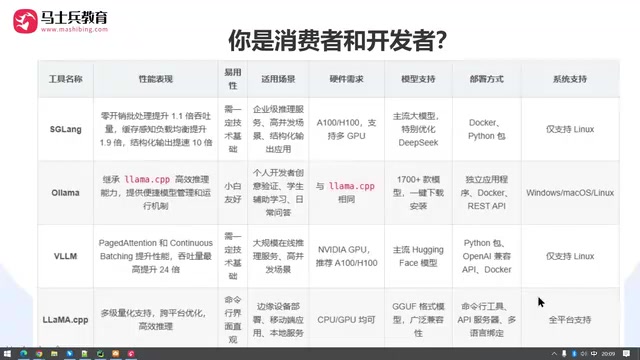
Developer-facing content is a different story entirely. It requires writing code and programming, with an emphasis on flexibility, high concurrency, distributed systems, performance, and customizability. These keywords mark the dividing line between enterprise-grade applications and casual hobbyist projects.
Why Enterprises Don't Use Quantized Models or Ollama
The instructor made a bold claim: enterprises will "absolutely never" use quantized versions of large models. His example: deploying a quantized DeepSeekAd via Ollama is fine for individual consumers, but it doesn't hold up in enterprise contexts — "I can run the full 70B DeepSeek and it'll outperform your quantized version."
On top of that, Ollama's biggest weakness is no distributed support, which is a critical limitation in enterprise high-concurrency, large-scale deployment scenarios. His recommendation: tool courses are fine "if you have spare time," but don't let them eat into your job search sprint.
The Six Core Technologies
Here's the list of six technical modules the instructor says you must master for a large model development role — the most valuable part of the whole discussion:
1. RAG Development
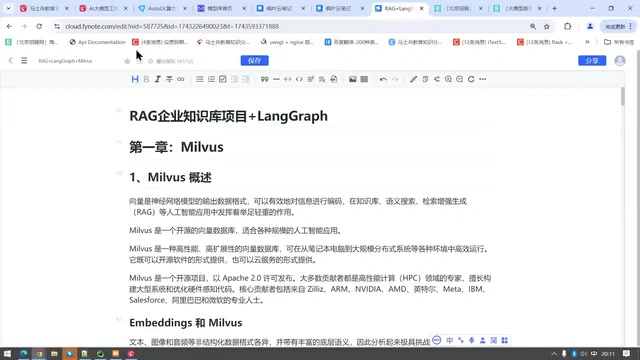
Retrieval-Augmented Generation is the dominant approach for enterprise-grade LLM applications. Everything involved in RAG development — from document chunking and vector retrieval to enterprise knowledge base construction — needs to be in your toolkit. He also prepared a Markdown document covering a RAG enterprise knowledge base project as companion material.
The core idea behind RAG (Retrieval-Augmented Generation) is to avoid relying solely on knowledge baked into model parameters. Instead, at inference time, relevant documents are first retrieved from an external knowledge base, then injected into the prompt so the model generates responses grounded in real information. This approach addresses the model's knowledge cutoff problem and significantly reduces hallucination risk.
In practice, a RAG pipeline typically includes: document preprocessing and chunking, converting text to vectors using an embedding model, writing vectors to a vector database (e.g., Milvus, Qdrant, Chroma), performing similarity search when a user asks a question, injecting the Top-K retrieved chunks into the prompt, and having the LLM generate the final answer. Each step involves significant engineering detail — how to chunk while preserving semantic integrity, how to implement hybrid retrieval (vector search + BM25 keyword search), and how to apply reranking to improve precision. This depth is exactly why RAG development can sustain an entire career direction on its own.
2. Agent Development
The instructor specifically noted that "Agent" is one of the most frequently appearing terms in real job descriptions. The tech stack required for agent development is a high-frequency exam topic in interviews.
An Agent refers to an LLM application paradigm capable of autonomous planning, tool invocation, and iterative execution based on feedback — distinct from single-turn Q&A or fixed pipelines. The classic Agent loop is the ReAct pattern: the model first Reasons (figures out what to do next), then Acts (calls a tool or API), observes the result, and continues reasoning until the goal is achieved.
On the development side, mainstream frameworks include LangChain's AgentExecutor, LangGraph (supporting stateful multi-step graph structures), and multi-agent collaboration frameworks like AutoGen and CrewAI. Common tool sets in enterprise Agent scenarios include: search engine calls, database queries, code execution sandboxes, and REST API calls. The core engineering skills for Agent development are: how to define Tools, how to design system prompts to constrain model behavior, and how to handle retry and fallback logic when tool calls fail.
3. Workflow Development
Workflows have one important and tricky concept called dynamic routing. The instructor specifically warned: dynamic routing in this context is "completely different" from the dynamic routing in traditional microservices development. As someone with a software engineering background himself, he emphasized not conflating the two.
4. Large Model Fine-Tuning
Fine-tuning models for specific business scenarios is the key capability for adapting general-purpose models to enterprise needs.
5. Distillation and Quantization
Model distillation and quantization are used to compress models and reduce deployment costs while preserving performance.
Knowledge Distillation involves using the outputs (soft labels or intermediate layer features) of a large "teacher model" to train a smaller "student model," allowing the student to retain much of the teacher's capability with far fewer parameters. A prime example is DeepSeek's R1 distillation series, where R1's reasoning data was used to fine-tune smaller models like Qwen and Llama, yielding versions that significantly outperform same-parameter-count baselines.
Quantization compresses model weights from FP32/BF16 precision down to INT8, INT4, or even lower bit-widths, reducing VRAM usage and inference latency. Common approaches include GPTQ (post-training quantization), AWQ (activation-aware weight quantization), and GGUF (the format used by llama.cpp). The instructor's claim that enterprises never use quantized models has some merit — in precision-sensitive scenarios with ample compute budgets, that holds true. But in edge deployment or cost-constrained environments, INT4/INT8 quantization remains mainstream. The two aren't actually contradictory.
6. MoE Architecture and Training from Scratch
Training a large model from the ground up involves architectures like MoE (Mixture of Experts). This is the highest-barrier module of the six.
MoE (Mixture of Experts) is a sparsely activated model architecture: the model consists of multiple "expert" sub-networks, and at inference time, a lightweight gating network (Router) dynamically selects a small subset of experts to participate in computation — rather than activating all parameters. This allows the model to maintain large overall capacity (total parameter count) while keeping actual compute (activated parameters) significantly lower than a dense model of comparable performance. GPT-4, Mixtral 8x7B, and DeepSeek-V2/V3 all use MoE architectures.
Engineering challenges in training from scratch include: data cleaning and mixing (tokenization, deduplication, quality filtering), distributed training frameworks (Megatron-LM, DeepSpeed, covering tensor parallelism, pipeline parallelism, and data parallelism), mixed-precision training (BF16 + gradient scaling), and training stability monitoring (loss spike handling, gradient clipping). The skill bar here is the highest of all six modules and typically appears in researcher roles at large tech companies or LLM startups. For entry-level developers, understanding the architectural principles is more realistic than being able to implement them independently.
Practical Advice for Job Seekers
Distilling the instructor's points into a clear path: first identify your target role type, then study core technologies mapped to actual JDs, and finally validate your abilities through complete projects. The full Ctrip AI Assistant project, RAG enterprise knowledge base, and LangGraph documentation he mentioned are all essentially hands-on exercises built around these six modules.
The most actionable move for anyone preparing for a large model development role: open a job platform, pull up a few JDs, and record the technical keywords you see. You'll find they cluster heavily around RAG, Agent, fine-tuning, and quantization. Tool-based content (Ollama, Dify) is worth knowing about, but it shouldn't be the center of your learning plan.
One caveat worth noting: this article reflects a single content creator's perspective. His claim that "enterprises absolutely never use quantized models" is somewhat absolute — in cost-sensitive real-world scenarios, quantized models still have genuine applications. Readers should weigh these recommendations against the specific requirements of the roles they're targeting.
Related articles

Chain of Thought Isn't Just for AI: How Humans Can Use CoT to Improve Thinking Quality
Chain of Thought isn't just a prompt trick for large models. Starting from a Hacker News discussion, this article analyzes why CoT works for human thinking too, breaks down actionable ways to transfer it, and highlights the key differences between human CoT and machine CoT.
Cloudflare Teams Up with OpenAI: Closi…
Cloudflare Teams Up with OpenAI: Closing the Loop from Vulnerability Discovery to Defense with AI
Cloudflare uses OpenAI Daybreak to investigate security vulnerabilities and generate reviewable remediation plans, while developers use Codex to boost coding efficiency and quality.

Orca Multi-Agent Orchestration in Practice: A Guide to Parallel Collaboration with Claude and Codex
Orca is Stable AI's free open-source agent workbench supporting 34 agents like Claude Code and Codex in parallel. Learn its Git worktree isolation, multi-model orchestration, and mobile management.