Want to Explain AI to Your Father? Here's a Reading List and Communication Strategy

Choosing AI introductory books for older generations: avoid technical details, balanced stance, friendly length, plus practical experience.
Starting from a Reddit user's request to find a book explaining AI to their father, the article analyzes why explaining AI to older generations is difficult: AI lacks everyday analogy anchors, and media narratives focus on job loss and loss of control. It proposes three book selection criteria—avoiding technical details, balanced author stance, and friendly length and language—and suggests three directions: popular science narrative, social impact, and visual introduction. It also notes AI publications update quickly, so on-site selection is more reliable. Finally, it emphasizes that books are just the starting point; using AI tools together and discussing specific concerns builds better intuition about AI's boundaries.
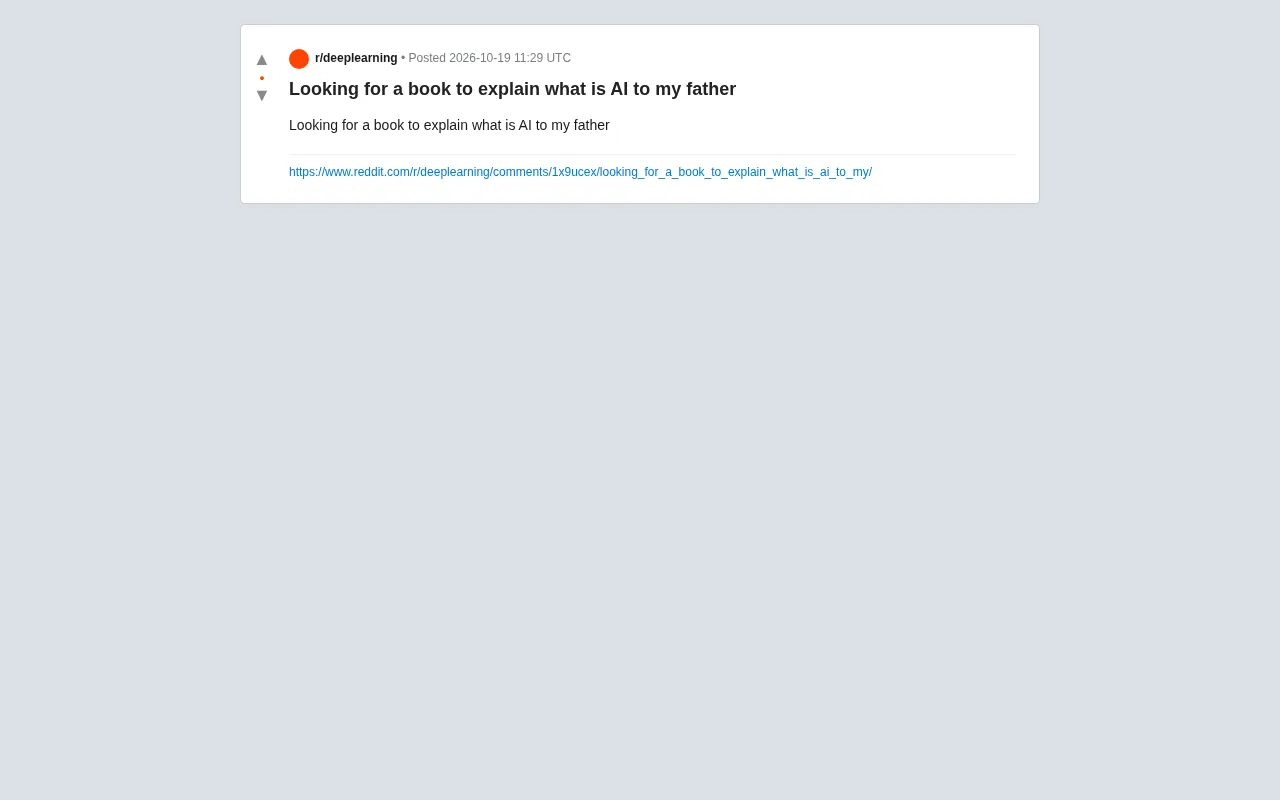
A Reddit user posted a request for help: "Looking for a book to explain to my father what AI is." This seemingly simple post strikes a chord with a common dilemma many of us face—we use AI tools every day, yet find it hard to explain what they actually are to our parents' generation.
Why "Explaining AI to Parents" Is So Hard
The difficulty isn't about parents' comprehension ability, but about the fact that the concept of AI itself lacks everyday anchors for analogy. Computers and the internet can still be explained with metaphors like "tools" or "information superhighway," but the behavior of large language models—generation, hallucination, probabilistic output—has almost no counterpart in the experiential world of older generations.
Another obstacle is media narrative. Most AI information parents encounter comes from sensational headlines: job loss, deepfakes, loss of control. Without a basic cognitive framework, these fragments easily assemble into a terrifying picture. Finding a suitable book is essentially giving your father a systematic entry point at a controllable pace.
"Hallucination" is a typical phenomenon of large language models: the model generates content that doesn't match facts in a fluent, confident tone. It isn't "lying," because the model itself has no intent—its output is probabilistic continuation based on statistical patterns in training data. When training data is sparse, questions are too specific, or they involve the latest information, it may piece together answers that seem plausible but are actually wrong. Understanding this is especially important for older generations—it explains why AI appears both knowledgeable and capable of basic errors, and shows that its output cannot be trusted without verification. Compared to traditional software tools, this "makes mistakes without knowing it" characteristic lacks everyday analogy, which is precisely the core concept that most needs to be clarified—and is most easily overlooked—when explaining AI to parents.
Three Practical Criteria for Choosing Books
Facing the vast sea of AI books on the market, there are several easily overlooked points when choosing books for older generations.
First, avoid technical details. There's no need to explain Transformer architecture or backpropagation—what's needed is an intuitive picture of "how it works, what it can do, what it can't do." Textbook-style reading with大量 formulas and charts is almost destined to sit on the shelf.
Second, the author's stance should be balanced. Neither pure optimist advocacy nor doomsday-style warnings are suitable as an introduction. An ideal book should clarify capability boundaries while also discussing social impact, allowing readers to form their own judgment.
Third, length and language should be friendly. Books under two hundred pages, with strong narrative and rich examples, have far higher completion rates than systematic tomes. For many older readers, the sense of achievement from "finishing a book" is more important than reading deeply.
Transformer architecture is the foundational technical structure of current mainstream large language models (such as the GPT series). Its core is the "attention mechanism," which allows the model to weigh the degree of association between different words in a sentence when processing text, thereby understanding context. Backpropagation is the algorithm for adjusting parameters when training neural networks: the model propagates errors back layer by layer based on the gap between output and correct answers, correcting weights, and gradually "learns" the task after repeated iterations. These concepts are the technical foundation for understanding AI principles, but involve mathematical knowledge such as matrix operations and gradients, which presents a high barrier for readers without technical backgrounds. Therefore, when choosing books for older generations, this content should only be mentioned as background rather than becoming the main reading thread; focusing energy on the intuitive level of "what it can do, what it can't do" yields much higher comprehension efficiency.
Book Directions Worth Considering
Although the original post didn't provide a specific recommendation list, based on common discussions of such needs, you can choose along three routes.
Popular science narrative route. These books connect AI's development through characters and stories, reading like tech history. Suitable for fathers who enjoy biographies and documentaries, allowing basic concepts to be established through relaxed reading.
Social impact route. Focusing on AI's impact on employment, education, and ethics, discussing "what this means" rather than "how this is achieved." If your father cares about current events and enjoys news commentary, these books are more likely to spark his interest.
Visual introduction route. Using大量 diagrams and analogies, breaking down concepts like machine learning and neural networks into visualizable processes. Most friendly to readers with no technical background, and also suitable as parent-child reading material.
One reminder: publications in the AI field update extremely quickly, and specific book titles easily become outdated. A more reliable approach is to take the above criteria to a bookstore or library and flip through them on site, checking whether the table of contents structure and writing tone feel right.
Beyond Books: Communication Strategy Matters Equally
Books are just the starting point. An experience that repeatedly appears in similar Reddit discussions is: rather than handing over a book, using an AI tool together with your father once often has a more direct effect.
Let him personally input a question, see how the answer is generated, then deliberately ask a question it gets wrong—this experiential cognition builds the intuition of "it's powerful but also makes mistakes" better than any textual explanation. Books can handle building the framework; actual use handles filling in the flesh.
Additionally, older generations' questions often focus on very specific points: Will I be scammed? Will children become dependent on it? Will my job be replaced? Rather than trying to cover the entire field at once, it's better to expand on the issues he cares about one by one. The value of a good introductory book lies in providing a common reference frame you can return to repeatedly.
Frequently Asked Questions
For older generations with no technical background, how thick should the first book be? It's recommended to keep it under two hundred pages, prioritizing popular science reading with strong narrative and many examples. Finish one book before considering advanced ones.
Which is more suitable, paper books or e-books? For older generations not accustomed to e-reading, paper books have higher completion rates and are convenient for annotations and repeated browsing.
What if they still don't understand after finishing the book? Return to actual experience. Choose a low-risk daily scenario (such as asking AI to help write a greeting message), and understanding tool attributes through specific tasks is easier to internalize than abstract concepts.
One-line Summary
Choosing AI introductory books for older generations: avoid technical details, balanced stance, friendly length, combined with practical experience.
Paragraph Summary
The article starts from a Reddit user's request "looking for a book to explain to my father what AI is," analyzing why explaining AI to older generations is difficult: AI lacks everyday analogy anchors, and media narratives mostly focus on job loss and loss of control. It proposes three criteria for choosing books—avoiding technical details, balanced author stance, and friendly length and language. The article further provides three book directions: popular science narrative, social impact, and visual introduction, and reminds that AI publications update quickly, so on-site selection by criteria is more reliable than buying from a list. Finally, it emphasizes that books are just the starting point—using an AI tool together with older generations and discussing specific issues they care about builds intuition about AI's capability boundaries better than simply handing over a book.
Related articles

The Truth About AI Coding: Code Output Soars, So Why Is Delivery Still Hard to Speed Up?
Engineering leaders from Databricks, Uber, and Google Maps discuss AI coding's real impact: code output soars but delivery bottlenecks shift, code review faces rethinking, and enterprises begin fine-grained token governance.

A New Paradigm for Text Editing in Compose: TextFieldState Replaces the Old API
Jetpack Compose introduces the TextFieldState API to fix dropped characters and cursor jumps from async input. The old value/onValueChange callbacks will be deprecated in 1.13. This article covers InputTransformation, OutputTransformation, four state hoisting patterns, and new formatted text editing capabilities.

Remote Compose: A New Document-Driven Paradigm for Cross-Platform UI on Android
Remote Compose transmits compact binary documents instead of screen pixels, enabling efficient UI rendering on remote surfaces like Wear OS and widgets. This article covers its document creation API, expression animations, size optimization techniques, and Wear OS progress.