Was Modern Art a CIA Psychological Warfare Tool? The Truth Behind Cold War Cultural Rivalry

Examining CIA's alleged role in promoting Abstract Expressionism and its parallels to modern AI-era information manipulation.
This article explores the long-debated question of whether the CIA covertly promoted Abstract Expressionism during the Cold War as a cultural weapon against Soviet ideology. Drawing on historical evidence including the Congress for Cultural Freedom and Frances Stonor Saunders' research, it examines competing interpretations before connecting Cold War cultural manipulation to modern concerns about algorithmic filter bubbles and AI-driven influence operations.
A Long-Standing Question
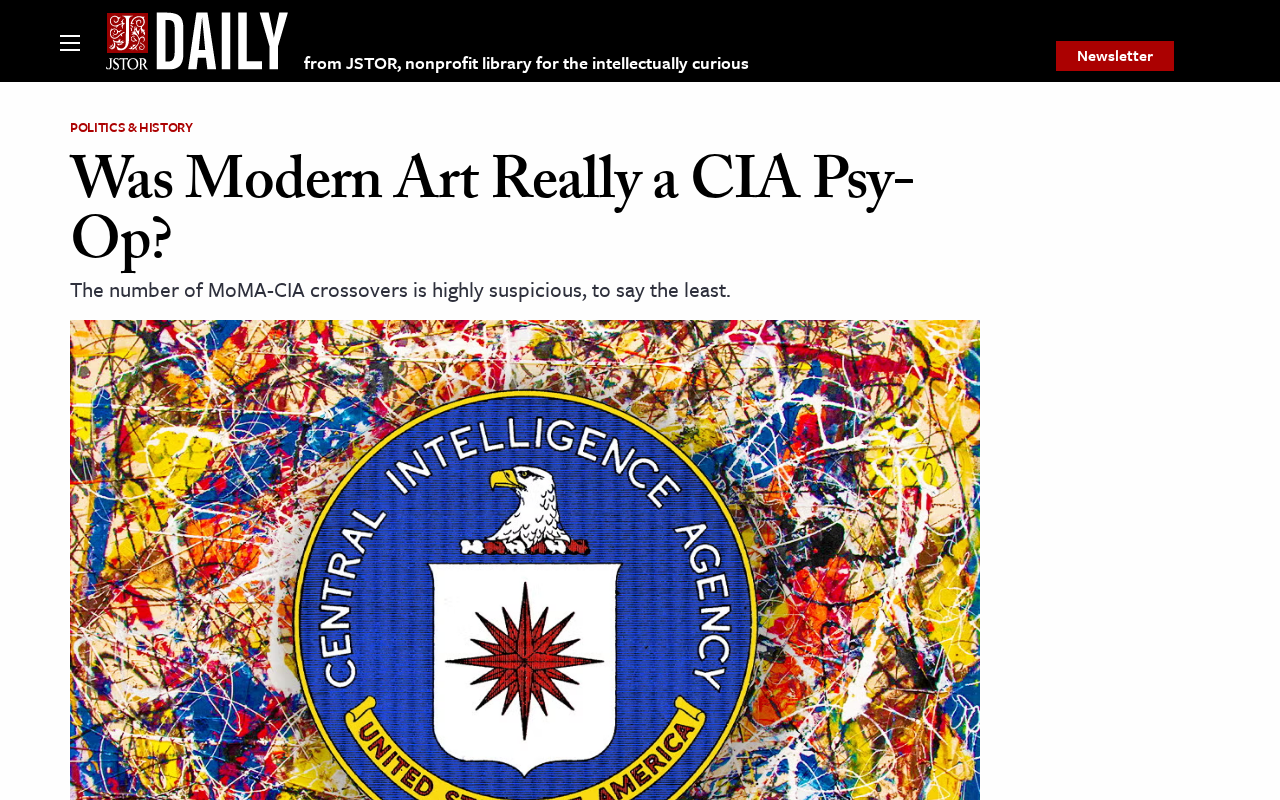
During the Cold War, Abstract Expressionism rose rapidly in the American art world. Artists like Jackson Pollock and Mark Rothko became icons of Western modern art. Yet a question that has long lingered at the intersection of art history and intelligence history persists: Was the spread of this art movement secretly promoted by the CIA?
A Hacker News discussion titled "Was Modern Art a CIA Psy-Op?" reignited this topic. While it's primarily a cultural and historical exploration, it offers valuable insights for understanding information dissemination, cultural influence, and even opinion-shaping in the modern AI era.
Historical Background: Cultural Rivalry Under the Cold War
The Soft Power Battle of Ideologies
After World War II, the confrontation between the American and Soviet blocs extended beyond military and economic domains into the cultural sphere. The Soviet Union championed "Socialist Realism," which emphasized art in service of political propaganda—realistic imagery with clear themes. Socialist Realism was officially established in 1934 as the only legitimate method of artistic creation in the Soviet Union. It demanded that artworks depict heroic images of workers, peasants, and soldiers in a realistic style, celebrating the great achievements of socialist construction. Any artistic exploration that deviated from this standard could be labeled "formalism" or "decadent art" and subjected to criticism. This high degree of artistic control conveniently provided the United States with a contrast target—if abstract art's free experimentation could be juxtaposed sharply against Soviet artistic control, it could convey the message that "freedom is superior to totalitarianism" without direct propaganda.
By contrast, the United States needed a cultural symbol that could demonstrate "freedom" and "individual expression" to counter this unified official aesthetic. Abstract Expressionism fit this need perfectly—it emphasized individualism, spontaneity, and uninhibited creative freedom, and was shaped into the visual embodiment of the "free world" spirit.
Abstract Expressionism was born in 1940s New York and was the first internationally significant art movement led by American artists. Pollock was famous for his signature "drip painting" technique—he would lay canvases on the ground and fling paint onto them with sticks and stiff brushes, creating images full of dynamism and chance. Rothko took the opposite approach, known for his enormous color field paintings that created a deep meditative atmosphere through layers of semi-transparent color blocks. These two represented the two major branches of Abstract Expressionism: Action Painting and Color Field Painting. This contrast itself constituted a powerful ideological narrative.
Historical Evidence and Documentation of CIA Involvement
Claims of CIA involvement are not unfounded. In 1995, British journalist Frances Stonor Saunders of The Independent published investigative reports revealing that the CIA had indirectly funded exhibitions, journals, and art promotion activities through front organizations like the Congress for Cultural Freedom. Her later book The Cultural Cold War systematically documented this history.
The Congress for Cultural Freedom was established in 1950, headquartered in Paris, ostensibly as an international cultural exchange organization spontaneously organized by intellectuals. It had branches in 35 countries, published over 20 journals (including Britain's Encounter and America's The Paris Review), and organized hundreds of international conferences and art exhibitions. It wasn't until 1967, when Ramparts magazine exposed its CIA funding background, that the organization's true nature became publicly known. Its operational model was classic CIA: funds were transferred through seemingly independent foundations (such as the Farfield Foundation) in multiple layers, and actual participants—including many sincere intellectuals—were often completely unaware of the funding sources.
According to these sources, the CIA employed the "arm's length principle"—funding through intermediary organizations like foundations so that artists and curators were often completely unaware of the true source of funding. This term originally comes from the public arts funding domain, referring to governments providing funding without interfering in specific artistic decisions to ensure creative freedom. The CIA cleverly co-opted this framework, transforming it into a covert operational strategy: by passing funds through multiple layers of intermediary organizations, sufficient "distance" was maintained between the ultimate beneficiaries and the political source of funding. The brilliance of this method was that it didn't require directly instructing artists what to create—it only needed to tilt resource allocation: determining which exhibitions received funding, which magazines got published, and which artists were given international touring opportunities—to systematically shape the cultural landscape. This covert funding approach made cultural manipulation much harder to detect and trace.
"Psychological Warfare" or "Riding the Wave"? Two Interpretations Collide
View One: The CIA Was Leveraging, Not Creating
In the Hacker News comments, one camp argues that characterizing modern art as a "CIA Psy-Op" is an exaggeration. Art movements have their own internal developmental logic and aesthetic evolution. The rise of Abstract Expressionism was a natural result of the New York art scene's organic growth, and CIA involvement was more about "leveraging" than "creating." In other words, the intelligence agency merely identified and amplified an already existing cultural phenomenon.
View Two: Systematic Promotion Constitutes Opinion Manipulation
The other camp emphasizes that even if the art movement was spontaneous, organized and purposeful funding and international exhibition tours constitute a form of opinion manipulation. When a government agency systematically promotes the global dissemination of certain cultural products, its motives and effects already transcend the realm of pure artistic appreciation.
The Truth Likely Lies in the Middle
Taking a balanced view, the more prudent conclusion is this: the birth of Abstract Expressionism was a product of art history's internal evolution, but its internationalization and establishment of dominant status were indeed deeply influenced by Cold War cultural politics. The CIA's role was more that of a "catalyst" and "amplifier" rather than a "creator."
Implications for Today: From the Cultural Cold War to Information Manipulation in the AI Era
Hidden Forces in Cultural Dissemination
The reason this historical topic sparked discussion in the tech community is largely because it touches on an eternal proposition: the spread of culture and information is never entirely neutral. Behind it often lie the driving forces of capital, power, and ideology—and these forces are frequently hidden.
In today's digital age, these mechanisms continue in more complex forms. Social media recommendation algorithms, platform content distribution strategies, and even the scaled dissemination of AI-generated content are all shaping public cognition and aesthetic preferences in ways we can barely perceive. Modern social media platform recommendation algorithms are typically based on collaborative filtering and deep learning models that predict and push content users are most likely to engage with by analyzing behavioral data such as clicks, dwell time, likes, and shares. While this mechanism improves user experience, it also produces a "filter bubble" effect—users are continuously exposed to information consistent with their existing views, and cognitive diversity gradually narrows. Compared to the CIA's Cold War approach of "selectively amplifying" specific cultural products through foundations, algorithmic recommendation systems represent a quantum leap in both scale and precision: they can customize information environments for each individual, and the entire process is almost completely automated and opaque.
Concerns About "New-Type Psychological Warfare" in the AI Era
If the Cold War era required foundations and exhibitions to spread specific cultural narratives, then in today's era of widespread generative AI, the cost of manufacturing and disseminating specific viewpoints has dropped dramatically. Large language models can generate text in bulk, image generation models can customize visual symbols, and social bots can amplify specific voices.
Generative AI technology—particularly large language models (LLMs) represented by the GPT series and image generation models represented by Stable Diffusion and Midjourney—has driven the marginal cost of content production toward zero. An organized actor can now generate thousands of stylistically diverse but ideologically consistent articles within hours, create hundreds of seemingly independent social media accounts, and coordinate dissemination using automation tools. A 2023 joint study by Stanford University and Georgetown University noted that AI-driven influence operations have shifted from theoretical risks to real-world threats. Intelligence agencies and non-state actors worldwide are exploring the possibilities of using AI for large-scale opinion shaping, making the relatively clumsy cultural manipulation techniques of the Cold War era seem primitive and inefficient.
This gives the historical question of "Was modern art psychological warfare?" a new real-world reflection at the technological level—as the barriers to information production and dissemination continue to fall, how to identify the driving forces behind them and maintain independent judgment becomes a challenge every information consumer must face.
Conclusion: Cultivating Critical Thinking Matters More Than Answers
Regardless of whether modern art was truly a carefully designed psychological warfare operation, this discussion itself reminds us that cultural phenomena often have complex political and economic motivations behind them. The value of history lies not in providing black-and-white answers, but in cultivating our critical thinking about information sources and dissemination motives.
In an era where algorithms and AI dominate information flow, this kind of critical thinking is perhaps more important than ever.
Related articles

Cursor Can Now Control Your Computer: AI Agents Can Drive Desktop Apps for Testing
Cursor adds desktop control: AI agents can drive desktop apps like the iOS Simulator to test their own features. We analyze the impact on dev workflows, possible technical approaches, and reliability concerns.

Vibecoding a Custom Inference Engine: High Hopes, Harsh Reality
A Reddit developer shares the real experience of vibecoding a custom inference engine: running GGUF Q4 models in the browser with WebGL2 and GLSL, only to fall into tokenizer debugging hell. This article analyzes the engineering challenges of browser-side LLM inference and why cloning llama.cpp is the more rational choice.

How High Are Anthropic's Early Investor Paper Returns Ahead of IPO?
Anthropic's early investor paper returns draw attention ahead of IPO. This article analyzes sources of book gains, capital structure, pre-IPO games and risks, and implications for the AI startup ecosystem.