Wavefunction: A Minimalist Open-Source Coding Agent for Mac
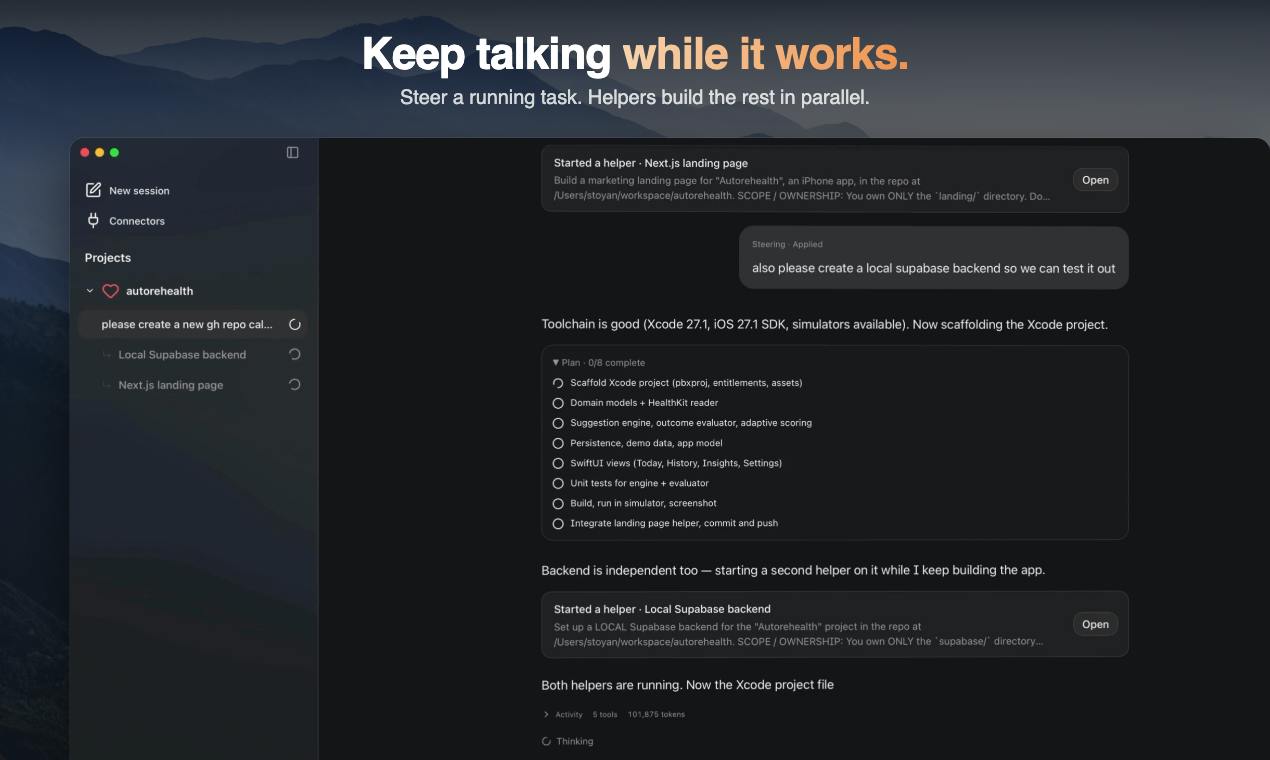
Wavefunction is a minimalist open-source coding agent for Mac, supporting parallel tasks, multiple models, and an independent desktop.
Wavefunction is a minimalist open-source coding agent built specifically for Mac, countering the "super app" trend in coding agents. Its core design allows the agent to run multiple tasks in parallel while keeping conversations uninterrupted, separating conversation flow from task execution. Model integration is flexible, supporting reuse of ChatGPT subscriptions, Anthropic, Google, OpenRouter, or local models. Computer use runs on an isolated desktop rather than the user's main desktop, reducing the risk of mistakes. Developed by Stoyan Stoyanov, it's completely free and open source, suitable for Mac developers who value controllability and are willing to configure it themselves. However, with only 2 Product Hunt comments, community feedback is limited, and actual stability and compatibility remain to be verified.
Why We Need a Minimalist Coding Agent
Coding agent tools are becoming increasingly bloated, gradually evolving into "super apps." Wavefunction goes the opposite direction, releasing a minimalist open-source coding agent built specifically for Mac on Product Hunt. It doesn't aim for breadth and completeness, but instead focuses on keeping developers focused and in flow when using AI-assisted coding. According to its Product Hunt page, the project received 71 upvotes, ranking 14th for the day, with categories covering open source, developer tools, artificial intelligence, and GitHub.
Core Design: Parallel Tasks and Uninterrupted Conversation
Wavefunction's most prominent feature is allowing users to continue conversing while the agent executes multiple tasks. Most coding agents lock the interface while running, or turn the chat window into a pile of task logs. Wavefunction separates the conversation flow from task execution, so you can continue making new requests or asking follow-up questions during a running task without waiting for it to finish.
This interaction model feels more natural for developers who need to switch lines of thought frequently: the agent handles code modifications, file operations, or retrieval tasks in the background while you retain control of the conversation.
Separation of "Conversation Flow" and "Task Execution" in Coding Agents
In most AI coding tools, the chat interface serves two roles simultaneously: receiving user instructions and displaying the agent's real-time execution logs (such as reading files, running commands, and generating patches). This coupling means that while the agent executes a task, users cannot insert new messages—they can only wait or force an interruption. Wavefunction's design decouples the conversation flow (the interaction channel between user and agent) from task execution (background code modifications, file operations, etc.), similar to the separation of "foreground interaction" and "background jobs" in an operating system. Users can continue asking questions or adjusting requirements while a task runs, and the agent will queue or process new messages in parallel without locking the interface. This model is friendlier for developers who need to switch lines of thought frequently and advance multiple small tasks simultaneously, but it also requires the agent to have task scheduling and context management mechanisms—otherwise, inconsistencies between conversation and task state may arise.
Multi-Model Support and Subscription Reuse
On model integration, Wavefunction doesn't bind to a single provider. It supports using a ChatGPT subscription, Anthropic, Google, OpenRouter, and can also connect to local models. This means users who already have a ChatGPT subscription can directly reuse their existing quota without purchasing additional API keys; users sensitive to data privacy can choose local models, keeping code off their machine from leaving.
Multi-model availability also brings flexibility: different tasks can use models with stronger reasoning capabilities or lower costs as needed, especially suitable for switching between prototype exploration and formal refactoring scenarios.
The Difference Between ChatGPT Subscriptions and API Keys
Many users easily confuse ChatGPT subscriptions (such as Plus, Pro) with OpenAI API keys. Subscriptions are for end users, providing conversation quota within the web/client; API keys are billed by token for developers integrating into third-party tools. Typically, third-party coding agents require users to purchase separate API keys to call models. Wavefunction claims to support reusing ChatGPT subscriptions, meaning it may use some authorization mechanism (such as OAuth login or proxy forwarding) to let users directly use subscription quota without extra payment. This lowers the barrier to entry, but actual availability depends on OpenAI's terms and technical implementation—some subscription plans do not allow direct calls from third-party tools. For providers like Anthropic and Google, Wavefunction also offers integration options, and users need to configure the corresponding API keys or subscription credentials themselves.
Independent Computer Use Environment
Wavefunction's computer use feature runs on its own desktop, not yours. This is quite critical in coding agents. When the agent executes shell commands, opens applications, or operates files, if done directly in your work environment, the risk of mistakes and interference is hard to avoid. Isolating the agent's desktop not only protects your main workspace but also makes the agent's behavior easier to observe and terminate.
For scenarios requiring the agent to perform multi-step system operations, the independent desktop acts as a safety boundary. You can continue working on your own desktop while letting the agent complete tasks in a side environment.
Computer Use and Desktop Isolation
Computer use refers to an AI agent's ability to directly operate graphical interfaces (clicking, typing, opening applications) or execute system commands, not just generate text. In coding scenarios, the agent may need to run shell commands, start local servers, operate file managers or debugging tools. If these operations happen directly on the user's main desktop, there's a high risk of accidentally deleting files, closing applications, or pop-up windows interfering with work. Wavefunction restricts computer use to run in an independent desktop environment (possibly a virtual desktop, container, or separate user session), effectively carving out a sandbox for the agent. Users can continue working on the main desktop while observing the agent's behavior in the side environment and terminating tasks at any time. This isolation also facilitates auditing the agent's operation records, aligning with the open-source tool's pursuit of controllability.
Open Source and Positioning
Wavefunction is developed by Stoyan Stoyanov and is completely free and open source. In the current context where coding agents are generally moving toward commercialization and feature stacking, its positioning is clear: it doesn't aim to be an all-purpose assistant, but a lightweight, auditable coding tool. Open source means users can inspect the agent's behavior logic, modify it themselves, or self-host—directly appealing to developers who value controllability.
However, it's worth noting that the Product Hunt page has only 2 comments, and public discussion is still very limited. Actual stability, agent execution accuracy, and compatibility with different models currently lack sufficient community feedback.
Auditability and Self-Hosting of Open-Source Coding Agents
Open source means the source code is public, and users can inspect the agent's decision logic, data flows, and permission scope without relying on vendor privacy statements. For tools like coding agents that need to access codebases and execute commands, auditability is especially important—developers can confirm that the agent won't upload code to unauthorized servers or perform dangerous operations. Self-hosting allows users to deploy the agent on their own machines or private servers, fully controlling the runtime environment. Wavefunction is completely free and open source, lowering usage costs, but it also means project maintenance depends on individual developers or small teams, with uncertainty around long-term updates, security patches, and community support. With only 2 Product Hunt comments, public discussion is limited, and actual stability and compatibility still need more user validation.
Who Should Try It
If you already use a Mac for daily development and want a lightweight tool that doesn't interrupt your flow, supports multiple models, and isolates agent operations from your main desktop, Wavefunction is worth checking out. It's better suited for developers willing to configure models themselves and who value open-source controllability, rather than users expecting an out-of-the-box all-in-one suite.
Amid the trend of coding agents increasingly becoming "super apps," Wavefunction offers an opposite path: make one thing small, make it thorough, and return control to developers.
One-line Summary
Wavefunction is a minimalist open-source coding agent for Mac, supporting parallel tasks, multiple models, and an independent desktop.
Paragraph Summary
Wavefunction is a minimalist open-source coding agent built specifically for Mac, going against the current trend of coding agents becoming "super apps." Its core design allows the agent to execute multiple tasks in parallel while keeping conversations uninterrupted, separating conversation flow from task execution. Model integration is flexible, supporting reuse of ChatGPT subscriptions, as well as Anthropic, Google, OpenRouter, or local models. The computer use feature runs on an independent desktop rather than the user's main desktop, reducing the risk of mistakes. Developed by Stoyan Stoyanov, the project is completely free and open source, suitable for Mac developers who value controllability and are willing to configure it themselves. However, with only 2 Product Hunt comments, community feedback is limited, and actual stability and compatibility remain to be verified.
Related articles

Skykea Showdown: A Hilarious Variety Show Experience of a Minecraft Airship Building Competition
Skykea Showdown is a Minecraft airship building racing variety show. This article analyzes its two-phase build + hole race format, airship mod lift physics, secret mission design, and team confrontation dynamics—ideal for game content creators.

Did the US Midterms Vote No to AI Data Centers? A Map Reveals the Truth
After the US midterms, media claimed voters rejected AI data centers, but a map shows restrictive votes are concentrated in a few Ohio townships, affecting less than 1% of US towns—the national anti-AI wave is exaggerated.

ApexW Optimizer Benchmark: Matches 8-bit AdamW in Unsloth with Lower Memory Usage
Developer shares benchmark of ApexW optimizer in Unsloth: ApexW 8bit has lower optimizer state memory (47.101 MB) and slightly better final loss than 8-bit AdamW, but similar speed. Needs independent reproduction.