WavePrune: Using Just One Rotation Period of RoPE Actually Improves Long-Context Performance

WavePrune limits RoPE to one rotation period per channel, eliminating position aliasing and improving long-context performance without fine-tuning.
WavePrune is an improvement to Rotary Position Embedding (RoPE) built on a key finding: RoPE's periodic rotation structure causes "position aliasing" — position pairs separated by integer rotation periods become indistinguishable in attention, introducing noise. WavePrune restricts each frequency channel's attention range to its first rotation period, structurally eliminating this aliasing. The method is plug-and-play with no retraining needed; on the HELMET long-context benchmark, four of five tested models improve, with Qwen3-8B gaining 4.3 points. Pretraining from scratch also yields better length extrapolation. Additionally, the channel-level sliding windows introduce fine-grained sparsity that, paired with custom CUDA kernels, delivers ~1.15× prefill and 1.24× decoding speedups over FlashAttention-2 at 32K context. The work challenges the assumption that RoPE's full periodic structure is essential, offering a fresh perspective on positional encoding design.
RoPE's Periodicity Problem Revisited
Rotary Position Embedding (RoPE) is the dominant approach for handling positional information in today's large language models. Its core idea is to rotate each two-dimensional channel of the query and key vectors at specific frequencies, making attention scores invariant to absolute position shifts. This elegant design addresses relative position modeling and has been widely regarded as indispensable.
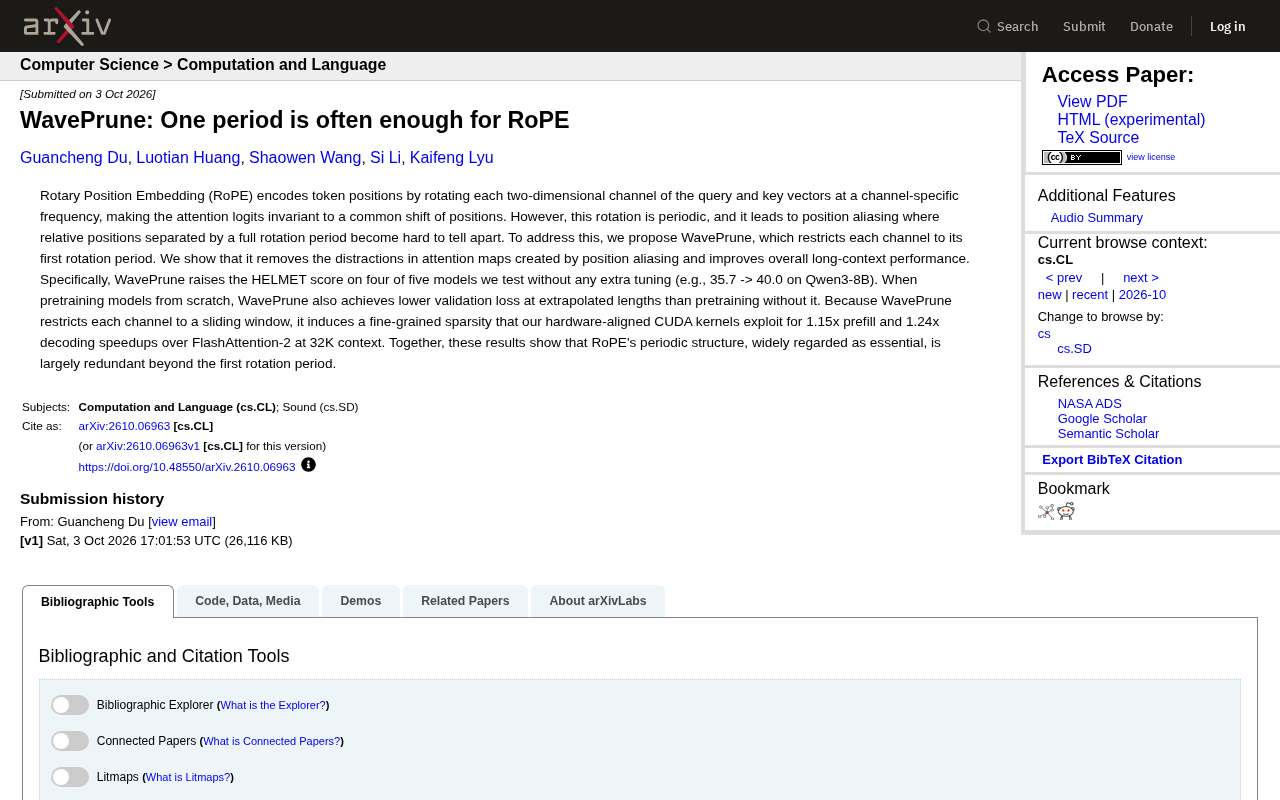
But a new arXiv paper titled WavePrune: One period is often enough for RoPE raises a thought-provoking point: RoPE's rotations are periodic, and this introduces a largely overlooked side effect — position aliasing. When two relative positions differ by exactly one full rotation period, they become nearly indistinguishable after rotation, introducing noise into the attention map.
In other words, the very periodicity that makes RoPE elegant may be redundant — or even harmful — beyond the first rotation period.
RoPE was originally proposed by Su et al. in 2021. Mathematically, it encodes positional information as rotation operations in the complex domain. Specifically, for a query vector at position $m$, each two-dimensional channel $(q_{2i}, q_{2i+1})$ is multiplied by the rotation matrix $\begin{pmatrix}\cos(m\theta_i) & -\sin(m\theta_i)\ \sin(m\theta_i) & \cos(m\theta_i)\end{pmatrix}$, where $\theta_i = 10000^{-2i/d}$ is a frequency parameter tied to the dimension. When queries and keys are dot-producted, the absolute positions cancel out, leaving only the relative position $(m-n)$ — the key reason RoPE can model relative positions. Different channels use different frequencies: low-index channels rotate fast (high frequency) while high-index channels rotate slowly (low frequency), forming a multi-scale structure analogous to Fourier analysis. This mechanism is widely adopted by LLaMA, Qwen, Mistral, and other mainstream models, and has spawned length extrapolation variants like YaRN and LongRoPE. It is the de facto standard for positional encoding in current LLM architectures.
WavePrune's Core Idea: Pruning Away Extra Periods
The method proposed in the paper, WavePrune, is conceptually straightforward: restrict each channel to its first rotation period.
The reasoning is that since position aliasing occurs beyond one full period, why not simply retain only the information within that first period? High-frequency channels have short rotation periods and thus can only cover nearby relative positions, while low-frequency channels have long periods and can cover greater distances. By assigning each channel an effective window matching its period length, WavePrune essentially gives different frequency channels different "visibility ranges."
The immediate effect is that aliasing-induced noise in attention maps is eliminated, improving the model's overall ability to understand long contexts.
Performance Gains Without Any Fine-Tuning
The experimental results presented in the paper are compelling. On the HELMET long-context benchmark, WavePrune improves scores on four out of five tested models — with zero additional tuning required. A notable example is Qwen3-8B, whose HELMET score rises from 35.7 to 40.0, a substantial improvement.
This plug-and-play characteristic means existing models can apply WavePrune directly at inference time without retraining, making it highly practical.
Position aliasing is a concept borrowed from signal processing. In sampling theory, if the sampling rate is insufficient, signals at different frequencies overlap and become indistinguishable — a phenomenon called aliasing. The analogous problem in RoPE is: if a channel has rotation period $T$, then two position pairs with relative distances $d$ and $d+T$ produce identical rotation angles, making them indistinguishable in terms of attention scores. For high-frequency channels (short periods), this issue arises at relatively short distances; for low-frequency channels (long periods), it only emerges in very long sequences. WavePrune's key insight is that rather than expecting the model to learn during training to ignore this periodic ambiguity, it is better to structurally prevent attention computations beyond one period, eliminating aliasing noise at its source.
Benefits Extend to Pretraining from Scratch
Beyond enhancing existing models, the paper also validates WavePrune in from-scratch pretraining scenarios. Models pretrained with WavePrune achieve lower validation loss at extrapolated lengths compared to baseline models trained without it.
Length extrapolation has long been a challenge in long-context modeling — models perform well within their training length but often degrade quickly on longer sequences. By constraining each channel's effective range, WavePrune appears to alleviate this problem, enabling more stable performance beyond the training length.
Length extrapolation refers to a model's ability to process text exceeding its maximum training sequence length. While the Transformer's attention mechanism imposes no hard limit on sequence length, performance in practice often drops sharply beyond training length. This stems from two main causes: positional encoding values unseen during training create out-of-distribution inputs, and attention weights for very long distances are never effectively learned. Methods like ALiBi, YaRN, and dynamic NTK scaling have been proposed to improve extrapolation by modifying positional encoding frequencies or decay patterns. WavePrune approaches this from a different angle — by eliminating periodic redundancy within each channel, it makes each channel's effective range more clearly defined, reducing ambiguity when processing extra-long sequences. This perspective forms an interesting complement to existing extrapolation methods.
A Hardware Acceleration Bonus
An interesting byproduct is inference speedup. Since WavePrune restricts each channel to a sliding window, it naturally introduces fine-grained sparsity — each channel only needs to attend to positions within its window, and computations outside that window can be skipped entirely.
The paper's authors designed hardware-aligned CUDA kernels to exploit this sparse structure. At a context length of 32K tokens, WavePrune achieves 1.15× prefill speedup and 1.24× decoding speedup compared to FlashAttention-2.
This means WavePrune not only improves model quality but also reduces inference cost — a concrete benefit as long-context inference becomes increasingly common.
FlashAttention-2 is currently the most widely used attention acceleration scheme in industry, proposed by Tri Dao et al. It tiles the attention matrix computation and exploits GPU SRAM to reduce HBM memory reads and writes, significantly reducing memory usage and improving throughput without changing the computation result. It is an efficient implementation of dense attention that is already highly optimized for global attention patterns. The fine-grained sparsity introduced by WavePrune offers further optimization opportunities that FlashAttention-2 cannot exploit — because different channels have different (and relatively small) effective window sizes, a large fraction of attention position-pair computations can be skipped entirely, unlike sparse attention methods that skip entire rows or columns at fixed strides. This non-uniform, channel-level sparsity structure requires purpose-built CUDA kernels to fully leverage, which is precisely where the paper's additional engineering contribution lies.
Rethinking the Design Philosophy of RoPE
Perhaps the most valuable contribution of this paper is not the specific performance numbers, but the challenge it poses to a widely accepted assumption. RoPE's periodic structure has long been regarded as the essence of its design. Yet WavePrune's experiments suggest that this periodicity is largely redundant beyond the first rotation period.
This opens a new perspective for positional encoding research: rather than pursuing ever more complex positional modeling mechanisms, perhaps we should focus on removing interference from existing ones. For researchers and engineers focused on long-context capabilities and inference efficiency, WavePrune offers a direction worth exploring.
It should be noted that this article is based on the paper's abstract. Specific implementation details, ablation studies, and generalization across a broader range of models will require consulting the full paper and subsequent community validation.
Related articles

Chain of Thought Isn't Just for AI: How Humans Can Use CoT to Improve Thinking Quality
Chain of Thought isn't just a prompt trick for large models. Starting from a Hacker News discussion, this article analyzes why CoT works for human thinking too, breaks down actionable ways to transfer it, and highlights the key differences between human CoT and machine CoT.
Cloudflare Teams Up with OpenAI: Closi…
Cloudflare Teams Up with OpenAI: Closing the Loop from Vulnerability Discovery to Defense with AI
Cloudflare uses OpenAI Daybreak to investigate security vulnerabilities and generate reviewable remediation plans, while developers use Codex to boost coding efficiency and quality.

Orca Multi-Agent Orchestration in Practice: A Guide to Parallel Collaboration with Claude and Codex
Orca is Stable AI's free open-source agent workbench supporting 34 agents like Claude Code and Codex in parallel. Learn its Git worktree isolation, multi-model orchestration, and mobile management.