Waymo CEO Explains: The Fundamental Limitations of Tesla's Vision-Only Autonomous Driving Approach

Waymo CEO details why Tesla's camera-only approach has fundamental safety and perception limitations.
Waymo's CEO publicly explained why Tesla's vision-only autonomous driving approach faces fundamental limitations, citing cameras' physical perception boundaries, lack of sensor redundancy for safety-critical operations, and the narrowing cost gap as LiDAR prices plummet. The debate reflects a deeper philosophical clash between data-driven AI scalability and engineering redundancy for deterministic safety in the race toward fully autonomous vehicles.
The Autonomous Driving Route Debate Resurfaces
In the development of autonomous driving technology, the industry has long been divided between two fundamentally different technical approaches: one is the "vision-only" approach championed by Tesla, which relies solely on cameras for environmental perception; the other is the "multi-sensor fusion" approach represented by Waymo, which simultaneously uses cameras, LiDAR (Light Detection And Ranging), and millimeter-wave radar. Recently, Waymo's CEO publicly explained why Tesla's vision-only autonomous driving approach has fundamental limitations, reigniting this heated industry debate.
This is not merely a disagreement over technical preferences between two companies—it concerns the underlying logic of autonomous driving safety and the critical choices about how millions of vehicles will truly achieve driverless operation in the future.
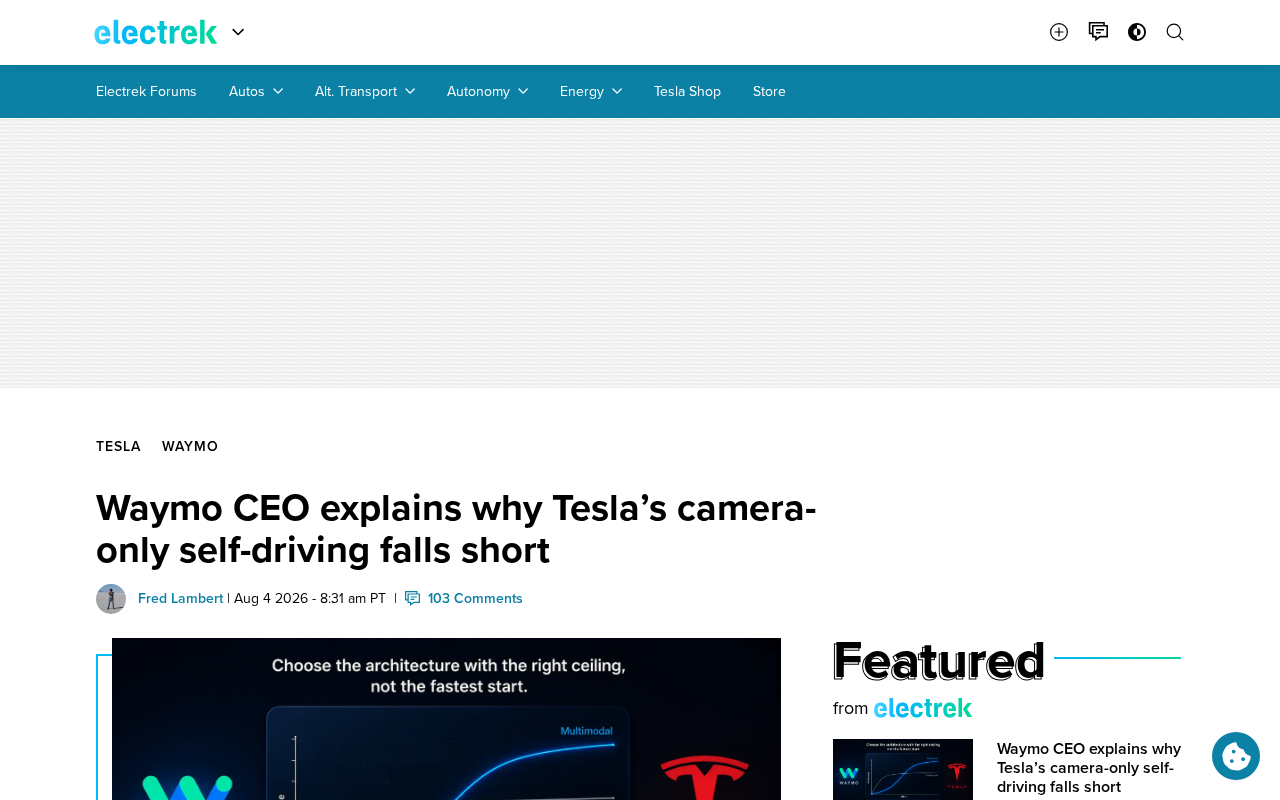
Where Are the Core Limitations of the Vision-Only Approach?
The Physical Perception Boundaries of Cameras
The Waymo CEO's core argument is this: cameras are fundamentally passive perception devices whose performance is highly dependent on lighting conditions and image quality. Cameras work similarly to the human eye, relying on visible light reflected from the environment to capture image information, which means they cannot function independently in environments lacking light sources. In conditions such as strong backlighting, nighttime, heavy rain, dense fog, or snow, camera perception capability degrades significantly. Human drivers also encounter visual impairments in these scenarios—and this is precisely where autonomous driving systems need to surpass humans, not replicate their limitations.
More critically, cameras have inherent disadvantages in measuring distance and speed. In computer vision, recovering three-dimensional spatial information from two-dimensional images (i.e., depth estimation) is a classic ill-posed problem, because the mapping from 2D to 3D inherently has infinitely many possible solutions. Current mainstream depth estimation methods include monocular depth estimation (using neural networks to infer depth from a single image) and binocular stereo vision (calculating distance using disparity between two cameras), but these methods exhibit significantly increased errors at long range, on textureless surfaces, and in dynamic lighting conditions. By contrast, LiDAR (Light Detection And Ranging) actively emits laser pulses and measures the return time to directly obtain distance information, with ranging accuracy typically at the centimeter or even millimeter level. It is unaffected by lighting conditions, can operate normally in complete darkness, and provides precise 3D point cloud data.
The Absence of Sensor Redundancy for Safety
Waymo's approach emphasizes "sensor redundancy"—when one type of sensor fails or is limited, other sensors can provide supplementary information and verification. This design philosophy originates from mature practices in aviation safety: critical systems must have multiple layers of redundancy to ensure safe operation even during single-point failures.
Specifically, the aviation industry has employed Triple Modular Redundancy (TMR) design for decades, where the same function is executed in parallel by three independent systems, with majority voting determining the final output. For example, the Boeing 787's flight control computers use three independent channels, each developed with different hardware architectures and software teams to avoid common-mode failure. The core principle of this design philosophy is: different types of sensors have different failure modes, and the probability of all failing simultaneously is far lower than the probability of any single sensor failing. In the autonomous driving context, cameras may fail due to lighting issues, LiDAR may be interfered with by water droplet scattering in heavy rain, and millimeter-wave radar may have weak recognition of static objects—but the probability of all three completely failing in the same scenario simultaneously is extremely low.
Tesla's vision-only approach bets all perception tasks on cameras as a single modality. Once cameras fail due to malfunction, occlusion, or environmental factors, the system lacks other independent perception means for cross-validation, which constitutes a significant safety risk when pursuing L4/L5 fully autonomous driving. Here it's worth explaining that autonomous driving levels are defined by SAE International, ranging from L0 to L5: L0 is fully manual driving; L1 and L2 are driver assistance where the driver must maintain supervision at all times; L3 is conditional automation where the system can fully take over under specific conditions but the driver must be ready to intervene; L4 is high automation where the system can drive completely independently within a defined Operational Design Domain (ODD); and L5 is full automation that can replace humans under any conditions. Waymo's current driverless robotaxi service operates at L4, while Tesla's FSD is still classified as an L2 driver assistance system under regulatory frameworks.
How to Balance Cost and Safety
Tesla's Business Logic for Choosing Vision-Only
It should be objectively noted that Tesla's choice of the vision-only approach is not without merit. LiDAR was historically expensive, often costing thousands or even tens of thousands of dollars, making it difficult to deploy at scale in consumer-facing production vehicles. Musk has publicly stated multiple times that LiDAR is "foolish," arguing that since humans can drive using only vision, AI should ultimately be able to do so as well.
Behind this logic lies a massive data advantage: Tesla's fleet of vehicles on the road constitutes an enormous real-world driving data collection network. Through "Shadow Mode" and end-to-end neural network training, the system can theoretically continuously approach and even surpass human visual driving capability. "Shadow Mode" refers to the FSD system running silently in the background, comparing its decisions against the human driver's actual operations to identify system shortcomings and collect edge case data for training. End-to-End neural networks encapsulate the entire processing pipeline—from raw sensor input to final control output (such as steering angle, acceleration/braking commands)—in a unified deep learning model, replacing the traditional autonomous driving architecture where perception, prediction, planning, and control modules are separated. Tesla began large-scale deployment of its FSD V12 version in late 2023, making it the industry's first mass-deployed end-to-end autonomous driving system. Its core advantage lies in avoiding information loss and error accumulation between modules, allowing the neural network to learn the optimal mapping from pixels to driving behavior on its own. As of 2024, Tesla has over several million vehicles on the road continuously collecting data, creating a data flywheel advantage that competitors find extremely difficult to replicate.
Waymo's Commitment to Safety-First Principles
Waymo's perspective is more conservative and cautious. As a company already providing fully driverless robotaxi services in cities like Phoenix and San Francisco, Waymo emphasizes the ability to withstand extreme scenario testing in real commercial operations. When vehicles have no safety driver whatsoever, any perception error could lead to irreversible consequences, making multiple redundancy a non-negotiable baseline.
With LiDAR costs dropping dramatically in recent years, the cost argument that once supported the vision-only approach is gradually weakening. The cost evolution of LiDAR represents one of the most important techno-economic trends in the autonomous driving industry. During the 2007 DARPA Urban Challenge era, Velodyne's 64-line mechanical spinning LiDAR cost $75,000; by around 2020, similar products had dropped to the $4,000-$8,000 range. In recent years, solid-state and semi-solid-state LiDAR manufacturers such as Hesai Technology, RoboSense, and Innovusion have leveraged new technology approaches including MEMS micro-mirrors, Flash arrays, and FMCW (Frequency Modulated Continuous Wave) to push automotive-grade LiDAR prices to the $200-$500 range, with some entry-level products approaching $100. In 2024, LiDAR-equipped passenger vehicle shipments in the Chinese market alone exceeded one million units. This price level means LiDAR is no longer exclusive to robotaxis but could potentially enter mainstream consumer vehicles, making Waymo's multi-sensor approach more economically compelling.
Divergent Views in the Technical Community
In Hacker News discussions, the technical community shows clear divisions on this topic. Those supporting Waymo's position argue that from a safety engineering perspective, redundancy is an indisputably correct choice, especially in scenarios involving passenger safety.
Another camp points out that humans do indeed primarily rely on vision to drive, and the vision-only approach is theoretically feasible—the issue lies in current AI maturity rather than the sensors themselves. Some comments also note that the two companies are actually targeting different scenarios—Waymo focuses on geofenced robotaxi operations, while Tesla pursues universal autonomous driving usable on any road, which dictates their different technical trade-offs.
It's worth understanding the fundamental difference between these two models. Geofenced operation means autonomous vehicles only provide service within pre-defined and thoroughly mapped specific geographic areas. Before deploying a new service area, Waymo uses dedicated survey vehicles to collect centimeter-precision 3D HD maps of the area, recording road geometry, lane markings, traffic signal positions, curb heights, and other detailed information. These HD maps provide powerful prior knowledge for the autonomous driving system, enabling vehicles to compare real-time sensor data against known map information, dramatically reducing perception and localization uncertainty. However, this model's expansion speed is constrained by mapping costs and cycles—currently Waymo only operates in a few cities including Phoenix, San Francisco, and Los Angeles. Tesla's pursuit of universal autonomous driving does not rely on HD maps and aims to let vehicles drive autonomously on any road. While this vastly improves scalability, it also means the system must rely entirely on real-time perception to understand the environment, placing far more demanding requirements on perception capabilities.
A Technical Route Choice Without a Standard Answer
The route debate between Tesla and Waymo is fundamentally a collision between two philosophies: "data-driven general intelligence" versus "engineering redundancy for deterministic safety." The former bets that continuous leaps in AI capability will ultimately break through perception bottlenecks; the latter bets on ensuring infallibility through physical sensor complementarity.
From the current state of commercialization, Waymo has already achieved truly driverless operation, validating its technical approach; meanwhile, Tesla, leveraging its scale and data advantages, is rapidly iterating its FSD system. Which route will first achieve large-scale, low-cost, highly safe fully autonomous driving remains to be proven by time and the market. What is certain is that this debate about "how vehicles should see the world" will continue to influence the direction of the entire autonomous driving industry.
Related articles

Workbuddy for Absolute Beginners: How a Desktop AI Agent Fits Into Real Workflows
A beginner's guide to the Workbuddy desktop AI agent: installation, claiming credits, file management, and building automated workflows—compared with CodeX for fit and cost, helping professionals shift from AI question-askers to AI managers.

OpenAI's New Agent Stack: Computer Use, Decisions API, and Ultra-Fast Workflows
OpenAI Dev Day unveiled a new agent stack: Computer Use outperforms humans, Decisions API delivers ultra-low-latency classification via Luna, Agents API opens the same Computer Use capabilities, and GPT-6.1 Sol costs only one-seventh of Astra. Core updates, benchmark data, and developer insights.

Liang Wenfeng Open-Sources DeepInfo Inference Framework, Takes On U.S. Ban
DeepSeek open-sources its DeepInfo inference framework after its models, featuring GPU/CPU cross-pipelining, small-model prediction with large-model verification, and full Huawei Ascend and NVIDIA chip support—facing the U.S. federal ban head-on. This article analyzes its significance for AI deployment and open-source strategy.