Waymo Robotaxis Expand into Canada, Road Testing Begins in Toronto

Waymo expands Robotaxi testing to Toronto, its first market outside the U.S.
Waymo announced it will begin autonomous vehicle testing in Toronto, Canada—its first Robotaxi operation outside the U.S. The initial phase focuses on testing rather than commercial services, continuing its U.S. strategy of testing before commercialization. Toronto's complex winter conditions offer extreme environment validation, while climate adaptability, regulatory approval, and localization pose key challenges.
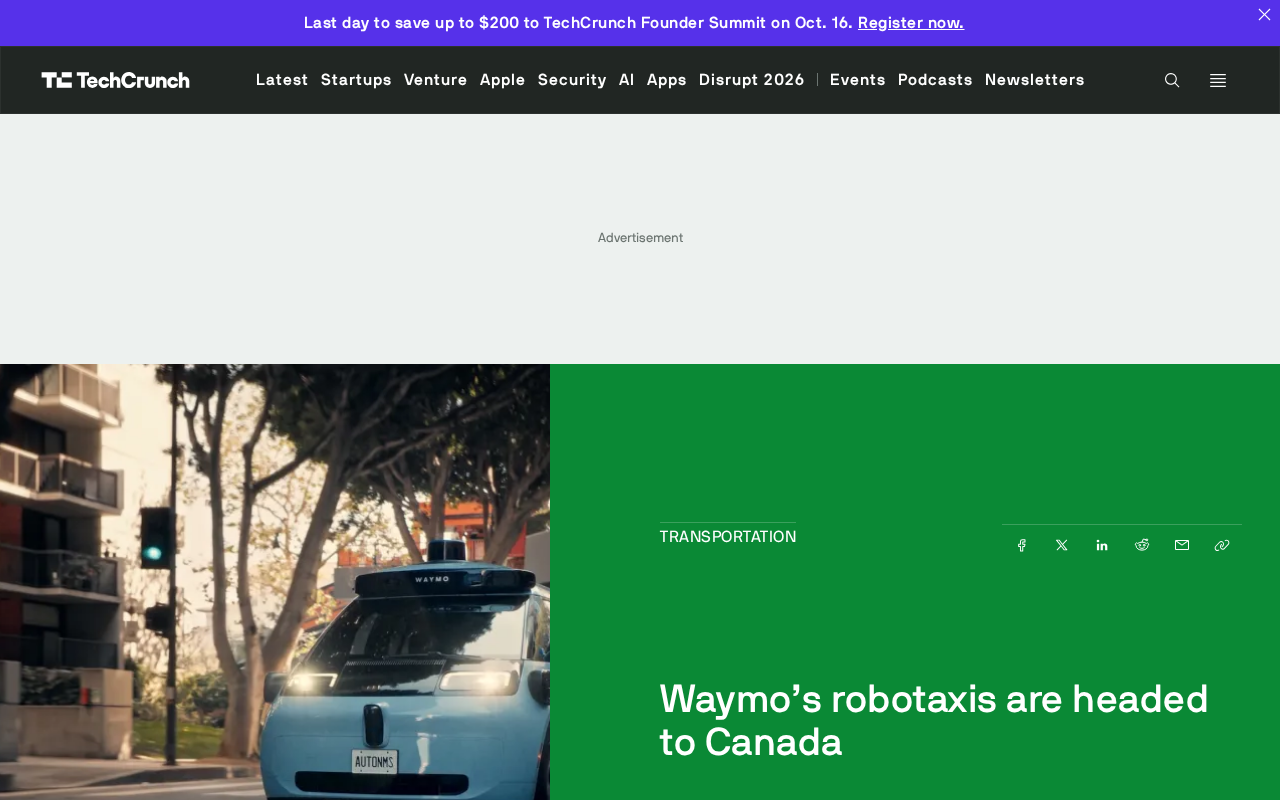
Waymo, the leader in autonomous driving, is expanding its Robotaxi business beyond the United States. According to recent reports, the company plans to begin testing autonomous vehicles in Toronto, Canada, marking Waymo's first entry into a market outside its home country.
Why Toronto?
Waymo's choice of Toronto as its first stop for international expansion is no coincidence. Toronto is not only Canada's largest city but also one of North America's key technology innovation hubs. Its complex urban road environment—including harsh winter weather, dense downtown traffic, and diverse road infrastructure—provides highly challenging testing scenarios for autonomous driving systems.
For Waymo, if its autonomous driving system can operate reliably in Toronto's winter conditions, it would serve as strong proof of its technical robustness. This kind of validation experience under extreme conditions holds significant reference value for future expansion into cities with diverse climate conditions.
Ontario's Autonomous Vehicle Regulatory Framework: Ontario has permitted autonomous vehicle road testing under specified conditions since 2016, and in 2021 introduced a draft Autonomous Vehicle Act, gradually refining its testing permit and safety reporting systems. Unlike the fragmented state-by-state approach in the U.S., Canada's federal level establishes the Motor Vehicle Safety Act through Transport Canada, while provincial governments handle operating permits. This dual-layer regulatory structure means Waymo must simultaneously satisfy federal safety standards and Ontario's specific testing requirements, resulting in higher compliance costs.
Starting Phase: Testing First
According to information released by Waymo, the company will focus initially on testing its autonomous vehicles on Toronto streets, rather than immediately offering commercial Robotaxi services to the public.
This "test first, commercialize later" approach is consistent with Waymo's established practice in the U.S. market. Previously in cities like San Francisco, Phoenix, and Los Angeles, Waymo went through extended testing periods, gradually opening services to the public only after accumulating sufficient driving data and validating safety.
The core objectives of the testing phase include:
- Validating the autonomous driving system's performance in Canadian road environments
- Collecting localized high-definition maps and driving data
- Assessing the impact of winter climate on sensors and systems
- Establishing communication and compliance frameworks with local regulators
Strategic Significance of International Expansion
Waymo's entry into the Canadian market reflects the autonomous driving industry's shift from single-market validation to larger-scale commercial deployment.
From a competitive standpoint, Tesla's FSD (Full Self-Driving) feature has already been tested and promoted in multiple countries, while Waymo, as a leading company in L4 autonomous driving technology, has taken a relatively cautious approach to internationalization. This move into Canada can be seen as a signal that Waymo is accelerating expansion under commercialization pressure.
One detail worth noting: cross-border operations mean Waymo must navigate different national and regional regulatory systems. Canadian provinces have varying regulatory policies on autonomous driving, and Ontario (the province where Toronto is located) has been relatively proactive in autonomous driving legislation in recent years, providing a more favorable policy environment for Waymo's testing.
L4 autonomous driving refers to vehicles that can fully complete all driving tasks within a specific Operational Design Domain (ODD) without requiring human driver takeover, but are typically restricted to pre-mapped urban roads or specific areas. Unlike the L2+ assisted driving represented by Tesla's FSD, L4 systems place liability on the automaker, resulting in more stringent requirements for safety validation and regulatory approval. Waymo is one of the few companies globally to have achieved commercial L4 Robotaxi operations, and its expansion pace is often constrained by local regulations and technical validation progress.
Challenges Ahead
Despite the promising outlook, Waymo's expansion in Canada still faces multiple challenges:
Climate adaptability. Toronto's winter temperatures can drop below minus 20 degrees Celsius, and heavy snow and icy roads can severely impact the perception capabilities of LiDAR and cameras. Waymo needs to demonstrate that its system can operate safely under extreme conditions with snow-covered roads and invisible lane markings.
Regulatory approval. Although Ontario is open to autonomous driving, fully driverless commercial operations still require approval at both the provincial and federal levels. This process may be more complex than in some U.S. states.
Localization adaptation. Subtle differences exist between Canada and the U.S. in traffic signs, road design, and driving habits. Waymo's autonomous driving system needs to complete localized adaptation and validation.
The perception limitations of LiDAR and cameras in winter environments deserve further explanation. LiDAR measures distance by emitting laser beams, but heavy snow, thick fog, and icy road surfaces can cause beam scattering or abnormal reflections, producing noise or even rendering the sensor ineffective; cameras are susceptible to having their lenses blocked by snow accumulation and lane markings being obscured. To address these situations, autonomous driving systems typically need to fuse data from multiple sensors such as millimeter-wave radar and inertial measurement units, and rely on HD maps for positioning. Waymo's testing in Toronto will focus on validating the robustness of this multi-sensor fusion approach under extreme weather conditions.
Impact on the Industry
Waymo's Canadian expansion plan sends a positive signal to the entire autonomous driving industry. It demonstrates that a leading company has confidence in its technological maturity and is willing to invest resources in testing and deployment in overseas markets.
If Waymo's testing in Toronto progresses smoothly, more autonomous driving companies are expected to follow suit, driving further integration of autonomous driving regulations and service networks across North America. For ordinary consumers, this means the day when they can experience Robotaxi services in more cities is one step closer.
One-line Summary
Waymo tests Robotaxis outside the U.S. for the first time, choosing Toronto to validate autonomous driving technology in extreme climates.
Paragraph Summary
Waymo announced it will begin autonomous vehicle testing in Toronto, Canada—its first Robotaxi operation outside the U.S. The initial phase focuses on testing rather than commercial services, continuing its U.S. strategy of testing before commercialization. Toronto's complex winter road conditions and dense traffic provide extreme environment validation opportunities, but also bring challenges in climate adaptability, regulatory approval, and localization. This move is seen as a signal of Waymo's accelerated international expansion under commercialization pressure, and if testing succeeds, it could prompt more autonomous driving companies to follow, promoting North American regulatory and service network integration.
Related articles

Chain of Thought Isn't Just for AI: How Humans Can Use CoT to Improve Thinking Quality
Chain of Thought isn't just a prompt trick for large models. Starting from a Hacker News discussion, this article analyzes why CoT works for human thinking too, breaks down actionable ways to transfer it, and highlights the key differences between human CoT and machine CoT.
Cloudflare Teams Up with OpenAI: Closi…
Cloudflare Teams Up with OpenAI: Closing the Loop from Vulnerability Discovery to Defense with AI
Cloudflare uses OpenAI Daybreak to investigate security vulnerabilities and generate reviewable remediation plans, while developers use Codex to boost coding efficiency and quality.

Orca Multi-Agent Orchestration in Practice: A Guide to Parallel Collaboration with Claude and Codex
Orca is Stable AI's free open-source agent workbench supporting 34 agents like Claude Code and Codex in parallel. Learn its Git worktree isolation, multi-model orchestration, and mobile management.