Waymo's New Growth Strategy: Opening Robotaxi Service to Teenagers

Waymo opens robotaxi service to teenagers, turning its driverless nature into a competitive edge in a market traditional ride-hailing avoids.
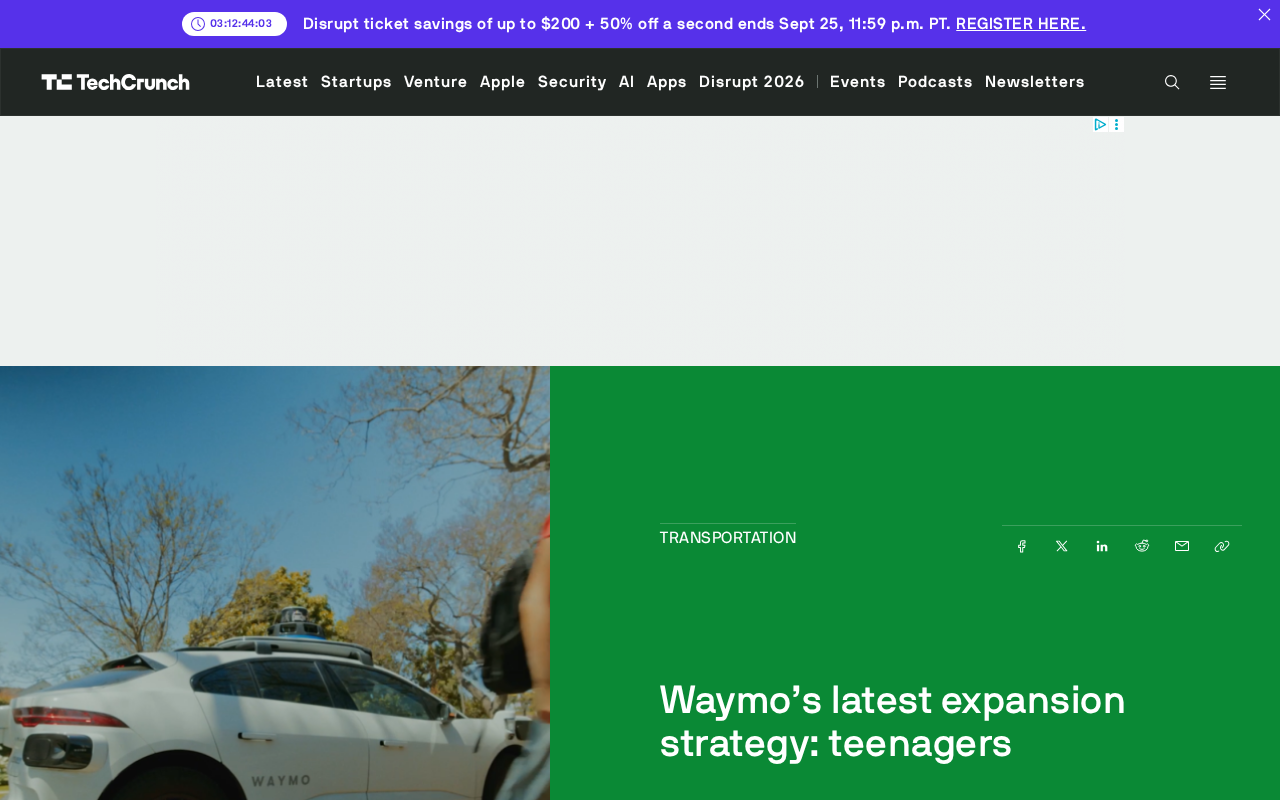
Waymo has opened its robotaxi service in Nashville to riders aged 13–17, making it the second city to allow unaccompanied minors. The core logic: without a human driver, the safety concern of a stranger alone with a minor disappears — flipping what's often seen as a limitation into a competitive advantage. Expanding from one city to two suggests the pilot has gone well, and Waymo is treating this as a systematic growth strategy. Despite challenges around parental liability and varying state regulations, cultivating teen users positions Waymo for long-term brand loyalty and market relevance.
Waymo Targets Teen Riders
Waymo is extending its autonomous taxi service to a new demographic — teenagers. According to the latest reports, Waymo has opened its robotaxi service in Nashville to riders aged 13 to 17, making it the second city where the company allows minors to ride unaccompanied.
On the surface, this looks like a straightforward expansion of who can use the service. But it signals something deeper about Waymo's thinking on market growth. Having steadily rolled out to adult users, bringing teenagers into the fold means Waymo is now exploring territory that traditional ride-hailing platforms have deliberately avoided.
Why Teenagers Are a Uniquely Attractive Market
For families, autonomous taxis hold a distinct appeal when it comes to getting teens around. Most teenagers don't have a driver's license yet, or lack sufficient driving experience, which means parents often have to drive them themselves. An autonomous service with no human driver — predictable in behavior and trackable in real time — speaks directly to parents' safety concerns about their kids traveling independently.
Traditional ride-hailing platforms like Uber and Lyft have long been cautious about letting minors ride, mainly due to safety and liability concerns around unaccompanied minors being alone with a stranger driver. Waymo's driverless nature, which might seem like a limitation in some contexts, actually becomes a differentiated advantage here — and that may be precisely why Waymo is leaning into the teen market.
In terms of market size, there are roughly 25 million teenagers aged 13 to 17 in the United States. They generate significant transportation demand year-round — for school, extracurricular activities, and social outings — and that demand has long been met primarily by parents driving them around. Research shows that American parents spend an average of about one hour per week acting as their child's personal chauffeur, a hidden burden that represents real, persistent demand. While Uber and Lyft technically prohibit users under 18 from riding independently, enforcement is inconsistent — minors using a parent's account is common, and neither platform offers a legitimate parental authorization channel. That regulatory vacuum is exactly the opening Waymo is stepping into. By building a dedicated parental account authorization system, Waymo can operate within a compliant framework and formally productize a need the industry has long overlooked.
From One City to a Multi-City Pilot
Notably, Nashville is the second city where Waymo has opened its service to minors — which means this isn't a one-off experiment, but a strategy in the process of being rolled out. Expanding from one city to two typically signals that the initial pilot produced acceptable results and the company is confident enough to replicate the model elsewhere.
This gradual expansion also fits the characteristically cautious pace of the autonomous driving industry. Rather than launching everywhere at once, a city-by-city approach helps contain potential safety and compliance risks while building operational experience across different regulatory environments.
Potential Challenges and Controversies
Opening the service to teenagers is not without risk. Minors riding alone raises a complex set of issues around parental liability, emergency response, and account authorization. If an incident or dispute occurs, determining responsibility will be far more fraught than it would be with an adult passenger. Moreover, laws governing minors' use of such services vary across states and cities, which could slow Waymo's ability to scale the model quickly.
From a business perspective, teenagers have limited spending power today — but they are tomorrow's core users. Getting younger generations accustomed to riding in autonomous taxis from an early age helps Waymo build long-term user loyalty and brand recognition. This is a move aimed at the future.
On the technical side, handling teenage passengers presents some unique challenges for autonomous vehicles. Waymo's robotaxis currently rely on Remote Assistance to handle edge cases the vehicle can't resolve on its own — things like temporary road closures or a passenger having a medical episode inside the car. When the passenger is a minor who may not be able to manage an emergency independently, the remote support team's response capabilities and handling procedures need to be specifically designed and tested for that scenario. On top of that, real-time tracking for parents, trip-sharing notifications, and passenger identity verification (ensuring the account is being used by the authorized teen, not someone else) all require additional product engineering investment. This partly explains why Waymo is taking a city-by-city pilot approach rather than launching everywhere at once.
Conclusion
Waymo's expansion to teen riders is a telling signal in the broader commercialization of autonomous driving. It capitalizes on the natural advantages of driverless technology in specific use cases, while pushing into market territory that traditional ride-hailing has struggled to reach. As more cities come online, it will be worth watching whether this strategy becomes a meaningful new engine for Waymo's growth at scale.
Related articles

Workbuddy for Absolute Beginners: How a Desktop AI Agent Fits Into Real Workflows
A beginner's guide to the Workbuddy desktop AI agent: installation, claiming credits, file management, and building automated workflows—compared with CodeX for fit and cost, helping professionals shift from AI question-askers to AI managers.

OpenAI's New Agent Stack: Computer Use, Decisions API, and Ultra-Fast Workflows
OpenAI Dev Day unveiled a new agent stack: Computer Use outperforms humans, Decisions API delivers ultra-low-latency classification via Luna, Agents API opens the same Computer Use capabilities, and GPT-6.1 Sol costs only one-seventh of Astra. Core updates, benchmark data, and developer insights.

Liang Wenfeng Open-Sources DeepInfo Inference Framework, Takes On U.S. Ban
DeepSeek open-sources its DeepInfo inference framework after its models, featuring GPU/CPU cross-pipelining, small-model prediction with large-model verification, and full Huawei Ascend and NVIDIA chip support—facing the U.S. federal ban head-on. This article analyzes its significance for AI deployment and open-source strategy.