Waymo's New Tokyo Robotaxi to Use Toyota bZ4X, Launching in 2027

Waymo and Toyota upgrade partnership: 2027 Tokyo robotaxis will use locally assembled bZ4X.
Waymo and Toyota's partnership is moving from the April 2025 strategic agreement to concrete implementation: the 2027 Tokyo robotaxi service will use the Toyota bZ4X assembled in Japan. Unlike Waymo's previous aftermarket retrofit model, the bZ4X will be "produced under Toyota's same roof," suggesting sensor integration may be incorporated into the production line to reduce per-vehicle costs and ensure fleet supply. This alliance approach contrasts with Tesla's full-stack self-development; if successful, it could attract more automakers to follow suit. For Toyota, it opens a B2B demand outlet for the lackluster bZ4X and accumulates operational data. However, the 2027 target faces uncertainties including regulatory approvals, production ramp-up, insurance liability, and user acceptance, with fleet size, service areas, and pricing all undisclosed.
Partnership Upgrade: From Strategic Partners to Purpose-Built Vehicles
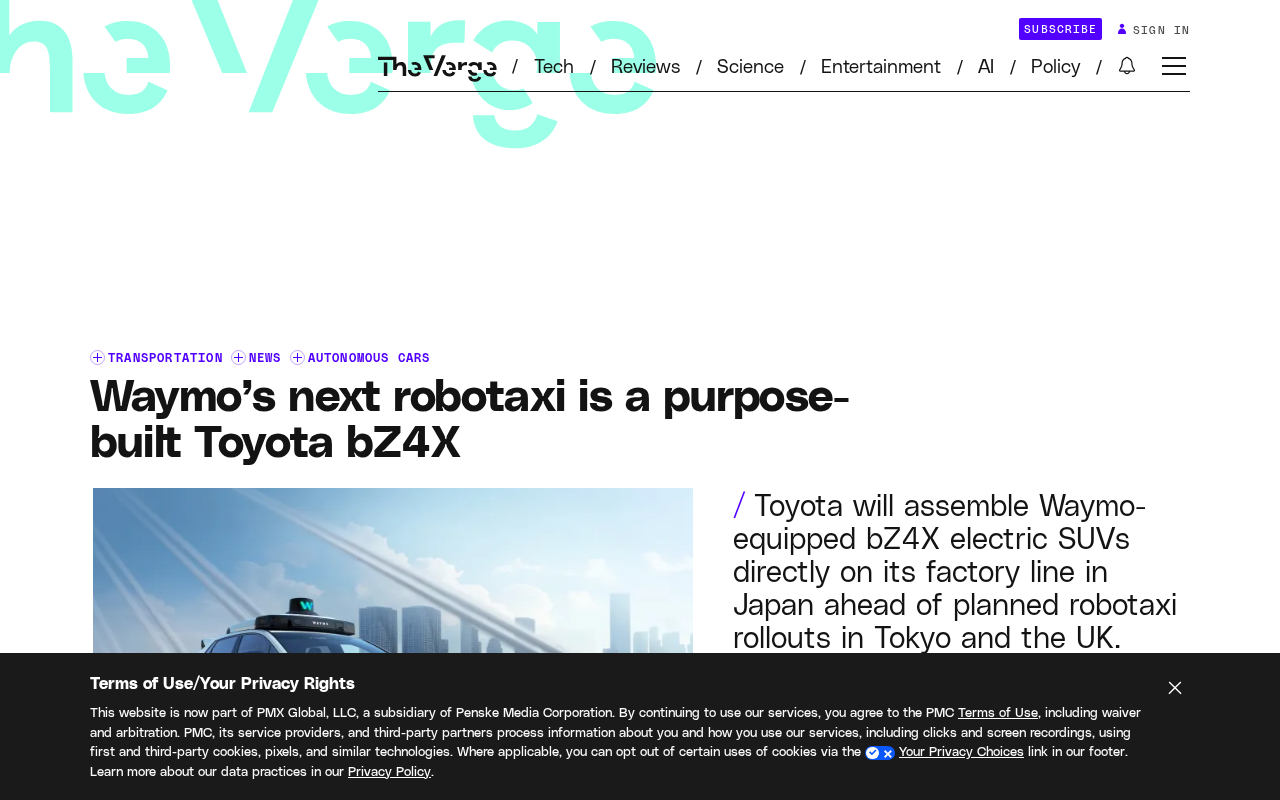
Waymo and Toyota's partnership is rapidly moving toward implementation. According to an official Waymo announcement, its Tokyo robotaxi service will launch in 2027, using the Toyota bZ4X all-electric model assembled in Japan. This news builds on the strategic partnership first announced by both parties in April 2025, marking a new phase in the binding model between autonomous driving companies and traditional automakers.
Unlike the Jaguar I-Pace and other models Waymo previously used in Phoenix, San Francisco, and elsewhere, the bZ4X is an all-electric SUV built on Toyota's e-TNGA architecture, meaning Waymo's hardware integration will be more deeply embedded in Toyota's vehicle manufacturing process. Official statements say these robotaxis will be "produced entirely under Toyota's own roof," suggesting that retrofitting and sensor integration may be completed directly on the production line rather than through the traditional aftermarket modification model.
Why the bZ4X?
Choosing the bZ4X as the next-generation robotaxi platform reveals Waymo's considerations around scaling and cost control. Toyota's global production capacity and supply chain management capabilities are assets that no autonomous driving company could easily replicate independently. Embedding the Waymo Driver system into a mass-produced EV helps lower per-vehicle retrofit costs and provides a more stable vehicle supply for subsequent fleet expansion.
On the other hand, Japan's regulatory environment for autonomous driving is relatively favorable, and Tokyo's complex urban roads and high-density traffic make it an ideal scenario for testing robotaxi capabilities. Waymo's choice of Tokyo as one of its first overseas deployment cities reflects both confidence in its technological maturity and an intent to leverage Toyota's local resources to accelerate regulatory approval.
e-TNGA architecture is a modular platform developed by Toyota specifically for battery electric vehicles, standing for "e-Toyota New Global Architecture." Its design allows flexible adjustment of wheelbase, battery pack capacity, and motor layout on the same platform, covering everything from compact sedans to mid-to-large SUVs. e-TNGA places the battery pack flat in the center of the chassis, helping to lower the center of gravity and improve body rigidity, which directly affects the installation stability and field-of-view consistency of autonomous driving sensors (such as LiDAR and cameras). For Waymo, a vehicle developed on a mature EV platform means more predictable energy consumption, thermal management, and electrical/electronic architecture, making it easier to deeply couple the Waymo Driver system with the vehicle's underlying controls rather than adapting to traditional fuel vehicles or older EVs.
Waymo Driver is Waymo's self-developed L4 autonomous driving system, comprising a multi-modal sensor suite including LiDAR, millimeter-wave radar, and high-definition cameras, as well as a software stack responsible for perception, prediction, planning, and control. Unlike Tesla's pure vision approach, Waymo Driver relies on high-precision maps and redundant sensors to achieve fully autonomous driving without safety drivers in defined areas. Embedding this system into mass-produced vehicles requires deep integration with the vehicle's electrical/electronic architecture, power management, steering and braking actuators—precisely the manufacturing synergy value implied by "production under the same roof."
Potential Impact on the Industry Landscape
The deep binding between Waymo and Toyota stands in sharp contrast to Tesla's insistence on full-stack self-development. The former follows an alliance approach of "autonomous driving tech company + traditional automaker manufacturing," while the latter attempts to control everything from chips to complete vehicles. If this alliance approach proves successful in Tokyo, it could attract more traditional automakers to seek partnerships with autonomous driving companies rather than independently investing heavily in developing L4 systems.
For Toyota, this partnership is also an attempt to find a differentiated selling point in its electrification transition. The bZ4X series has had lukewarm market performance, and connecting to Waymo's robotaxi network could at least open up a stable B2B demand outlet for the model while accumulating real-world autonomous driving operational data.
Full-stack self-development refers to a company independently controlling everything from underlying hardware (such as chips and sensors) to upper-layer software (perception and decision algorithms) and complete vehicle manufacturing. Tesla is a typical representative of this approach: its FSD chip, Dojo supercomputer, pure vision perception solution, and vehicle electronic architecture are all self-developed. The advantages lie in fast software-hardware iteration loops and greater cost control flexibility, but upfront investment is extremely high and risk is concentrated. The alliance approach between Waymo and Toyota has clear division of labor: Waymo provides the autonomous driving technology stack and operational experience, while Toyota handles the vehicle platform, manufacturing, and supply chain. The core difference between the two models is that the alliance approach attempts to reduce per-vehicle costs and accelerate scaling through industrial division of labor, but it needs to resolve issues of responsibility allocation, data sharing, and profit distribution between the technology provider and the manufacturer. If the Tokyo project succeeds, it will provide a replicable template for the alliance approach.
Timeline and Uncertainties
The 2027 launch target gives both parties about two years of preparation time, but the pace of robotaxi deployment is often constrained by regulatory approvals, vehicle production ramp-up, and operational system development. Tokyo's regulatory framework, insurance liability allocation, and user acceptance all need to be resolved one by one. Currently, officially disclosed information remains limited, with fleet size, service areas, and pricing strategies all undisclosed.
What is certain is that Waymo's internationalization pace is accelerating, and Toyota has become a key manufacturing partner in its overseas strategy. The progress of this partnership will directly influence the competitive landscape of the robotaxi market in the coming years.
One-line Summary
Waymo and Toyota upgrade partnership: 2027 Tokyo robotaxis will use locally assembled bZ4X.
Paragraph Summary
Waymo and Toyota's partnership is moving from the April 2025 strategic agreement to concrete implementation: the 2027 Tokyo robotaxi service will use the Toyota bZ4X all-electric model assembled in Japan. Unlike Waymo's previous aftermarket retrofit model with the Jaguar I-Pace, the bZ4X is based on the e-TNGA architecture, and vehicles will be "produced under Toyota's same roof," suggesting sensor integration and retrofitting may be incorporated into the production line, thereby reducing per-vehicle costs and ensuring fleet supply. Choosing Tokyo is due both to Japan's relatively favorable regulatory environment and because high-density urban traffic is an ideal scenario for testing robotaxi capabilities. This "autonomous driving company + traditional automaker" alliance approach contrasts sharply with Tesla's full-stack self-development, and if successful could attract more automakers to follow suit. For Toyota, the partnership could open a B2B demand outlet for the lackluster bZ4X and accumulate operational data. However, the 2027 target still faces uncertainties including regulatory approvals, production ramp-up, insurance liability, and user acceptance, with fleet size, service areas, and pricing all undisclosed.
Related articles

Private Key Set to 4? CA's Elementary Mistake Leaves TLS Exposed
CA eMudra set private keys to tiny values like 4, making TLS certificates brute-forceable. A Computerphile video demonstrates the full process from extracting public keys to forging certificates, and explores the fragility of the PKI trust chain.

How Gen Turns Data into Decisions with ChatGPT Work
In an OpenAI user case, business leader Gen shares how ChatGPT Work turns data into decisions: within hours of launch, teams can judge whether integrations and onboarding flows work, shifting decision iteration from hundreds of trial-and-error attempts to a fast feedback loop.

ChatGPT vs. Claude In-Depth Comparison: Strong at Coding but Weak at Research — How to Bridge the Gap?
A user considers switching from ChatGPT to Claude, finding Claude stronger at coding but shallower at research. We analyze the differences and share tips to make Claude's research deeper.