Weak at ML Programming? A Complete Path to Breakthrough Through Systematic Practice

A structured four-stage path to bridge the gap between ML theory knowledge and hands-on coding ability.
This article addresses the common gap between understanding ML theory and being able to implement algorithms from scratch. It explains why ML lacks a "Blind 75" equivalent, introduces the Deep-ML platform for structured practice, and provides a four-stage progressive path: NumPy vectorization basics, classical ML algorithm implementation, deep learning components from scratch, and engineering-level evaluation — with practical tips for practitioners who have project experience but weak programming foundations.
An Overlooked Reality: Understanding Principles ≠ Knowing How to Implement
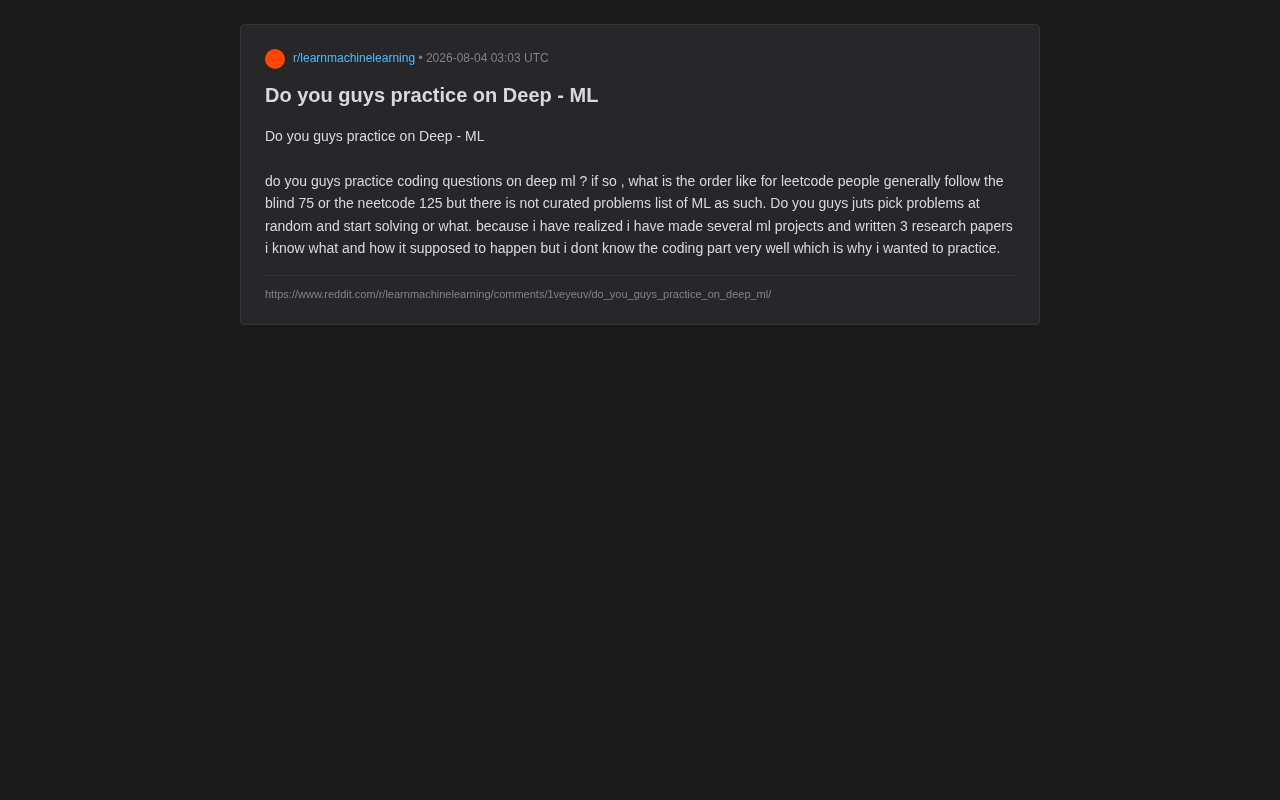
Recently, a post in Reddit's machine learning community struck a chord with many. A developer candidly admitted: they've worked on multiple ML projects, published 3 research papers, and thoroughly understand how models "should work" — but when it comes to actually writing the code, they always feel underprepared. So they posed a pragmatic question:
Does anyone practice coding problems on platforms like Deep-ML? If so, what order do you practice in?
This seemingly simple question reveals a capability gap that's pervasive among ML practitioners — the chasm between theoretical understanding and engineering implementation. You might be able to derive the mathematical formulas for backpropagation or comprehend Transformer's attention mechanism, but when asked to hand-write gradient descent in pure NumPy, implement K-means, or build a simple neural network forward pass without any framework abstractions, you often get stuck.
Backpropagation is the core algorithm for neural network training, and its mathematical essence is the recursive application of the chain rule on a computational graph. While understanding the chain rule theoretically isn't difficult, implementation requires handling tensor dimension matching, gradient accumulation, topological sorting of the computational graph, and other engineering details. The Transformer attention mechanism involves Query-Key-Value matrix operations, numerical stability of scaled dot-product attention (dividing by √d_k to prevent softmax gradient vanishing), and tensor reshape operations for multi-head attention — each step requiring precise dimension management. This explains why many people can draw architecture diagrams on a whiteboard but cannot independently write runnable code.
Why Machine Learning Has No "Blind 75" Problem Set
Anyone familiar with algorithm interviews knows that LeetCode practice has very mature pathways: Blind 75, NeetCode 150 — these carefully curated problem lists organize the most frequently tested and representative problems by topic and difficulty, allowing job seekers to efficiently cover key areas.
Blind 75 was originally posted by a former Facebook engineer on the anonymous professional community Blind. He selected 75 of the most frequently asked interview questions from hundreds of LeetCode problems, covering core data structures and algorithm topics like arrays, linked lists, trees, graphs, and dynamic programming. NeetCode 150 was expanded from this by YouTuber NeetCode, adding more medium-difficulty problems to cover a wider range of topics. These lists succeeded because software engineering interview topics are relatively fixed, and there's abundant publicly shared interview experience, allowing the community to converge on a consensus core problem set.
But as the original poster pointed out, there is no such widely recognized problem list for machine learning. There are several reasons behind this:
ML Coding Problems Have Fuzzier Boundaries
Algorithm problems have clear inputs/outputs and a single optimal solution, while ML implementation problems often involve numerical computation, randomness, and hyperparameter choices, making evaluation criteria more complex. A single "implement logistic regression" problem might test mathematical derivation, vectorization techniques, or numerical stability handling.
Numerical stability is one of the most easily overlooked yet most critical issues in from-scratch ML implementations. For example, directly computing the softmax function can cause floating-point overflow due to exponentiation — the standard practice is to subtract the maximum value of the input vector before exponentiating. In logistic regression, evaluating log(0) in cross-entropy loss produces negative infinity, requiring a tiny epsilon value or the log-sum-exp trick. In gradient descent, a learning rate that's too large can cause numerical explosion, while one that's too small leads to extremely slow convergence. These are engineering details that pure theoretical derivations never address but must be handled in actual coding — and they're exactly the capability dimensions that platforms like Deep-ML focus on testing.
The Knowledge Scope Is Extremely Broad
From linear algebra fundamentals and classical ML algorithms, to deep learning components and optimizer implementations, to evaluation metrics and data preprocessing — ML implementation skills span an enormous range that's hard to cover in a 75-problem list.
Job Requirements Vary Enormously
Research roles, algorithm engineering roles, and MLOps roles have vastly different programming requirements. Researchers may need rapid prototyping ability, while engineers need solid system implementation foundations — this makes it difficult to form consensus on a "standard problem list."
The Core Value and Usage of the Deep-ML Platform
Deep-ML (deep-ml.com) emerged precisely to fill this gap. It's like a machine learning version of LeetCode, offering coding exercises ranging from linear algebra and ML basics to deep learning, requiring you to implement algorithm cores by hand rather than calling pre-built library functions.
The core value of such platforms lies in:
- Forcing you to "implement from scratch": No direct
import sklearnallowed — you must understand the math-to-code mapping at every step. - Instant feedback: Test cases verify whether your implementation is correct, which is more efficient than fumbling around in Jupyter on your own.
- Difficulty stratification: Starting from basic matrix operations and gradually progressing to complex neural network implementations.
For practitioners who are "strong in theory, weak in code," this kind of deliberate practice is precisely what fills the gap.
The Best Order for ML Coding Practice: A Four-Stage Progressive Path
Although there's no authoritative ML version of Blind 75, we can absolutely build a reasonable progressive path based on the knowledge hierarchy. Here's the recommended learning sequence:
Stage 1: Mathematics and NumPy Vectorization Fundamentals
First, build muscle memory for vectorized programming. Implement in pure NumPy:
- Matrix multiplication, transposition, dot products
- Vector normalization, covariance matrix computation
- Eigenvalues/eigenvectors (for understanding PCA)
The importance of NumPy's vectorized operations isn't just about code conciseness — it's a fundamental performance difference. Under the hood, NumPy calls BLAS/LAPACK linear algebra libraries (such as Intel MKL, OpenBLAS) that have been optimized over decades. These libraries leverage CPU SIMD instruction sets (like AVX-512) for data-level parallelism while optimizing cache access patterns. A vectorized matrix multiplication can be 100-1000x faster than an equivalent Python nested for loop. Mastering vectorized programming means understanding how to transform scalar mathematical formulas into batch tensor operations — this is also the foundational mindset for efficient GPU computation with frameworks like PyTorch and TensorFlow.
The goal of this stage is to develop intuition for "how mathematical formulas become vectorized code" and avoid writing inefficient for loops.
Stage 2: Hand-Implementing Classical ML Algorithms
Implement from simple to complex:
- Linear regression (both normal equation and gradient descent approaches)
- Logistic regression (including sigmoid and cross-entropy loss)
- K-means clustering
- K-Nearest Neighbors (KNN)
- Information gain calculation for decision trees
- Naive Bayes
For each algorithm, try deriving the loss function yourself, write out the update rules, then implement in code.
Stage 3: Implementing Deep Learning Components from Scratch
This is where difficulty ramps up steeply but yields the greatest returns:
- Hand-write forward and backward propagation for fully connected layers
- Implement common activation functions and their derivatives (ReLU, Sigmoid, Softmax)
- Implement common optimizers (SGD, Momentum, Adam)
- Build a simple multi-layer perceptron training loop from scratch
- Advanced: implement attention mechanisms, convolution operations
Adam (Adaptive Moment Estimation) optimizer combines the advantages of Momentum and RMSProp, maintaining exponential moving averages of first-moment estimates (mean) and second-moment estimates (variance) of gradients. Implementing Adam from scratch requires: maintaining two state variables (m and v) for each parameter, implementing bias correction (because m and v are initialized to zero, causing underestimation in early stages), and adding epsilon in division to prevent division by zero. Behind the seemingly brief mathematical formulas lie multiple engineering considerations involving state management, parameter organization, and numerical precision — this is a classic example of the theory-to-practice gap.
Stage 4: Engineering-Level Evaluation and Data Processing
- Implement various evaluation metrics (Precision, Recall, F1, AUC)
- Data preprocessing pipelines (standardization, one-hot encoding)
- Cross-validation logic
Practical Advice for Those "With Project Experience but Weak Programming"
The original poster's situation is very typical and representative. Here are some targeted suggestions:
First, don't practice randomly. Picking problems at random may seem flexible, but it easily leads to fragmented knowledge coverage. Progress through stages based on the knowledge hierarchy above — this builds systematic understanding while providing continuous positive feedback.
Second, understand before coding, and review the math after coding. You already have a theoretical advantage — what you need is to build a bidirectional mapping between "formulas and code." After writing code, cross-check each line against the mathematical derivation. This bidirectional verification dramatically deepens understanding.
Third, ban high-level abstractions. During practice, deliberately avoid using sklearn or PyTorch's high-level APIs. Force yourself to implement with NumPy or even pure Python. Once your foundations are solid, returning to the framework level will bring sudden clarity.
Fourth, combine practice with projects. If you have rich project experience, try replacing parts you previously "called with one line" with your own implementations, and verify the results match. This transfer practice is extremely efficient.
Final Thoughts
"Understanding principles but not being able to implement" isn't a personal capability deficiency — it's a structural problem that commonly exists in learning paths. The fact that the ML field still lacks a widely recognized coding problem list shows this is a blank space worth exploring.
For individuals, what matters isn't waiting for a perfect problem list to appear, but proactively building a progressive practice path from mathematical foundations to deep learning components based on your own knowledge system. Platforms like Deep-ML provide excellent training grounds, but real progress comes from deliberate, systematic implementation from scratch. When you can independently write a trainable neural network without relying on any framework, that feeling of theory and practice clicking together will elevate your understanding of machine learning to an entirely new level.
Related articles

Chain of Thought Isn't Just for AI: How Humans Can Use CoT to Improve Thinking Quality
Chain of Thought isn't just a prompt trick for large models. Starting from a Hacker News discussion, this article analyzes why CoT works for human thinking too, breaks down actionable ways to transfer it, and highlights the key differences between human CoT and machine CoT.
Cloudflare Teams Up with OpenAI: Closi…
Cloudflare Teams Up with OpenAI: Closing the Loop from Vulnerability Discovery to Defense with AI
Cloudflare uses OpenAI Daybreak to investigate security vulnerabilities and generate reviewable remediation plans, while developers use Codex to boost coding efficiency and quality.

Orca Multi-Agent Orchestration in Practice: A Guide to Parallel Collaboration with Claude and Codex
Orca is Stable AI's free open-source agent workbench supporting 34 agents like Claude Code and Codex in parallel. Learn its Git worktree isolation, multi-model orchestration, and mobile management.