Webless Agents: Reviewing a Customer Support AI Built on Your Published Content
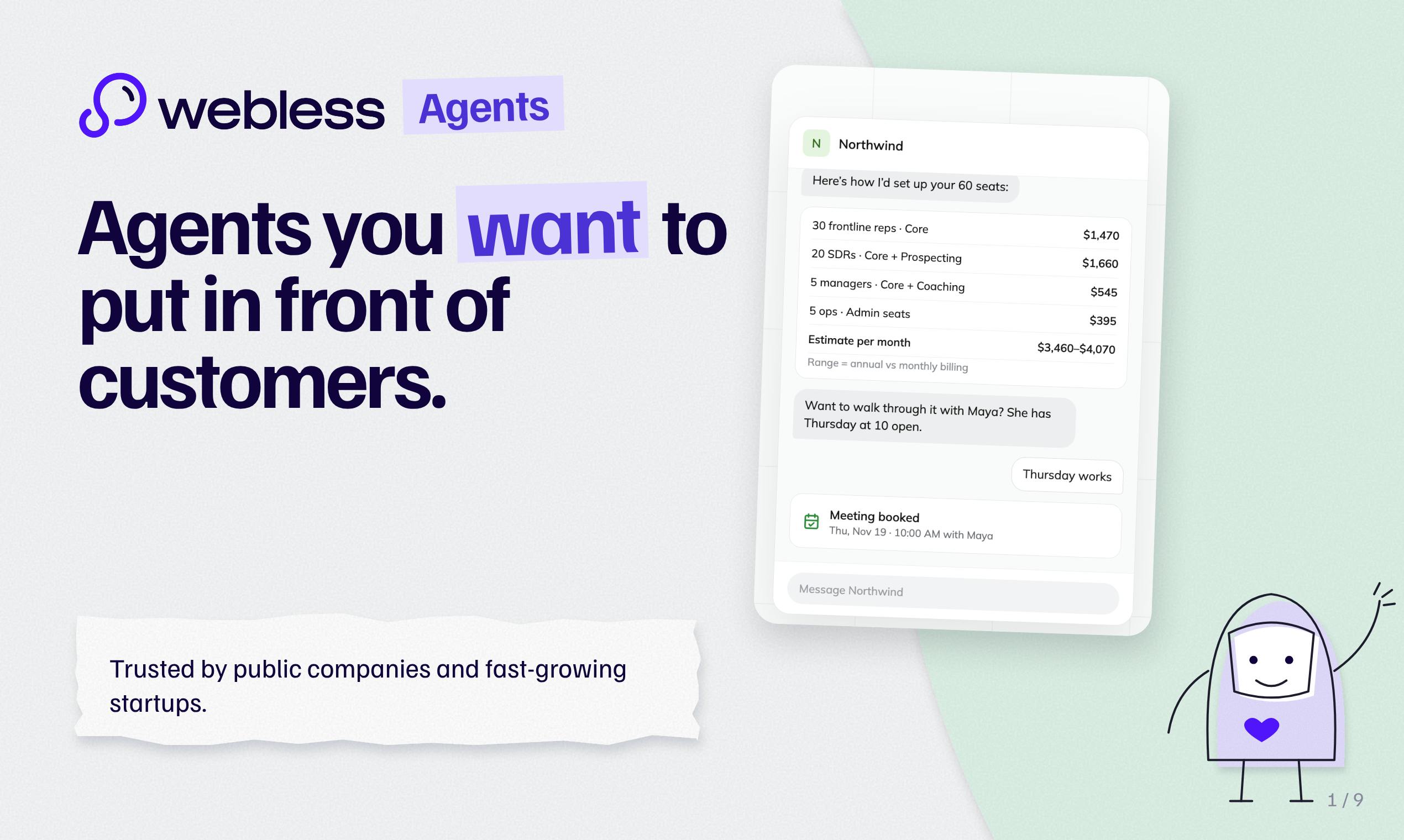
Webless Agents locks answers to published content, making your support bot a controllable sales front-end.
Webless Agents tackles the trust problem of website chatbots by letting users describe business goals in natural language, then building an agent constrained to a company's published content, with human review of every instruction before launch. It handles Q&A, buyer qualification, quotes, bookings, and human handoff. Best suited for B2B teams with mature content assets, though content staleness and limited public info are concerns.
Product Positioning: Solving the Trust Problem of Customer Support Chatbots
Webless Agents opens on Product Hunt with a pointed claim: most website chatbots are something you would never want your customers to see. That line hits a nerve shared by anyone who has used a traditional support bot—off-topic answers, fabrications, and failures at critical moments. Webless's solution isn't to make the model smarter; it's to lock the generation scope strictly to "content you've already published publicly."
In plain terms: you describe the business outcome you want in natural language, and Webless builds an agent based on your published content that answers only according to what you've already said. Before launch, you can review and modify every instruction. After launch, it handles Q&A, qualifies buyers, sends quotes, books meetings, and hands complex cases off to your human team.
This approach essentially shifts "hallucination control" from prompt engineering to data source governance: rather than teaching the model not to lie, it ensures the model never has the opportunity to touch any corpus outside your content.
Core Mechanism: From "Conversation" to "Business Actions"
Build Process: Define Goals in Natural Language
Webless's build entry point isn't a drag-and-drop conversation flow editor but a natural language description of a business outcome. You tell it what you want (e.g., "identify visitors with purchase intent and schedule demos"), and it generates the agent's instruction set accordingly. This lowers the barrier for marketing and sales organizations without an NLP team, but it also means the agent's behavioral ceiling depends on how clearly you describe your needs.
NLP teams refer to engineering or research groups dedicated to natural language processing (NLP), typically responsible for intent recognition, entity extraction, dialogue state management, prompt tuning, and model fine-tuning. Traditionally, for a chatbot to accurately understand business scenarios, enterprises needed such teams to write and maintain complex dialogue flows, train classification models, and iterate continuously. Webless's claim of "lowering the barrier" refers precisely to compressing this layer of work into a natural language description—with the product handling intent parsing and instruction generation in the background, so business users don't need to understand tokens, embeddings, or the internals of intent classifiers. However, this also means coarser debugging granularity: when the agent behaves unexpectedly, what users can adjust is often just the description itself, not the underlying logic.
Review Layer: A Human Gate Before Launch
The product explicitly retains a human review step: every instruction can be checked and modified before publishing. This is the key design that distinguishes it from "one-click deploy, tune later" tools. For customer-facing scenarios, controllability often matters more than automation.
Customer-facing deployments refer to systems or processes used directly by external customers rather than only internal employees. The risks of such deployments are significantly higher than internal tools: a wrong answer could be screenshotted and shared by a customer, a wrong quote could constitute a contractual offer, and in some industries it may involve compliance liability. The industry therefore generally follows the "human-in-the-loop" principle, retaining human confirmation at key nodes of automated workflows. Webless places review at the instruction layer before launch rather than the real-time layer of each answer—a "pre-review" model. It ensures the initial setup is controllable, but it cannot intercept incorrect combinations or misreadings of published content by the agent at runtime, which is fundamentally different from real-time human fallback.
Business Loop: More Than Answering Questions
Notably, it connects conversations directly to commercial actions—qualifying buyers, sending quotes, booking meetings, and handing off to humans. This turns the agent from an "information lookup tool" into a "front-end step in the sales process," but it also raises the bar for content accuracy and instruction rigor: an outdated quote description could be sent directly to a customer by the agent as fact.
Retrieval-Augmented Generation (RAG) is the mainstream technical path for grounding large models in specific materials: the system first retrieves snippets relevant to the question from a knowledge base, then passes those snippets as context to the model to generate an answer. Webless's "answer only from published content" is mechanically close to a strictly constrained RAG—the retrieval scope is limited to publicly available website content, thereby minimizing the model's exposure to external corpora at the source. Unlike ordinary RAG, its constraint focuses not on retrieval precision but on data source boundaries, so answer quality depends heavily on the coverage and freshness of the content library; questions not covered by the library can only be refused or handed off, not improvised.
Strengths and Concerns: An Independent Observation
Public information about this product is currently limited—its Product Hunt page shows 79 votes, 3 comments, and a #5 ranking for the week, indicating an early exposure stage. Based on its product description, the following judgments can be made:
Strengths: The answer mechanism constrained to published content is naturally appealing in compliance-sensitive industries (finance, healthcare, B2B services); the human review layer lowers the psychological barrier to customer-facing deployment; and the coverage from Q&A to quotes and bookings reduces integration work with other tools.
Concerns: A single-source product description cannot verify actual answer quality or handoff accuracy; relying solely on published content means content update lag will directly show up in support answers; and the lack of public pricing and integration ecosystem information makes it hard to assess how deeply it works with existing CRM and calendar systems.
Use Cases and Decision Advice
For B2B teams with fairly complete content assets (help centers, product docs, and FAQ libraries in place), Webless's "content as knowledge base" model carries lower risk and controllable deployment costs, making it suitable as the first automated gate for sales lead qualification. For scenarios with scattered, frequently updated content or a need for large amounts of dynamic data (inventory, real-time pricing), this mechanism constrained to published content may instead become a bottleneck.
Its Product Hunt offer is three free months of the highest-tier plan, a low-cost validation window for teams wanting to test the waters on a small scale—but during the trial, two things should be checked carefully: how the agent refuses boundary questions, and the completeness of context when handing off to a human.
FAQ
How is Webless Agents different from traditional website chatbots? Traditional bots typically generate answers freely based on general models, while Webless strictly limits answers to your published content and requires human review of every instruction before launch.
Does it only do Q&A? No. According to the product description, it can also qualify potential buyers, send quotes, book meetings, and hand off to your team.
What size of company is it suitable for? Official information doesn't disclose specific applicability, but the human review process and content dependency make it better suited to teams that already have mature content assets.
One-line Summary
Webless Agents locks answer scope to published content, turning the support bot into a controllable front-end step in sales.
Paragraph Summary
Webless Agents addresses the trust problem of traditional website chatbots—off-topic answers and fabrications—by replacing prompt engineering with data source governance: users describe business goals in natural language, and the product builds an agent based on a company's publicly published content, strictly limiting answers to that existing content, with every instruction reviewable and modifiable by humans before launch. Functionally, it goes beyond Q&A to cover sales process actions such as qualifying buyers, sending quotes, booking meetings, and handing off to humans. The article finds it naturally appealing in compliance-sensitive industries and notes that the human review layer lowers the barrier to customer-facing deployment, but content update lag will directly show up in answers, and with limited public information, actual answer quality and integration depth are hard to verify—making it better suited to small-scale trials by B2B teams with mature content assets.
Related articles

Braised Meat Shop Forced Out by Rent Hike: A Life-and-Death Contest Between Craft and Location
Braised meat shop owner forced out by a 100,000 yuan rent hike moves overnight; landlord's daughter takes over with seasoning packets and overnight meat sickens customers. A tale of location versus craft.

AI One-Click Emotional Short Drama: Bilibili Creator Tests the "Beautiful Landlady" Script
Bilibili creator uses AI to produce the emotional short drama "The Beautiful Landlady Comes to Fix the Guy's Drain," testing everything from script generation to character consistency.

Braised Meat Stall Goes Viral, Landlord Raises Rent—She Leaves Gracefully by Contract While Rival Cuts Corners and Loses Everything
A braised meat stall's rent was hiked from ¥68K to ¥168K after going viral; the owner moved out by contract while her rival cut corners and lost it all.