WebLLM: A Complete Guide to Running Large Language Models Locally in the Browser

WebLLM enables large language models to run locally in browsers using WebGPU and WebAssembly.
WebLLM is a high-performance in-browser LLM inference engine that leverages WebGPU, WebAssembly, and model quantization to run large language models entirely on the client side. It offers strong privacy protection, zero server costs, and offline availability, but faces challenges including large initial model downloads, hardware GPU dependency, and evolving browser compatibility. Best suited for privacy-sensitive tools and lightweight AI features.
What It Means to Bring LLM Inference into the Browser
For a long time, running large language models (LLMs) meant powerful servers, expensive GPU clusters, and uploading user data to the cloud. The WebLLM project proposes a radically different approach: running LLMs entirely within the user's browser, with no server support needed and no data sent to remote endpoints.
This project has garnered significant attention on Hacker News. Its core value lies not only in technical feasibility but also in redefining the relationship between LLM deployment and privacy protection. This article provides an in-depth analysis of WebLLM's technical principles, key advantages, and real-world limitations.
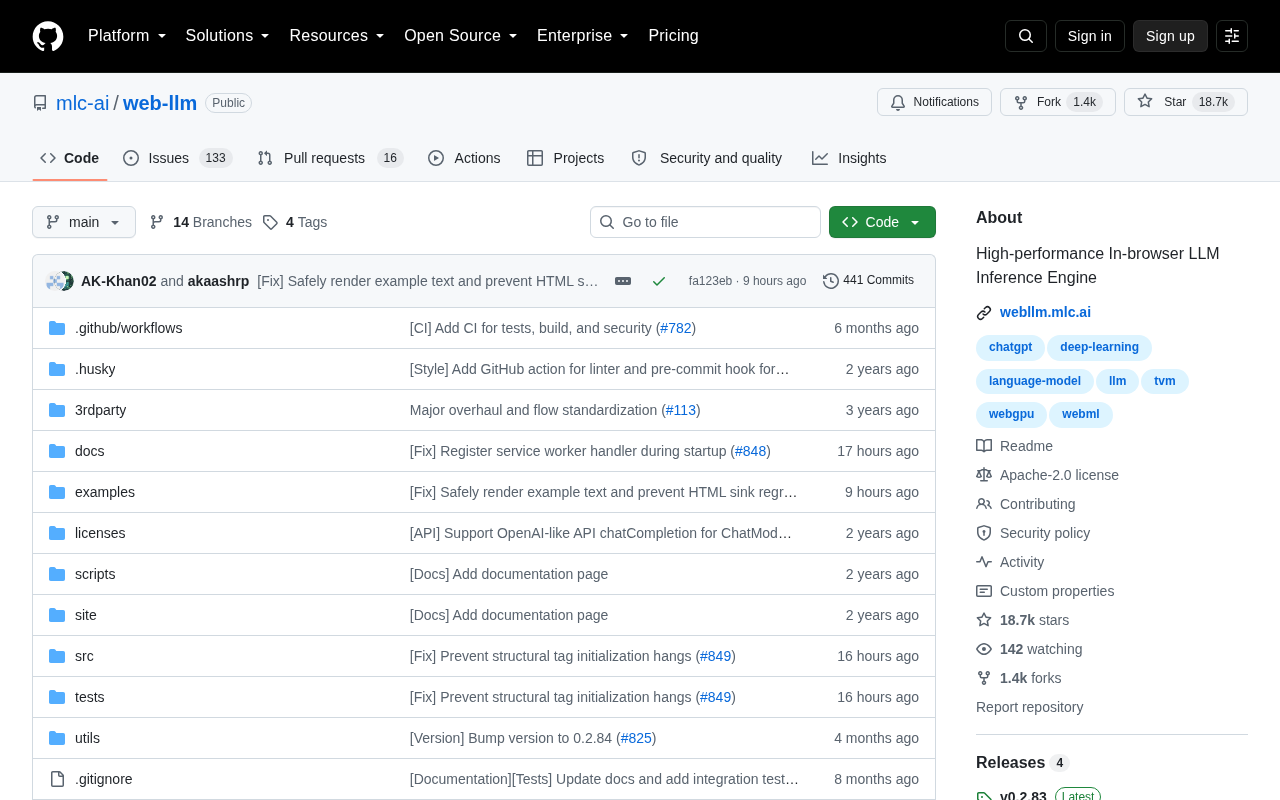
What Is WebLLM: An In-Browser LLM Inference Engine
WebLLM is a high-performance in-browser LLM inference engine. Its goal is to move the entire model inference pipeline to the client-side browser, leveraging hardware acceleration capabilities provided by modern browsers to achieve near-native inference performance.
Core Technologies Behind WebLLM
WebLLM's implementation relies on several key browser technologies:
-
WebGPU: A next-generation browser graphics and compute API that can directly invoke the local GPU for parallel computation. Compared to the earlier WebGL, WebGPU offers much lower-level compute capabilities, making it the critical foundation for running LLM matrix operations in the browser. WebGPU is a new Web graphics and general-purpose compute API being standardized by the W3C, drawing design inspiration from modern low-level graphics APIs like Vulkan, Metal, and Direct3D 12. Compared to its predecessor WebGL (based on OpenGL ES), WebGPU introduces Compute Shaders, a more granular resource binding model, and pipeline state management, allowing developers to execute general-purpose parallel computing tasks (GPGPU) directly on the GPU — not just graphics rendering. For LLM inference, the core operations — matrix multiplication and attention mechanism computation — are inherently massively parallel tensor operations, making them ideal candidates for GPU acceleration. By providing direct access to GPU compute pipelines, WebGPU gives browsers the ability to efficiently execute these types of deep learning inference tasks for the first time.
-
WebAssembly (Wasm): Used to execute compiled inference logic at high performance, compensating for JavaScript's shortcomings in compute-intensive tasks. WebAssembly is a binary instruction format designed as a compilation target that executes at near-native speed in modern web browsers. It has been supported by all major browsers since 2017 and was originally driven by Mozilla, Google, Microsoft, and Apple. Wasm allows developers to compile high-performance code written in C, C++, Rust, and other languages into a browser-executable format, breaking through the bottleneck of JavaScript as an interpreted language for compute-intensive tasks. In WebLLM's architecture, Wasm primarily handles non-GPU computation logic during model inference, including tokenizer encoding/decoding, sampling strategy execution, KV Cache management, and other CPU-side tasks, forming a complete GPU+CPU collaborative inference pipeline with WebGPU.
-
Model Quantization and Compilation Optimization: To run models with billions of parameters within the browser's limited memory, WebLLM relies on quantization techniques (such as 4-bit quantization) to compress model size, along with machine learning compilation frameworks for targeted optimization. Quantization is one of the core techniques for deep learning model compression. The basic idea is to convert model weights from high-precision floating-point numbers (such as FP32 or FP16) to low-precision representations (such as INT8, INT4, or even lower bit widths). Taking 4-bit quantization as an example, a weight parameter that originally occupies 16 bits of storage is compressed to just 4 bits, directly reducing the model size to one-quarter of the original. Common quantization methods include GPTQ, AWQ (Activation-aware Weight Quantization), and the GGUF format. Quantization inevitably introduces some precision loss, but research has shown that carefully calibrated 4-bit quantization causes only minimal performance degradation on most tasks. The WebLLM project typically uses the MLC-LLM (Machine Learning Compilation for LLM) framework to quantize and compile-optimize models, converting PyTorch models into formats that can be efficiently executed on WebGPU. The underlying infrastructure of MLC-LLM is Apache TVM — an open-source deep learning compiler stack that can automatically optimize and compile models from different frameworks into efficient code for specific hardware platforms, including automated operator fusion, memory layout adjustment, and hardware-specific kernel generation.
This technology stack transforms the browser from a mere presentation layer into a local AI inference platform with real computational capability. It's worth noting that LLM inference is essentially a series of dense matrix operations. Taking the Transformer architecture as an example, each layer includes QKV projection and attention weight computation in the Self-Attention mechanism, as well as large-scale matrix multiplication in the Feed-Forward Network (FFN). A 7B parameter model may need to perform billions of floating-point operations to generate a single token. This explains why GPUs are crucial for LLM inference — GPUs have thousands of compute cores, making them naturally suited for this kind of massively parallel matrix computation. The significance of WebGPU is that it allows JavaScript code in the browser to schedule these GPU cores to execute the core computations in Transformers, rather than relying on serial CPU processing.
Three Core Advantages of Running Large Models in the Browser
Privacy Protection: User Data Never Leaves the Device
The most direct value is privacy. Traditional cloud-based LLM services require uploading every user input to servers for processing, which poses significant security concerns for sensitive scenarios such as healthcare, legal, and internal corporate documents. WebLLM keeps all inference local — user data never leaves the device at any point — fundamentally eliminating the risk of data leakage.
Zero Server Costs: AI Applications Without a Backend
For developers, in-browser inference means building completely backend-free AI applications. The computational cost of the model is shifted to the user side, and developers don't need to pay for GPU inference servers. This is an extremely attractive cost model for individual developers, small teams, and products looking to distribute AI capabilities at scale.
Offline Availability: AI That Works Without an Internet Connection
Once the model is loaded, WebLLM applications can continue working offline. This opens up new possibilities for edge scenarios and privacy-first utility applications, making AI functionality no longer strongly dependent on network connectivity.
Real-World Challenges and Limitations Facing WebLLM
Despite its promising outlook, WebLLM still faces significant real-world constraints — pain points frequently mentioned in community discussions.
Model Size and Initial Load Time
Even after quantization, a usable LLM weight file typically ranges from several hundred MB to several GB. Users need to download the complete model on their first visit, resulting in noticeable wait times and bandwidth consumption. While browser caching can mitigate repeated loading, the initial loading barrier remains high. WebLLM leverages built-in browser storage mechanisms (such as the Cache API and IndexedDB) to persist downloaded model weights, avoiding repeated downloads on each visit. The Cache API is part of the Service Worker specification and allows storing HTTP request-response pairs with no strict capacity limit in theory, though actual limits are managed jointly by the browser and operating system. However, different browsers have significantly varying storage quota policies, and cached models are deleted when users clear their browsing data. Some browsers also automatically reclaim this cache when storage space runs low, forcing users to re-download the model.
Dependence on User Hardware GPU Capabilities
WebGPU performance is highly dependent on the GPU capabilities of the user's device. The experience is smooth on high-end devices, but inference speed and the scale of models that can be run are noticeably limited on lower-spec laptops or mobile devices. This means WebLLM applications need to make trade-offs between "model capability" and "device coverage." Additionally, during autoregressive generation, each new token generated by the LLM needs to reference information from all previous tokens. To avoid redundant computation, the inference engine caches the Key and Value vectors of all previous tokens, known as the KV Cache. As the generated sequence length increases, KV Cache memory usage grows linearly. For example, a 7B model processing a context of 2048 tokens may require several GB of VRAM for the KV Cache alone. This poses a serious challenge for memory management in the browser environment, as the VRAM allocatable by WebGPU is constrained by the browser sandbox and is typically far less than what native applications can access. This is one of the key reasons why WebLLM faces performance bottlenecks when handling long-context tasks.
Browser Compatibility Is Still Evolving
Although WebGPU has been progressively rolling out in mainstream browsers like Chrome, its overall adoption and cross-browser stability are still evolving. For consumer-facing products, developers often need to prepare fallback solutions or compatibility notices.
Best Use Cases for WebLLM
Given its strengths and limitations, WebLLM is best suited for the following types of scenarios:
- Privacy-sensitive assistant tools: Such as local document Q&A and private note organization, where keeping data on-device is the core selling point.
- Education and demonstration scenarios: Allowing users to experience LLM capabilities directly in the browser without deploying servers, significantly lowering the barrier to entry.
- Lightweight embedded AI features: Adding backend-independent intelligent capabilities to existing web applications, such as text summarization and translation assistance.
For scenarios requiring ultra-large parameter models, extremely fast response times, or broad support for low-end devices, cloud-based inference will remain the mainstream choice for the foreseeable future.
Conclusion: A Complementary, Not Replacement, LLM Deployment Path
WebLLM represents a valuable exploration in LLM deployment approaches. It is unlikely to completely replace cloud-based inference, but it clearly outlines a technical path centered on privacy protection and decentralization. The local inference approach represented by WebLLM aligns closely with the broader edge computing trend. The core idea of Edge Computing is to push data processing and computational tasks from centralized cloud infrastructure to locations closer to the data source — users' end devices. In the AI domain, this trend is known as "Edge AI" or "On-device AI," with representative examples including Apple's Core ML framework, Google's MediaPipe, and Qualcomm's AI Engine. Unlike these solutions that require native application support, WebLLM's unique value lies in using the Web as its medium, theoretically reaching all WebGPU-capable devices through a single URL while maintaining the privacy and low-latency advantages of edge computing. This combination opens up a new distribution model: AI capabilities that depend on neither app stores nor cloud APIs.
As WebGPU matures, model quantization techniques advance, and end-device computing power increases, the practical boundaries of running large models in the browser will continue to expand.
For developers interested in AI privacy, inference cost optimization, and edge computing, WebLLM is a direction worth tracking closely. It reminds us that the future of AI isn't just about bigger models and more powerful servers — it may also be about intelligence that is closer to users and more respectful of data sovereignty.
Related articles

Chain of Thought Isn't Just for AI: How Humans Can Use CoT to Improve Thinking Quality
Chain of Thought isn't just a prompt trick for large models. Starting from a Hacker News discussion, this article analyzes why CoT works for human thinking too, breaks down actionable ways to transfer it, and highlights the key differences between human CoT and machine CoT.
Cloudflare Teams Up with OpenAI: Closi…
Cloudflare Teams Up with OpenAI: Closing the Loop from Vulnerability Discovery to Defense with AI
Cloudflare uses OpenAI Daybreak to investigate security vulnerabilities and generate reviewable remediation plans, while developers use Codex to boost coding efficiency and quality.

Orca Multi-Agent Orchestration in Practice: A Guide to Parallel Collaboration with Claude and Codex
Orca is Stable AI's free open-source agent workbench supporting 34 agents like Claude Code and Codex in parallel. Learn its Git worktree isolation, multi-model orchestration, and mobile management.