WebMCP Explained: How OpenAI Is Pushing Web Pages to Become AI-Callable Tools

WebMCP aims to turn web pages into standardized, AI-callable tools — and OpenAI wants to lead the charge.
WebMCP extends the Model Context Protocol into the browser, enabling AI agents to invoke web page functions like APIs instead of simulating human interactions. OpenAI's WebMCP Challenge signals a push toward standardizing this web interaction layer, raising critical questions about security, governance, and website adoption incentives.
What Is WebMCP
WebMCP is a significant extension of the Model Context Protocol (MCP) into the browser and web environment. It attempts to answer an increasingly urgent question: when AI agents need to interact with real-world websites, how should they do so in a standardized, secure, and efficient manner?
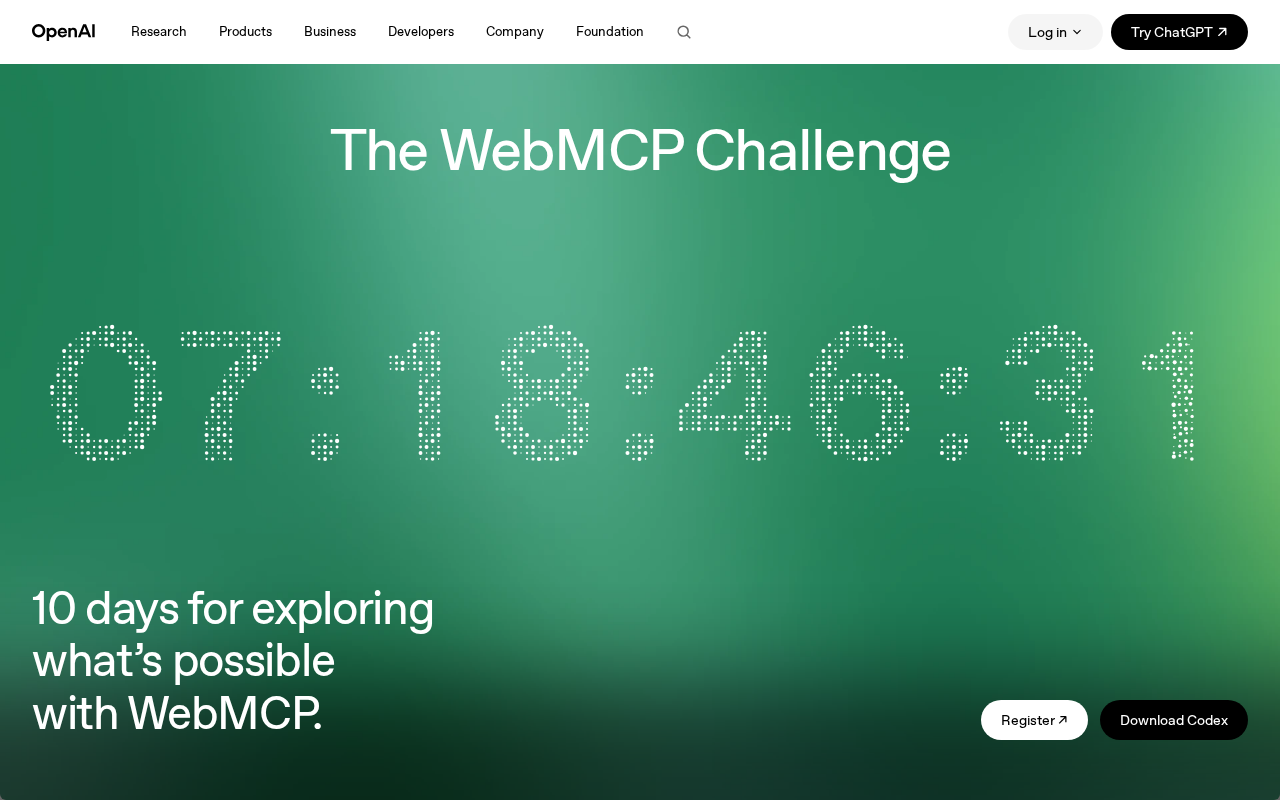
The recent WebMCP Challenge launched by OpenAI has attracted attention on Hacker News. While the post itself contained limited information, it sent a clear signal: major AI companies are pushing "letting AI directly use web pages" from concept toward engineering implementation.
The Evolution from MCP to WebMCP
What Problem MCP Solves
MCP was originally proposed by Anthropic with the goal of establishing a unified communication standard between large language models and external data sources and tools. Before MCP, every application that wanted to integrate AI required a separately developed adapter layer, leading to severe fragmentation. By defining standardized interfaces for "tools," "resources," and "prompts," MCP enables models to invoke external capabilities in a consistent manner.
Why WebMCP Is Needed
The real challenge lies in the fact that the vast majority of services and information on the internet exist as web pages — and these pages were never designed with AI interfaces in mind. Traditionally, AI agents could only interact with web pages in two ways:
- Screen parsing / pixel-level operations: Having the model "look at screenshots and click coordinates" — fragile and expensive
- DOM scraping and script injection: Easily broken when page structure changes
WebMCP's approach is to have websites proactively expose a "machine-readable" capability layer, allowing AI agents to invoke web page functions like calling an API, rather than simulating human mouse and keyboard operations. This essentially brings MCP's tool-oriented philosophy into the browser ecosystem.
The Strategic Significance of OpenAI Entering WebMCP
A Critical Piece in the AI Agent Race
"AI Agent" has become the industry's main theme. OpenAI's Operator, Anthropic's Computer Use, and Google's related explorations are all solving the same thing — enabling AI to not just answer questions, but actually "get things done." And the primary venue for getting things done is often the browser.
OpenAI's push for the WebMCP Challenge signals its intent to participate in — or even lead — the standardization of the web interaction layer. Whoever controls the standard holds the gateway advantage in the future agent ecosystem. This follows the same logic as the browser wars and API wars of the past.
How the Challenge Drives Protocol Development
Using a Challenge (competition) format is a classic approach to developer ecosystem building: attracting developers through bounties and competition to contribute implementations, discover protocol flaws, and build early use cases. This accelerates standard refinement while cultivating adoption momentum within the community.
Key Questions at the Technical and Ecosystem Level
Security and Permission Boundaries
The biggest concern with letting AI directly invoke web capabilities is security. If a malicious website declares misleading "tools" or tricks an agent into executing dangerous operations (such as fund transfers or data deletion), the consequences could be severe. Therefore, WebMCP-type protocols must have built-in:
- A clear permission authorization model
- User confirmation mechanisms before critical operations
- Trustworthiness verification of tool sources and intent
Standards Competition and Fragmentation Risk
Hacker News discussions also reflect the community's cautious stance: the MCP ecosystem is still in its early stages, and multiple vendors may release variants that aren't fully compatible with each other. Without neutral governance, WebMCP could easily repeat historical patterns of standard fragmentation. The ideal scenario is for it to become open, vendor-neutral public infrastructure — like HTTP or REST.
Analyzing Website Adoption Incentives
Another practical question: why would websites proactively expose interfaces for AI? For content platforms, AI agents might bypass ads and directly extract value. But for e-commerce, SaaS, and tool-based services, becoming "AI-callable capabilities" actually represents new traffic and transaction entry points. This difference in motivation will determine WebMCP's adoption speed and scope.
Web Pages Are Being Redefined as "AI Toolsets"
The emergence of WebMCP marks a quiet transformation in the role of web pages — evolving from "interfaces designed for humans to view" into "tool collections for AI to use." While it's still in early exploration stages and OpenAI's Challenge is more of a test balloon, the underlying trend cannot be ignored: the future internet may simultaneously serve two types of users — humans and agents.
For developers, now is a good time to pay attention to and participate in this standard's evolution. For the industry as a whole, whoever can find the balance between security, openness, and adoption costs will have the opportunity to define the next paradigm of AI-web interaction.
Related articles

Chain of Thought Isn't Just for AI: How Humans Can Use CoT to Improve Thinking Quality
Chain of Thought isn't just a prompt trick for large models. Starting from a Hacker News discussion, this article analyzes why CoT works for human thinking too, breaks down actionable ways to transfer it, and highlights the key differences between human CoT and machine CoT.
Cloudflare Teams Up with OpenAI: Closi…
Cloudflare Teams Up with OpenAI: Closing the Loop from Vulnerability Discovery to Defense with AI
Cloudflare uses OpenAI Daybreak to investigate security vulnerabilities and generate reviewable remediation plans, while developers use Codex to boost coding efficiency and quality.

Orca Multi-Agent Orchestration in Practice: A Guide to Parallel Collaboration with Claude and Codex
Orca is Stable AI's free open-source agent workbench supporting 34 agents like Claude Code and Codex in parallel. Learn its Git worktree isolation, multi-model orchestration, and mobile management.