Weight-Space Programming: When LLMs Write Weights by Hand, Transformers Aren't Required

When LLMs write weights directly, they abandon Transformers for sparse lookup tables—1,800x fewer parameters and more interpretable.
The article explores "weight-space programming": instead of training models, LLMs directly write target weights by hand. Given minimal guidance, ten labeled samples, and a sandbox, three frontier LLMs converged on compiling plain-text facts into sparse tables with a fixed query procedure, reaching up to 54.4% test accuracy with ~1,800x fewer parameters than the best Transformer written by the same LLM. Table structure yields strong interpretability: each error maps to one row, and deleting a row changes roughly one other answer, letting LLMs locate and rewrite wrong weights directly. An associative-memory model built on this runs up to 17x faster on GPUs than a same-size Transformer. However, pretrained LLMs remain more accurate; the claim concerns "what structure to build when writing weights," not replacing pretraining.
If Gradient Descent Isn't a Prerequisite, Are Transformers Still Necessary?
Transformers became the dominant architecture largely because they're "easy to train"—gradient descent optimizes them stably, and they run fast on GPUs. But what if we switch to a different programming paradigm: instead of training the model, we let a large language model (LLM) directly write the target weights by hand? Do those reasons still hold?
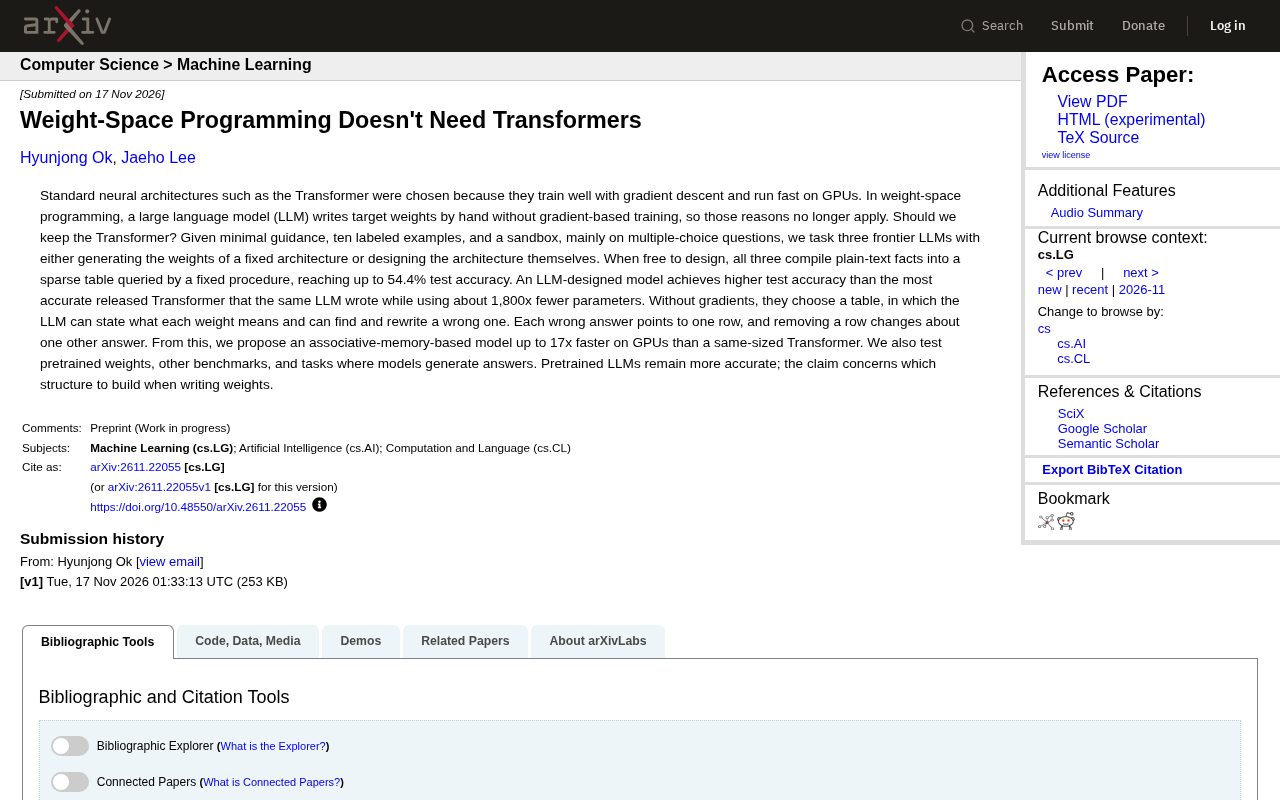
A study from rss (Weight-Space Programming Doesn't Need Transformers) approaches exactly this question. Researchers gave three frontier LLMs minimal guidance, ten labeled samples, and a sandbox environment, asking them to do two things: either generate weights for a fixed architecture, or design the architecture themselves. Testing focused mainly on multiple-choice questions.
The motivation is straightforward: since the weights are "written" rather than "trained," architecture choices should serve interpretability and editability—not the convenience of gradient descent.
Weight-Space Programming refers to a paradigm in which neural network weights are generated directly by a model or program rather than trained via gradient descent. The traditional pipeline is "define architecture → train weights on data," where weights are products of optimization; in weight-space programming, weights are "written," and the architecture is more like a designed container. This shifts the criteria for architecture selection from "does it facilitate backpropagation and GPU parallelism" to "are the weights interpretable, locatable, and editable." The concept overlaps with "HyperNetworks" and "program synthesis," but the key difference is that here the LLM directly acts as the weight author rather than training a meta-network to output weights.
Experimental Results: LLMs Chose a Lookup Table Structure
When allowed to freely design architectures, all three LLMs converged on the same approach: compiling plain-text facts into a sparse table and querying it with a fixed procedure. This design achieved 54.4% test accuracy in the best case.
More notable is the parameter efficiency comparison. A model designed by an LLM surpassed the most accurate published Transformer written by the same LLM—while using roughly 1,800 times fewer parameters.
This number matters because it shows that under weight-space programming, Transformer inductive biases provide no advantage. LLMs prefer a structure they can "read": each weight corresponds to an entry in the table with clear meaning.
Inductive Bias refers to the constraints an architecture itself imposes on the hypothesis space—for example, convolutional networks favor local translation invariance, and Transformer attention favors global token interaction. Inductive bias is typically an advantage in gradient training: it lets the model learn more generalizable patterns from less data. But under weight-space programming, the value of inductive bias is diminished, because weights aren't fitted from data—the architecture's "learning preferences" have no role to play. LLMs choose sparse tables precisely because this structure is most friendly to "writing weights": each weight corresponds to a readable entry, with no reliance on any implicit generalization mechanism.
Interpretability Comes from the Structure Itself
Without gradients, the LLM's choice of tables isn't accidental. The table structure lets the meaning of each weight be stated directly and makes error localization concrete:
- Every wrong answer points to one row in the table;
- Deleting a row changes roughly only one other answer.
This "locality" is something Transformers struggle to provide. In traditional neural networks, modifying one weight often shifts many outputs, and debugging feels like groping in a black box. Here, the LLM can directly find and rewrite the weight that was written incorrectly.
Based on this, the researchers proposed a model built on associative memory that runs up to 17 times faster on GPUs than a Transformer of comparable size. The speed advantage comes from structure: table lookup is lighter than the matrix operations of attention.
Associative Memory is a model that stores and retrieves information via key-value pairs, typically in the form of Hopfield networks or modern differentiable associative memory. Its core operation: given a query key, return the best-matching value, without multi-layer nonlinear transformations. Compared with attention, associative memory retrieval is closer to a lookup table; computation scales linearly with stored entries rather than quadratically, making it lighter on GPUs. The claim of "up to 17x faster than a same-size Transformer" stems precisely from this: table-style retrieval avoids the QK^T matrix multiplication and softmax overhead of attention, and the structure itself permits sparse access.
Boundaries and Limitations: Pretrained Models Are Still More Accurate
The paper doesn't dodge limitations. Researchers also tested pretrained weights, other benchmarks, and tasks where the model must generate answers (not just select them). The conclusion: pretrained LLMs still achieve higher accuracy.
The authors frame the claim carefully—it targets "what structure to build when writing weights," not "whether pretrained models are obsolete." In other words, weight-space programming is currently a complementary perspective, suited to scenarios requiring interpretable, editable weights rather than a wholesale replacement of existing paradigms.
From an engineering standpoint, the most practical takeaway may be this: when LLMs become the authors of weights, the objective function of architecture design shifts from "good for optimization" to "good for understanding and modification." Tables and associative memory are just one answer, but this shift itself deserves serious attention from architecture researchers.
Related articles

From 0 to 1: Vibe Coding an AI Knowledge Base — A Practical Retrospective and Tech Stack Breakdown
A retrospective on building the AI knowledge base OilBook from scratch with Vibe Coding: Next.js+Neon stack, Oil Dev Skill workflow, Stripe paywall security, interview-style writing, AI-flavor control, and Vercel deployment.

GLM-5.4 Hands-On: Native Vision Meets a New Vibe Coding Workflow
Hands-on with Zhipu GLM-5.4: native vision tested across a 3D product demo, pure-code video generation, and remote-control Vibe Coding, compared with GPT-6.2 and Gemini Neon.

AI and Humans Claim to Prove the Riemann Hypothesis: Machine-Verified, Yet Nobody Can Understand It
Anthropic mathematician and AI Claude claim to prove the Riemann Hypothesis with 17 million lines of Lean code, machine-verified but unreadable by humans. This article analyzes the event, the zero proportion record from 41.6% to 67.2%, and the gap between machine verification and human understanding.