Wepin: The Couples' Shared Map That Turns Shared Moments Into a Relationship Timeline

Wepin lets couples pin shared locations on a private map to build a visual timeline of their relationship.
Wepin is a private shared map app for couples, built by indie developer Onurcan Işık and available free on iOS and Android. After pairing up, partners can mark places they've visited together and add photos and notes, accumulating a visual relationship timeline over time. Beyond the map, the app includes daily streaks, a shared calendar, anniversary countdowns, and a wish list — covering past memories, future plans, and present connection. Its key differentiator is using the map as a spatial storytelling medium. The main challenges are the retention problem common to all couples apps and building user trust around sensitive location and photo data.
Every couple has places worth remembering — the restaurant where you had your first date, the city you explored together, that café you ducked into on a rainy night. Wepin, a new app that just launched on Product Hunt, aims to pin those scattered memories onto a private map, letting two people's shared footprints slowly fill in over time.
What Wepin Actually Is
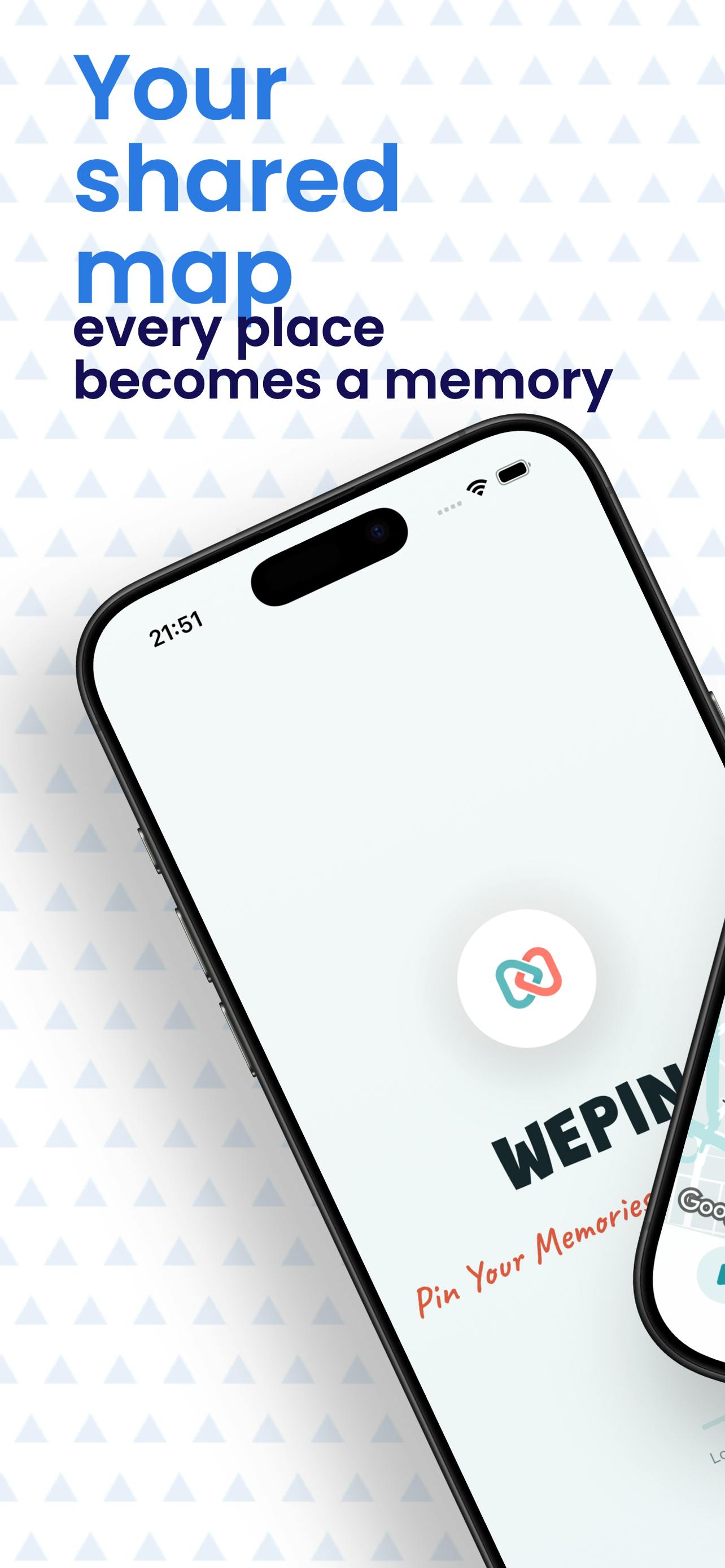
Wepin's purpose is straightforward: a private map that belongs only to you and your partner. Once two people are paired up, they can mark every place they've visited together on the map, adding photos and notes to each pin. Over time, the map fills with more and more markers, eventually becoming a visual timeline of the relationship.
The core idea is about accumulation. Everyday photos get buried in camera rolls, chat messages scroll away — but locations, as anchors for memory, tend to trigger emotional recall more naturally. Wepin structures the concept of "where we've been" and reassembles scattered moments across a spatial dimension.
More Than Just a Map: Thoughtful Feature Design
Beyond the core map-pinning feature, Wepin includes a set of small but purposeful tools built around the couples experience:
- Shared calendar and daily streaks: Borrowing the continuous-check-in mechanic from habit-tracking apps, it encourages both people to interact daily and build an emotional "combo streak."
- Anniversary countdowns: Automatically tracks important dates, helping avoid the classic "forgot our anniversary" argument.
- Wish list: A place to add locations you haven't visited yet but want to — great inspiration for your next outing.
- Home screen widget: Keeps the sense of connection right on the phone's home screen, a constant reminder of each other.
None of these features are groundbreaking on their own, but combined under the specific context of "couples," they form a complete toolkit for relationship maintenance. The map handles the past, the wish list points toward the future, and the calendar and streaks anchor the present.
The daily streaks mechanic was popularized at scale by apps like Duolingo, and its underlying logic comes from behavioral psychology's "continuous reinforcement" theory — the longer the streak, the stronger the motivation to avoid breaking it. In a couples context, this mechanic takes on a special emotional meaning: it transforms the abstract feeling of "did I think about my partner today?" into a concrete, quantifiable, shareable action. That said, over-reliance on streaks can create pressure, turning natural emotional interaction into an obligation. This is a delicate balance that couples apps need to get right in their design.
Product Positioning and Market Observations
In terms of category, Wepin sits across Maps, Lifestyle, and Couples, targeting the "relationship app" vertical. This space isn't new — from early shared expense trackers and anniversary reminders to shared scheduling tools, there's always been market demand for "two-person collaboration" in an emotional context.
Wepin's differentiating bet is on the map as a medium. Compared to purely text- or image-based records, a map brings spatial storytelling capability — you can literally see how two people's shared world has expanded, from one neighborhood to multiple cities. That kind of visualization carries its own emotional weight.
The app is currently available for free on both iOS and Android, built by indie developer Onurcan Işık. Its Product Hunt launch numbers were modest (7 upvotes, 1 comment, ranked #10) — a typical starting point for a small independent product.
What's Worth Noting — and the Challenges Ahead
For couples who love documenting their lives, Wepin offers a low-friction entry point — free, cross-platform, and focused. It takes the fuzzy idea of "shared memories" and turns it into a concrete, ongoing practice.
That said, this type of product faces inherent challenges. Retention in couples apps is highly dependent on both partners staying engaged — if one loses interest, the tool quickly falls dormant. Privacy and security are also sensitive concerns here: with location data and intimate photos involved, users pay close attention to how their data is stored and protected. Whether the product can build long-term value at the intersection of emotional stickiness and data trust will be the key to growing beyond a niche audience.
If you're looking for a more intentional way to document your journey together, Wepin is worth trying. It doesn't aim to solve any grand problem — it simply and quietly helps you piece together the places you've walked into a map that's entirely your own.
Retention is a universal pain point across the entire couples app vertical. Well-known players like Couple (later rebranded as Raft) and Between both built substantial user bases, but ultimately faced high churn due to uneven participation between partners and changes in relationship status. The privacy handling of location and photo data is equally worth scrutinizing — users typically want to know whether data is end-to-end encrypted, whether it's stored locally or on third-party servers, and whether it can be fully deleted after a breakup. For apps built around intimate relationships, a transparent privacy policy is often the first threshold for earning user trust.
Related articles

JobRunner MCP Server: AI Agents Can Now Fix Failed Java Jobs
JobRunner launches an open-source MCP server enabling AI agents to view cluster status, diagnose failures, and recover Java jobs—incident response from any cloud coding environment or existing agent.

MLAI Digital Launches 9 Security Agents: MCP Server Safeguards the Full Lifecycle of Agentic AI
MLAI Digital launches Security MCP Server with nine built-in specialized security agents covering vulnerability discovery, attack simulation, prompt injection detection, API and infrastructure assessment, and accelerated remediation—embedding security validation across the full Agentic AI lifecycle from development to production.

Running Isaac Lab on H100 GPUs: Exploring Better Approaches
Exploring optimization methods for running Isaac Lab on NVIDIA H100 GPUs, including MIG configuration, mixed precision, TensorRT acceleration, and community experience to improve robotics simulation and reinforcement learning efficiency.