WeWeb MCP: Let AI Agents Build Your App While You Stay in Control

WeWeb MCP lets AI agents build your app while keeping every change reviewable in a visual editor.
WeWeb's MCP solution connects AI agents like Claude Code, Cursor, and ChatGPT to its no-code platform, enabling them to automatically generate pages, workflows, data models, authentication, and integrations. Unlike black-box AI generators, WeWeb's key differentiator is that every AI change lands in a visual editor — no need to read raw code to review, modify, or take over. By adopting the MCP standard protocol, WeWeb supports pluggable AI clients without vendor lock-in. This design reflects a broader shift in AI dev tooling: from "full automation" toward "controllability and maintainability," positioning developers as reviewers and decision-makers rather than passive bystanders.
WeWeb MCP: AI Agents Build the App, Humans Keep the Control
WeWeb, a no-code development platform, has launched an MCP (Model Context Protocol) solution that tackles a recurring pain point in AI-assisted development: how to let AI agents genuinely participate in building applications without developers losing control over their code and product. The tool debuted on Product Hunt with 85 upvotes and a #10 ranking, categorized under software engineering, no-code, and "Vibe coding."
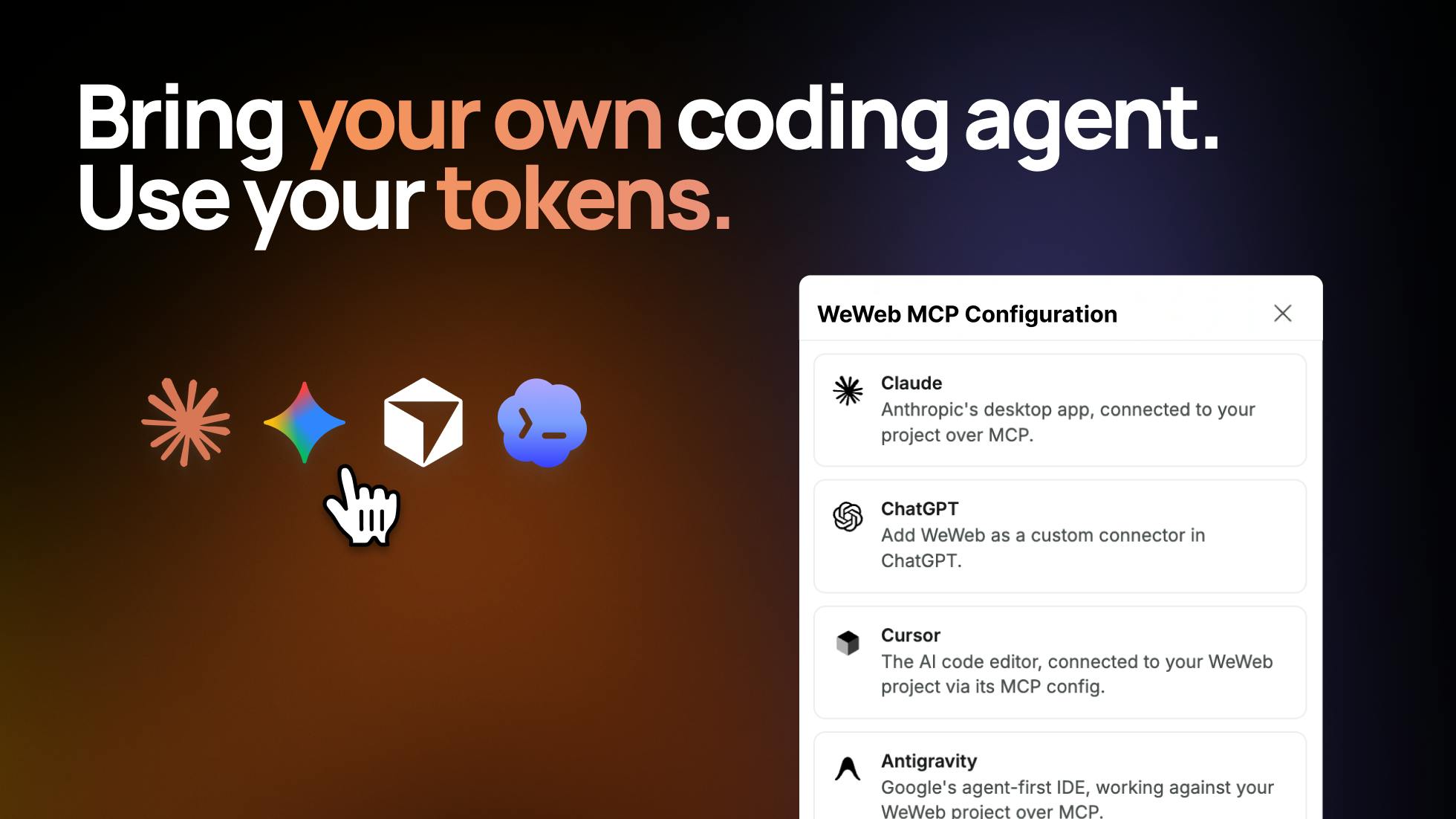
Core Philosophy: AI Does the Work, Humans Review It
WeWeb MCP's positioning can be summed up in a single slogan: "Your AI agent builds the app. You stay in control."
The approach works like this: connect Claude Code, Cursor, Codex, ChatGPT, or any MCP-compatible agent to WeWeb, and let it automatically generate pages, workflows, data models, data tables, authentication, and third-party integrations. The key differentiator is that every change the AI makes lands inside a visual editor, where developers can review, modify, and intervene at any point.
This stands in sharp contrast to the popular "black-box" model of generating an entire app from a single prompt. WeWeb emphasizes: "Your agent, your tokens, your code. No black box." — you use your own agent, consume your own tokens, and own your own code, with no opaque processes hiding anything.
Why MCP Is the Key
MCP (Model Context Protocol) has recently emerged as a universal interface standard for connecting AI agents to external tools. It allows different AI clients to call external systems in a unified way, without requiring custom integrations for each platform.
By embracing MCP, WeWeb avoids locking itself to any single AI vendor. Whether developers prefer writing code in Cursor or leveraging Claude Code's agentic capabilities, they can point to the same WeWeb backend to build. This "pluggable AI client" design reduces the cost of switching tools and positions WeWeb as a shared infrastructure layer across multiple AI workflows.
For no-code platforms, this represents a significant shift in role: previously they were visual tools operated by humans; now they also serve as a "construction site" that AI agents can directly read from and write to.
What is MCP? MCP (Model Context Protocol) was proposed and open-sourced by Anthropic in late 2024. It is essentially a standardized specification for communication between AI and external tools. Before MCP, whenever a developer wanted to connect an AI to their toolchain, they had to write custom adapter code for each AI platform separately — Claude had its own API format, OpenAI had its own, and the more tools involved, the higher the maintenance cost. MCP's core idea is to define a unified "server-client" protocol so that AI clients (like Claude Code and Cursor) can call any external system implementing the MCP interface — whether that's a database, code editor, or no-code platform — using the same approach. As an analogy, MCP is to AI toolchains what USB is to hardware peripherals: a universal connector that lets you swap devices freely. This explains why more and more SaaS platforms are rushing to add MCP support: whoever becomes the "standard entry point" for AI agents first is likely to gain a strong foothold in the next wave of AI workflow competition.
The Visual Editor: Balancing Trust and Efficiency
The most noteworthy design choice in WeWeb MCP is anchoring AI output inside a visual editor.
Purely generative AI development has a long-standing unresolved problem: after an AI generates large volumes of code or configuration, developers often struggle to understand, review, and maintain it. When something goes wrong, you end up with "AI-generated code that no one can fix." WeWeb's approach presents every AI change in a structured, visual form, so developers don't have to read code line by line — they can quickly assess whether a change meets expectations and adjust it directly in the editor.
This is essentially finding a middle ground between "fully automated AI" and "fully manual human work": AI handles the heavy lifting of initial setup and bulk operations, while humans handle oversight, fine-tuning, and final decisions. For teams delivering real production applications — not just toy demos — this reviewable, take-over-ready mechanism is often far more practical than a pure black-box generator.
Target Use Cases and Users
In terms of feature coverage, WeWeb MCP can generate pages, workflows, data models, data tables, authentication, and integrations — covering nearly the entire skeleton of a complete web application. This means its target users include both professional developers looking to accelerate their work with AI, and product teams already familiar with no-code tools who want to bring AI into their workflow for efficiency gains.
The "Vibe coding" category label also hints at its character — making development feel more like a collaborative experience of "describe intent → AI builds it → human calibrates" rather than traditional line-by-line coding from scratch.
What is Vibe coding? "Vibe coding" is a concept coined by OpenAI co-founder Andrej Karpathy in early 2025 that quickly gained traction. It refers to a style of programming where you describe your intent in natural language, rely entirely on AI to generate the code, and barely read the actual implementation. This dramatically lowers the barrier to creating software, but it also raises concerns about maintainability and reliability — when AI-generated code contains bugs or doesn't behave as expected, developers who haven't deeply engaged with the code often struggle to identify and fix the problem. WeWeb MCP falls under this category, but its design philosophy is precisely to embrace vibe coding's high efficiency while using the visual editor to add a "reviewability" safety net to the model — attempting to capture the best of both development cultures.
Observations and Takeaways
WeWeb MCP reflects a clear trend in today's AI development tooling: a shift away from chasing "full automation" toward emphasizing "controllability and reviewability." As more teams try deploying AI agents on real projects, many are realizing that control and maintainability — not raw generation speed — are what determine whether a tool can actually be adopted in practice.
Of course, the product is still in early stages. Comment counts on Product Hunt are in the single digits, and the actual generation quality, reliability with complex applications, and the synchronization experience between the visual editor and AI-driven changes still need to be stress-tested in real-world use. But the direction it proposes — "AI builds, humans review" — may well become one of the dominant paradigms in the next wave of AI-assisted development.
For teams currently evaluating AI development tools, WeWeb MCP offers a noteworthy model: rather than trying to replace the developer, it positions the developer as the reviewer and decision-maker at the end of the AI output chain.
Related articles

JobRunner MCP Server: AI Agents Can Now Fix Failed Java Jobs
JobRunner launches an open-source MCP server enabling AI agents to view cluster status, diagnose failures, and recover Java jobs—incident response from any cloud coding environment or existing agent.

MLAI Digital Launches 9 Security Agents: MCP Server Safeguards the Full Lifecycle of Agentic AI
MLAI Digital launches Security MCP Server with nine built-in specialized security agents covering vulnerability discovery, attack simulation, prompt injection detection, API and infrastructure assessment, and accelerated remediation—embedding security validation across the full Agentic AI lifecycle from development to production.

Running Isaac Lab on H100 GPUs: Exploring Better Approaches
Exploring optimization methods for running Isaac Lab on NVIDIA H100 GPUs, including MIG configuration, mixed precision, TensorRT acceleration, and community experience to improve robotics simulation and reinforcement learning efficiency.