What Are Agent Skills? A Comprehensive Guide to the AI Agent Development Architecture Paradigm

Agent Skills is a modular architecture paradigm for building AI agents with reusable, composable capability units.
Agent Skills is a development architecture for AI agents that organizes capabilities into modular, reusable components called Skills. Built on Anthropic's MCP (Model Context Protocol), it standardizes how agents interact with tools and data sources. Combined with multi-agent systems, harness frameworks, and deep agents, Skills provide the architectural foundation for enterprise-grade AI agent applications.
What Are Agent Skills: An In-Depth Breakdown from Concept to Architecture
In the field of AI Agent development, the technical concept of Agent Skills is rapidly gaining traction. Many developers feel confused when they first encounter this term, and may even struggle to answer when asked "Are you familiar with Skills?" in a technical interview. But in reality, understanding it isn't as complex as it might seem.
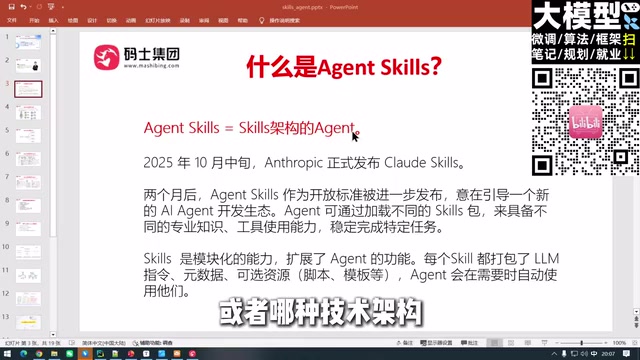
Literally speaking, "Skill" refers to an ability or capability. However, Agent Skills doesn't refer to a specific function — it's actually a development architecture for AI agents, or more precisely, a technical solution framework. When an enterprise needs to develop an AI agent application, they inevitably need to choose a technical architecture, and Agent Skills is one of the most noteworthy approaches available today.
What Is an AI Agent?
To understand Agent Skills, you first need to clarify what an AI Agent is. An AI Agent is a software system capable of perceiving its environment, making autonomous decisions, and taking actions to achieve goals. Unlike traditional reactive programs, Agents possess proactivity, autonomy, and adaptability. After the rise of Large Language Models (LLMs), the concept of Agents expanded significantly — modern AI Agents typically use an LLM as their "brain," combined with memory, planning, and tool-calling capabilities, enabling them to handle everything from simple Q&A to complex multi-step reasoning tasks. This concept can be traced back to multi-agent system research in the 1990s, but it truly entered the engineering implementation phase after projects like AutoGPT and BabyAGI drew attention in 2023.
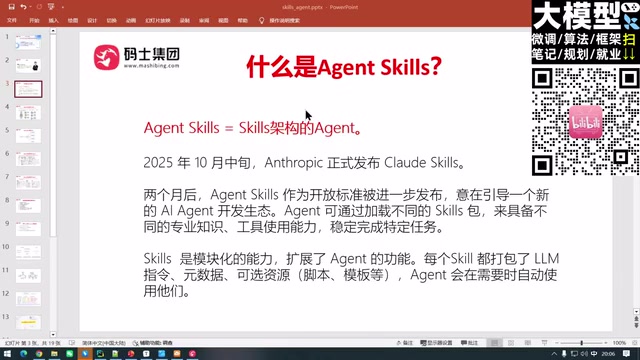
In short, a Skill is a technical framework — a specific implementation approach for Agents. The core question it answers is: when you need to build an AI agent application, what organizational method and architectural pattern should you adopt?
From Skills to Architecture: Design Philosophy and Advantages
Why use the word "skill" to name an architecture? There's a distinctive design philosophy behind it.
Traditional agent development often hard-codes various capabilities together, resulting in high coupling and poor reusability. The core idea of the Skills architecture is to make each agent capability modular and componentized — just as humans possess multiple independent "skills," an AI agent can also have reusable, composable capability units.
The Engineering Origins of Modular Design
Modular design is a classic paradigm in software engineering. Its core idea is to decompose complex systems into independent, replaceable, and reusable functional units. There are mature practices in microservice architectures, plugin systems, component-based frontends, and more. Agent Skills brings this philosophy into agent development, essentially deconstructing the "monolithic agent." This aligns with the Unix philosophy of "each program should do one thing well." In practice, modularity also brings significant advantages such as testability (each Skill can be tested independently), maintainability (modifying one Skill doesn't affect others), and team collaboration efficiency (different developers can work on different Skills in parallel).
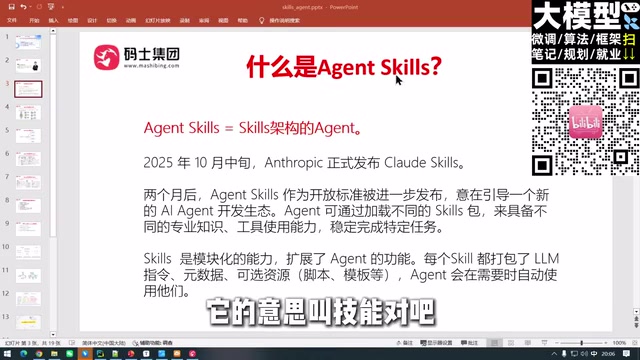
The benefits of this design are obvious:
- Flexible Assembly: Developers can equip agents with the skills they need for different task scenarios, without building from scratch every time.
- Engineering Standardization: Makes agent development more standardized and better suited for enterprise production environments.
- Capability Reuse: A single Skill can be shared across multiple Agents, dramatically improving development efficiency.
Positioning Agent Skills in Interviews and Real-World Practice
For practitioners preparing to enter the AI development field, understanding the precise positioning of Skills is crucial. When an interviewer asks about it, you need to clearly articulate:
A Skill is a development architecture and solution for Agents. It solves the problem of "how to organize and build agent capabilities." This is different from a specific programming language or a particular API call — it belongs to a higher-level architectural choice.
MCP Protocol: The Ecosystem Foundation of Agent Skills
To fully understand Agent Skills, you cannot avoid MCP (Model Context Protocol). MCP is a protocol commonly used in agent development, which can be understood as the standard interface for communication between agents and external tools or data sources.
Anthropic and the Birth of MCP
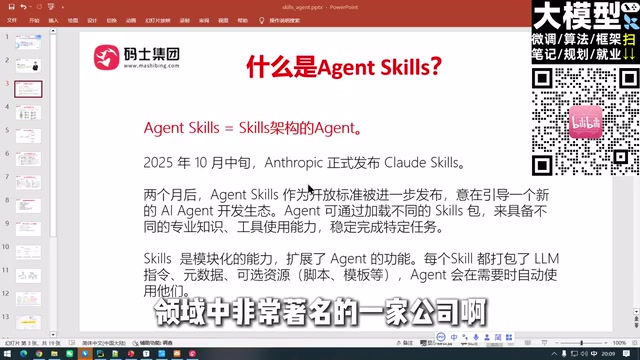
MCP was released by Anthropic. Founded in 2021, Anthropic was co-founded by siblings Dario Amodei and Daniela Amodei, former OpenAI Research Vice President and colleagues. The company focuses on AI safety research and large model development, with its core product, the Claude model series, known for safety, controllability, and long-context processing capabilities. Anthropic emphasizes "Constitutional AI" in its technical approach, constraining model behavior through a set of principles. The company has raised over $7 billion in cumulative funding from investors including Google, Amazon, and other tech giants. Anthropic's release of open standards like MCP and Agent Skills reflects its strategic position of "establishing safety standards while advancing AI capabilities."
Technical Principles of MCP
MCP (Model Context Protocol) is an open protocol based on JSON-RPC 2.0, using a client-server architecture. It defines three core primitives: Resources (providing contextual data), Tools (executing specific operations), and Prompts (prompt templates). MCP's design was partly inspired by LSP (Language Server Protocol), which achieved standardized integration between editors and language services in the IDE domain. MCP attempts to achieve a similar effect in AI — allowing any agent to connect to any external tool or data source through a unified interface, without writing custom code for each integration. This standardization greatly reduces the risk of ecosystem fragmentation.
Key Timeline of Technical Evolution
From a timeline perspective, the development pace of this ecosystem is noteworthy:
- Mid-October 2025: MCP protocol officially released, providing a standardized protocol for agent-external resource interaction.
- December 2025: Agent Skills released as an open standard, aimed at guiding a new AI development ecosystem.
From the protocol layer (MCP) to the architecture layer (Skills), Anthropic built a relatively complete set of agent development standards within just two months. The approach of releasing these as open standards has a clear objective — to drive the entire industry toward a unified development paradigm and lower the barrier to agent application development.
The Profound Significance of Open Standards for the AI Ecosystem
Open standards have played critical roles throughout technology history — HTTP unified web communication, SQL standardized database queries, and the OCI container standard drove cloud-native ecosystem prosperity. In the AI domain, the lack of open standards once led to severe ecosystem fragmentation: every framework had its own tool interface definitions, and every platform had unique plugin specifications. The release of MCP and Agent Skills as open standards means third-party developers, enterprises, and communities can all build on unified specifications, avoiding reinventing the wheel while reducing vendor lock-in risks. This approach is similar to how Google open-sourcing Kubernetes drove container orchestration standardization, ultimately benefiting the entire industry.
Multi-Agent Collaboration: The Complete Technology Stack Panorama
In real-world agent projects, Agent Skills doesn't exist in isolation. Instead, it works in concert with multiple technical components to form a complete solution. Here's a comprehensive overview of the core technical components:
Multi Agent (Multi-Agent Systems)
Multi-agent systems refer to multiple Agents collaborating to complete complex tasks. Compared to single agents, multi-agent architectures can achieve task division and collaboration, handling more complex business scenarios.
Research on Multi-Agent Systems (MAS) can be traced back to the field of distributed artificial intelligence. In engineering practice, multi-agent collaboration faces several core challenges: task decomposition and allocation (how to break down complex tasks and assign them to appropriate Agents), communication mechanisms (how Agents efficiently pass information to each other), conflict resolution (how to coordinate when multiple Agents' decisions contradict each other), and global consistency (ensuring coherence of final outputs). Current mainstream frameworks such as CrewAI, AutoGen, and LangGraph are all attempting to solve these problems, while the Agent Skills architecture provides a more standardized way to organize capabilities for multi-agent scenarios.
Harness (Framework and Support Structure)
Harness can be understood as the support framework for agent execution, providing runtime environments and scheduling capabilities for Agents. It serves as the skeleton connecting all components. Similar to an application server or container runtime in web development, it manages the Agent's lifecycle, resource allocation, error handling, and state management — handling the underlying infrastructure so developers can focus on implementing business logic.
Tools (Tool Layer)
Tools are extensions of an agent's capabilities. By calling external tools, Agents can transcend the inherent limitations of large models to accomplish specific tasks like computation, information retrieval, and system operations. In the Agent Skills architecture, Tools are standardized through the MCP protocol, allowing the same tool to be called by different Skills and different Agents to share the same tool ecosystem. Common tool types include: code executors, search engine interfaces, database queries, file operations, and API calls.
MCP (Communication Protocol Layer)
As mentioned earlier, MCP serves as the communication protocol responsible for standardizing the interaction patterns between agents and tools/data, ensuring efficient collaboration across modules.
Deep Agent
Deep Agent represents a more complex, more autonomously capable form of AI agent that can handle high-difficulty tasks requiring multi-step reasoning and long-horizon planning. Unlike simple instruction-execution Agents, Deep Agents typically possess self-reflection, strategy adjustment, and dynamic planning capabilities, allowing them to autonomously explore solution paths when facing uncertainty. These agents often require more complex Skill combinations and more granular orchestration logic.
These components together form the complete technology stack for modern agent development. Agent Skills, as the architecture layer, serves as the critical hub that organically connects all the parts together.
How AI Developers Can Capitalize on the Agent Skills Opportunity
For developers looking to go deep in the AI field, mastering Agent Skills and its supporting technology ecosystem is becoming an important professional competitive advantage. As this set of open standards gradually gains adoption, talent who can proficiently use Multi Agent, MCP, Tools, and other technologies for hands-on development will have a head start in the wave of AI application deployment.
It's worth noting that this technology ecosystem is still evolving rapidly. Both MCP and Skills are relatively new concepts, and the standards are continuously being refined. Therefore, developers should:
- Stay current with cutting-edge developments, keeping up with the latest standards and documentation released by leading companies like Anthropic. Also pay attention to Microsoft, Google, and other companies' efforts in agent standardization (such as Google's A2A protocol), understanding the similarities, differences, and complementary relationships between different standards.
- Get hands-on with real projects, accumulating experience in actual multi-agent collaboration scenarios. You can start by building a single Skill, then gradually expand to multi-Skill compositions and complex multi-Agent collaboration scenarios.
- Deeply understand architectural thinking, rather than staying at the surface level of API calls. Understanding why modularity matters, why communication protocols are needed, and why standardization is important — these architecture-level insights have more long-term value than specific technical details.
Theoretical knowledge is just the starting point. Only through repeated practice in real projects can you transform architectural concepts like Agent Skills into genuine development capabilities.
Key Takeaways
Related articles

Roc 0.1.0 Preview: A Fast, Friendly, and Functional New Programming Language
Roc language nears its first numbered release 0.1.0, transitioning from experimental to usable. Explore its platform architecture, core features, and toolchain.
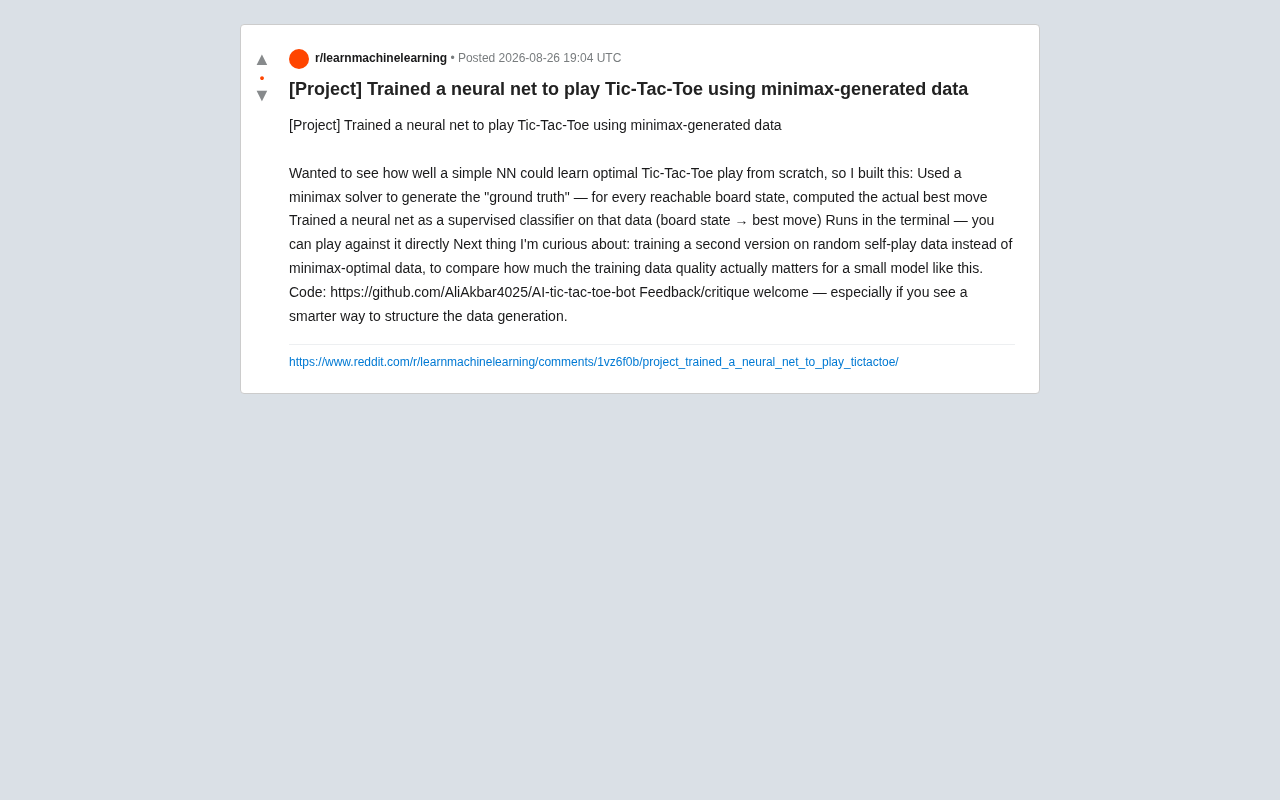
Training a Neural Network to Play Tic-Tac-Toe with Minimax Data: A Data Quality Experiment
Explore how Minimax-generated optimal data trains a neural network to play Tic-Tac-Toe. This article covers knowledge distillation, supervised learning modeling, and how data quality critically impacts small model performance.
Gemini Conversation History vs. Google Activity Logs: A Hidden AI Data Transparency Concern
A user discovered persistent inconsistencies between Google Gemini's conversation history and account activity logs, raising AI data transparency and privacy compliance concerns.