What Can Large Language Models Do? Core Principles and Real-World Use Cases Explained
A clear breakdown of how LLMs work, what they can do, and how to use them effectively in real-world scenarios.
This article demystifies large language models by explaining their core token-prediction mechanism and dispelling the myth that they "understand" the world like humans. It covers three major capability areas — NLP, speech, and multimodal processing — and walks through practical use cases including sentiment analysis, text classification, coding assistance, content creation, and role-playing, while clearly defining where LLMs fall short. Key tips on understanding boundaries, crafting better prompts, and integrating LLMs into daily workflows round out the guide.
Introduction: Understanding Use Cases Is the Key to Using LLMs Effectively
Most people's experience with large language models (LLMs) stops at opening a chat window and typing a few casual questions. But to turn them into genuine productivity tools, you first need to understand one thing: what LLMs are actually good at — and what they're not. Only by knowing their capability boundaries can you use them strategically, rather than treating them like some all-knowing magic machine.
This article starts from the core mechanics of how LLMs work, systematically covers their real-world applications in natural language processing, coding assistance, content creation, and more — and clears up one critical misconception: LLMs do not "understand" the world the way humans do.
Three Core Capability Areas of Large Language Models
Today's LLMs are primarily strong in three areas:
- Natural Language Processing (NLP): The most mature and widely applied domain, covering text generation, summarization, sentiment analysis, and more
- Speech Processing: Speech recognition, text-to-speech synthesis, meeting transcription, and similar tasks
- Image and Video Processing: Image analysis, video content summarization, and related tasks
As the technology evolves, these three areas are rapidly converging toward multimodality — meaning models are no longer limited to processing a single type of input. Where older models could only handle "text in, text out," today's models can simultaneously understand text, images, audio, and video.
Some practical examples: upload a product photo and a model can analyze its structure; send a recorded meeting and it can auto-generate meeting notes; give it a video clip and it can summarize the content. At their core, all of these capabilities come down to understanding and converting information across different modalities.
How LLMs Actually Work: Do They Really "Understand" Your Question?
This is the most important concept in this entire article. Many people assume LLMs work like humans: first understand your question, then retrieve the answer from some knowledge base. That's not what's happening.
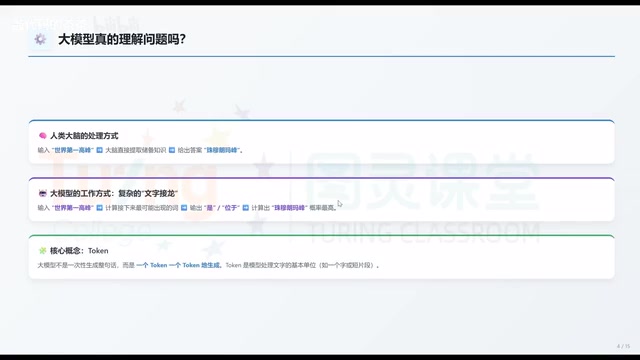
Token Prediction: Essentially a Very Sophisticated "Word Chain" Game
Take DeepSeek as an example. When you type "the world's highest mountain," the model doesn't look up a stored answer. Instead, it's doing something more like an extremely complex word-completion exercise.
After receiving your input, the model calculates what word or phrase is most likely to come next — maybe "is," maybe "located," maybe something else. Based on the vast language patterns it learned during training, it assigns probabilities to each possible continuation. Since "Mount Everest" has an extremely high probability of appearing in this context, the model generates it.
Here's the key insight: LLMs don't generate a full sentence all at once — they generate one token at a time. A token is the basic unit of text the model processes; for English it's roughly a word or word fragment. The model predicts the next token, adds it to the context, predicts the next one, and repeats — building up a complete response.

How Context Shapes Model Output
If you change your input to "the world's highest mountain is located," you'll notice the model's response shifts — it's now more likely to output "on the border between China and Nepal." This shows the model isn't just looking at individual words; it's analyzing the full context of the sentence.
This is exactly why prompts matter so much. Ask "tell me about Apple" in a context about fruit, and the model will talk about nutrition, varieties, and growing regions. Ask the same thing in the context of a tech company, and it will describe the corporation. LLMs are fundamentally probability models, but they operate over extraordinarily complex contextual probability relationships.
LLM Capabilities and Limitations for Complex Tasks
If an LLM is just predicting the next token at its core, how can it handle seemingly complex tasks like sentiment analysis, text classification, or math problems?
Sentiment Analysis: From Keywords to Contextual Understanding
Give the model the sentence "The service at this restaurant was excellent — I'll definitely be back" and ask whether it's a positive or negative review. The model doesn't actually feel emotions the way a human does; instead, it recognizes keywords like "excellent" and "definitely be back" — words that frequently appeared alongside positive reviews in its training data — and uses the context to judge the overall sentiment.
Even a sentence like "The prices were steep, but the service was excellent" — which contains a negative element — can be correctly identified as an overall positive review by factoring in the full context.

Text Classification: A Classic Enterprise Use Case
Given multiple sentences — "The work pressure is intense, I'm staying late every day," "Finding a job is getting harder and harder," and "Finishing this project was really satisfying" — a model can automatically sort the first two under work stress/life difficulties and the third under positive sentiment.
This capability is enormously valuable in enterprise settings. Customer feedback that used to require manual review can now be pre-sorted by an LLM into categories like product issues, complaints, feature requests, and positive feedback — leaving human staff to focus only on what matters most, dramatically improving efficiency.
Math and Logical Reasoning: Know the Boundaries
For a simple expression like "(5+6)×2," LLMs can quickly give the right answer because this type of data appeared extensively in training. But for something like "use 3, 7, 8, and 9 to make 24" — which requires trying multiple combinations — what looks like "thinking" is actually the model generating a solution path that fits the training patterns and context, not a true understanding of mathematical rules.
Logical reasoning puzzles make this even clearer. Take the classic problem: "You have a rope that burns unevenly and takes exactly one hour to burn completely. How do you measure 75 minutes?" (The correct solution: light both ends of the first rope simultaneously — it burns in 30 minutes — then light one end of the second rope for the remaining 45 minutes, totaling 75.) LLMs sometimes produce answers that look plausible but contain logical gaps, because they're generating the most statistically likely answer, not a mathematically verified proof.
Important warning: In financial, legal, and medical contexts, you cannot fully rely on model output. The right approach is to use LLMs for analysis, organization, and ideation — while keeping critical decisions subject to human verification.
Real-World LLM Use Cases in Depth
LLMs aren't omniscient robots. They don't understand the world the way humans do — but they have a powerful capability: rapidly processing large amounts of information and generating valuable output based on existing knowledge.

Coding Assistance: Where Developers See the Biggest Gains
Where you used to dig through official docs, search tech forums, and iterate through debugging sessions, you can now hand your requirements directly to an LLM. Ask it to "implement bubble sort in Python with test cases" and it won't just generate the sorting function — it'll address parameter design, loop logic, edge case handling, and even explain the code line by line. This is incredibly useful for beginners trying to understand existing codebases; it's like having an on-call coding mentor.
But can LLMs replace developers? The answer is no. Writing code is just one step in software development. The genuinely hard parts are system architecture design, decomposing business requirements, security considerations, and long-term maintenance. An LLM can write a login feature in minutes, but a real commercial system also needs user permissions, data security, password encryption, exception handling, and high-concurrency support. What LLMs are doing is changing how developers work and boosting their efficiency — not simply replacing them.
Content Creation: End-to-End Assistance From Outline to Draft
Writing articles, video scripts, slide decks, or marketing copy — all of these are fundamentally language generation tasks. For example, if you're making an introductory video about AI, you can ask the model to generate an outline first, then produce a voiceover script based on that outline. LLMs excel at generating content that fits specific formats, because they've learned these structures from massive training datasets.

That said, model-generated content isn't automatically high quality — it doesn't know your target audience, your voice, or your goals. The more specific your input, the better the output.
Role-Playing: A Powerful Learning Tool for Simulating Professional Scenarios
You can ask a model to simulate a historical figure, a professional consultant, a teacher, or an interviewer. For example: "You are a software engineering interviewer with 20 years of experience. Please begin the interview." The model will adjust its tone and responses to simulate that role's knowledge and perspective. This is enormously useful for language learning, mock interviews, and technical study.
Three Key Techniques for Getting the Most Out of LLMs
To sum up: the real value of an LLM isn't that it does everything for you — it's that it becomes a highly capable intelligent assistant. Three things matter most:
1. Understand the Capability Boundaries
LLMs excel at summarizing information, generating content, analyzing text, assisting with code, and brainstorming. But they don't guarantee every statement is accurate, every data point is current, or every reasoning step is correct. For anything important, always cross-verify.
2. Master Prompt Optimization
Prompts should be clear, specific, and information-rich. Instead of "write me some copy," try: "Design an AI application proposal for a manufacturing company, targeting senior management, covering use case scenarios, cost analysis, and implementation steps." The more context you provide, the more precise the output.
3. Integrate LLMs Into Your Daily Workflow
The truly efficient approach isn't occasional chatting — it's making LLMs part of your workflow: summarizing documents, polishing emails, explaining new technologies, assisting with code. Their value only becomes real when they're woven into your everyday work.
Related articles

Invalid Source Material Notice
The source material provided lacks substantive information and is unrelated to AI/tech topics, making it impossible to produce a complete professional article.

Invalid Source Material: Unable to Generate a Valid AI/Tech Article
This Twitter source material is an irrelevant marketing tweet with no AI or tech content, making it impossible to generate a valid professional article.
Insufficient Source Material: Unable to Generate a Valid Article
The source material was limited to a single broken tweet with no usable content, making it impossible to produce a complete, high-quality article.