What Happened to Silicon Valley? O'Reilly Long-Form Piece Sparks Heated Debate on Hacker News

O'Reilly's long-form piece questions Silicon Valley's shifting identity, sparking 302 points and 153 comments on Hacker News.
O'Reilly Radar published "What Happened to Silicon Valley?", which earned 302 points and 153 comments on Hacker News. The title's presupposition of loss questions Silicon Valley's identity, implying a rupture with its mythologized version. The HN comment section debated declining innovation density, capital logic overwhelming technological ideals, high costs squeezing out creators, and whether "Silicon Valley" still holds as a geographic and cultural concept. Remote work, shifting valuation logic, and generative AI are blurring Silicon Valley's identity, and the discussion itself reflects the tech community's collective anxiety better than the article's conclusions.
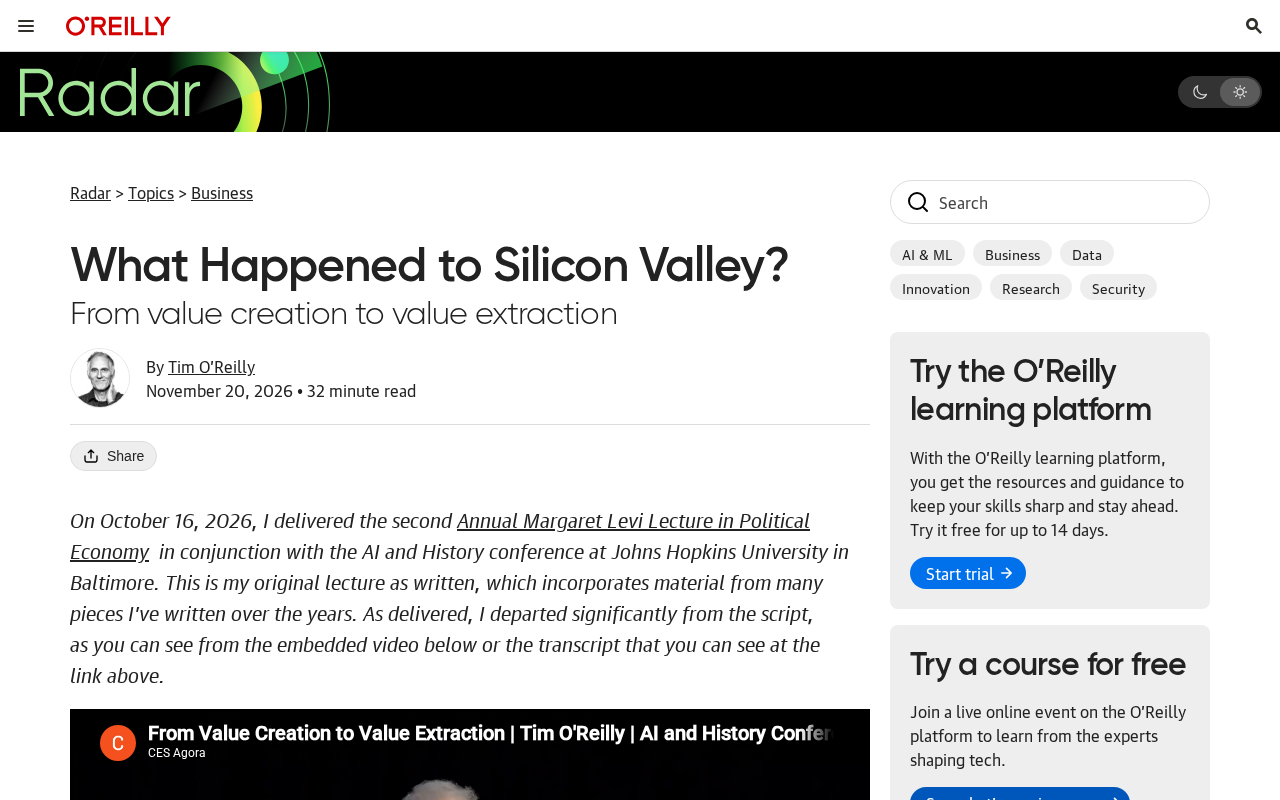
O'Reilly Radar published an article titled "What Happened to Silicon Valley?", which quickly ignited discussion on Hacker News—the post earned 302 points and 153 comments. That alone says something: questions about Silicon Valley's identity and direction still strike a chord with the tech community's collective mood.
A Public Conversation About "Silicon Valley Has Changed"
Judging by the Hacker News engagement data, this is no obscure bit of industry nostalgia. A score of 302 points means it made it into the day's trending view, and 153 comments show readers had a strong urge to weigh in—some agreeing, some pushing back, others using the piece as a springboard to share their own Silicon Valley stories.
There's a notable signal behind this level of engagement: when an article about "what happened to Silicon Valley" draws this scale of response, it suggests that tech workers' dissatisfaction or confusion with the current ecosystem has accumulated to the point where it needs a public outlet. The discussion itself reveals more about the community's mindset than the article's conclusions do.
Hacker News is operated by the venture capital firm Y Combinator and is a community where tech founders, engineers, and investors congregate heavily. Its content ranking isn't based purely on page views but is determined by a combination of user votes and time decay. A post's "score" comes from net votes (upvotes minus downvotes), so 302 points means the piece consistently earned positive evaluations over an extended period rather than briefly spiking. Comment count is a separate dimension: it reflects controversy rather than simple agreement. In HN's context, a high score paired with high comment volume usually means a topic is both widely acknowledged as important and sharply divided on specifics—discussions like this tend to reflect the community's true distribution of attitudes better than one-sidedly positive posts.
The Core Question: Is Silicon Valley Still Silicon Valley?
The question in the title carries an obvious presupposition of loss. O'Reilly, as a media outlet that has long observed the tech industry's evolution, chose this framing to re-examine Silicon Valley—which itself implies a judgment: there's a rupture worth naming between today's Silicon Valley and the mythologized version of it.
The HN comment section is often more compelling than the original article. From the structure of the discussion, it's possible to infer that the debate centered on several fronts: whether innovation density has declined, whether capital logic has overwhelmed technological ideals, whether high costs have driven out creators, and whether "Silicon Valley" as a geographic concept still carries its original cultural meaning. These themes recur in the tech community, but each time they surface, they correspond to new real-world pressures.
"The mythologized Silicon Valley" points to a long-circulating narrative template: garage startups, technology as the core driving force, venture capital and engineer culture coexisting, failure being tolerated and rapid iteration. This narrative was repeatedly retold by media, business schools, and startup communities from the 1990s through the 2010s, gradually becoming a cultural symbol rather than an accurate description of reality. Notably, Silicon Valley's industrial structure has already undergone multiple transformations—from semiconductors and hardware, to internet software, to the platform economy, and now to AI—each accompanied by nostalgia for the "original spirit." So the question "has Silicon Valley changed?" is not new; it's more like a fixed rhetorical device of cyclical self-examination in the tech industry, differing only in the specific pressures each round faces.
Why This Topic Is Heating Up Again Now
The shift in Silicon Valley's narrative didn't happen overnight. The normalization of remote work has changed the physical logic of talent concentration, the capital market's valuation logic for tech companies is adjusting, and the explosion of generative AI has led some to believe again in the story of "technology changing the world." Pulled by multiple forces, Silicon Valley's identity has become blurred.
O'Reilly's article offers a framework for taking stock, while the Hacker News comment section provides real reactions from the front lines. Together they form an instant snapshot of cultural change in the tech industry. For readers following the industry's direction, both the original piece and the discussion thread are worth reading in full.
Original link: https://www.oreilly.com/radar/what-happened-to-silicon-valley/
HN discussion: https://news.ycombinator.com/item?id=50602947
Generative AI is seen as a narrative turning point because it simultaneously satisfies two sets of expectations: on one hand, it creates a new technological frontier and startup window, lending renewed support to the claim that "technology itself remains the core asset"; on the other hand, the compute, data, and capital thresholds required to train large models are far higher than those of previous software startups, which instead reinforces the trend of resources concentrating in a few large companies. This duality makes generative AI both a revival of the Silicon Valley spirit and evidence of its hardening barriers, making it hard for the community to form a unified judgment. Remote work's impact is more geographic: talent no longer has to relocate to the Bay Area to participate in core projects, eroding Silicon Valley's monopoly as a source of "talent density."
One-line Summary
O'Reilly's long-form piece questions Silicon Valley's shifting identity, sparking 302 points and 153 comments on Hacker News.
Paragraph Summary
O'Reilly Radar published "What Happened to Silicon Valley?", which earned 302 points and 153 comments on Hacker News and made it into the day's trending view. The title's presupposition of loss questions Silicon Valley's identity, implying a rupture between today's Silicon Valley and its mythologized version. The HN comment section debated whether innovation density has declined, whether capital logic has overwhelmed technological ideals, whether high costs have squeezed out creators, and whether "Silicon Valley" still holds as a geographic and cultural concept. The normalization of remote work, shifting capital market valuation logic, and the explosion of generative AI are together pulling at Silicon Valley's narrative, blurring its identity. The discussion itself reflects tech workers' collective mood and ecosystem anxiety better than the article's conclusions.
Related articles

ChatGPT Plus Subscription Pitfall Guide: Go/Plus/Pro Tier Comparison and Quick Activation
A complete ChatGPT Plus subscription guide based on a Bilibili tutorial: from registering an account, comparing Go/Plus/Pro tiers, to the practical steps for quickly completing your subscription.

GPT-6.2 Sol/Astra Released! A Step-by-Step ChatGPT Plus Subscription Guide and Tier Comparison
GPT-6.2 Sol/Astra is out—here's a ChatGPT Plus subscription guide: register an account, compare Go/Plus/Pro tiers, and subscribe in a minute.

Comparing Three Channels for Subscribing to GPT Plus in China: Is Website Top-Up the Easiest?
How to subscribe to GPT Plus in China? This article compares website top-up, credit card, and mobile top-up channels—process, cost, and risk—with steps and tips to help you choose wisely.