What Is Agentic Text-to-SQL? How It Works and Its Business Value

Agentic Text-to-SQL upgrades AI from generating queries to completing full data analysis tasks with enterprise context and governance.
The article explains how Agentic Text-to-SQL evolves natural language querying from a simple SQL generation tool into a goal-oriented data analysis workflow. Traditional Text-to-SQL is limited because generated queries may lack business context and produce misleading answers. The agentic approach uses a six-step process — intent understanding, schema grounding, SQL generation, validation, result correction, and insight generation — combined with semantic grounding, knowledge graphs, and RAG. Governance must be built into the architecture, including RBAC, query validation, auditability, and human oversight.
Enterprises never lack data — what they lack is the speed to turn data into decisions. Sales figures are scattered across databases, financial information spans multiple systems, and operational metrics hide inside dashboards — when someone asks a simple business question, getting a reliable answer often requires technical experts, multiple rounds of SQL queries, and repeated analysis. Agentic Text-to-SQL is changing this.
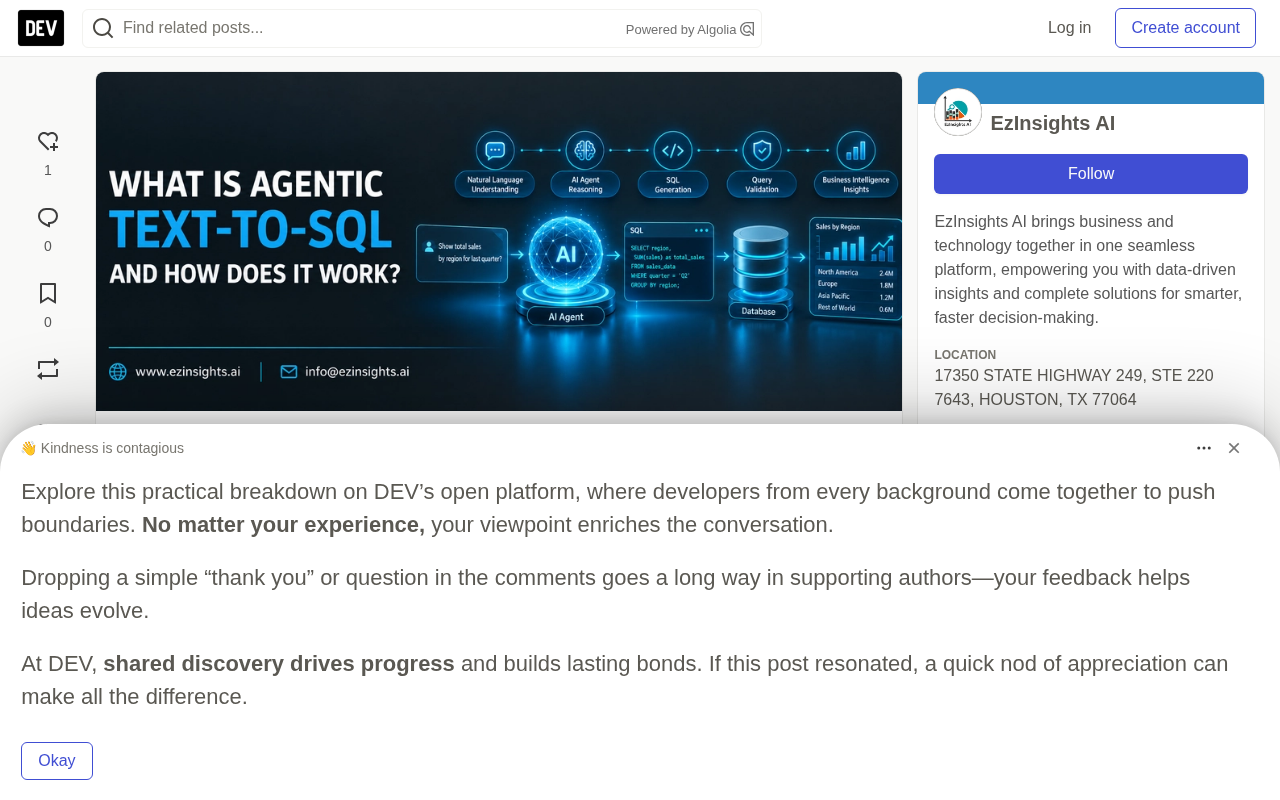
Its core idea isn't simply translating natural language into SQL, but using AI agents to complete the full process — from understanding intent, inspecting database structure, planning the analysis path, generating SQL, validating queries, interpreting results, and correcting the approach when necessary. This means Text-to-SQL is evolving from a "query generation tool" into a "goal-oriented data analysis workflow."
Why Traditional Text-to-SQL Is No Longer Enough
Traditional Text-to-SQL lets users ask questions in natural language, lowering the barrier to data access. But generating SQL is only one step in solving a business problem. AI may produce a query that runs successfully yet uses the wrong business definitions, joins irrelevant tables, omits critical filters, or interprets a metric differently from the finance team.
Take the question "Why did our profit margin decline last month?" A basic Text-to-SQL system might return a monthly profit table. But what the business actually needs to know is: did the decline come from rising costs, falling sales, a shift in product mix, regional performance differences, or changing customer behavior? The first query produced a number, while the real business need was an evidence-backed explanation.
The complexity of enterprise data compounds this challenge: tables may contain thousands of fields, business metrics have organization-specific definitions, and important context may live outside the database in documents, policies, and operational reports. EzInsights AI's Data Intelligence Framework proposes an approach that combines semantic search, knowledge graphs, and autonomous agents to connect data with business context.
The next generation of Text-to-SQL must do more than translate language into code — it must understand the question, find the right data, validate the approach, and explain what the results mean.
Core Capabilities of Agentic Text-to-SQL
Agentic Text-to-SQL is an AI-driven approach that combines natural language understanding, SQL generation, structured reasoning, validation, and iterative problem-solving.
The term "agentic" describes systems capable of executing multi-step work toward a defined goal — they keep moving forward using available tools and feedback, rather than stopping at the first answer. Depending on the design, specialized agents can handle user intent, database metadata, SQL generation, business rule checking, query execution, result validation, and explanation separately.
For example, when a business user asks "Which regions missed their quarterly revenue targets, and what's driving the gaps?", an agentic workflow might: identify the relevant revenue, target, region, and date fields; retrieve the organization's approved definitions for revenue and target attainment; generate SQL comparing actual revenue against targets by region; validate the query against database relationships and permissions; execute the query and check whether the results are complete and reasonable; investigate contributing factors through additional queries; and finally present a concise explanation, supporting numbers, and charts.
The specific steps depend on system capabilities and the permissions granted. Not every product that brands itself "agentic" can autonomously perform all of the above. The key distinction: traditional Text-to-SQL focuses on producing a query, while Agentic Text-to-SQL focuses on completing a data analysis task through a controlled sequence of steps.
A Six-Step Process from Natural Language Question to Business-Grade Answer
Intent understanding — The system identifies what the user wants to know, which metrics, time ranges, filters, and expected outputs are involved. If the question is ambiguous, the system requests clarification.
Semantic and schema grounding — The system examines available tables, fields, relationships, metric definitions, and relevant business terminology to determine which data should be used.
SQL planning and generation — Builds a query with the necessary joins, aggregations, conditions, and date filters, following the database dialect and business logic.
Validation and controlled execution — Safety checks assess whether the query is permitted, structurally correct, and reasonably efficient, then execute it under appropriate database permissions.
Result validation and correction — If execution fails, results are incomplete, or checks uncover issues, the system can revise the query or request clarification. A query that runs successfully does not by itself prove that the business interpretation is correct.
Insight generation — The final response turns query results into readable explanations, tables, visualizations, and possible follow-up questions, with enough context for users to evaluate the conclusions.
Schema Grounding is a critical step in Text-to-SQL, referring to how the system maps business terms in natural language to actual tables, fields, primary/foreign key relationships, and constraints in the database. Enterprise databases often have thousands of tables and fields, with names that may be abbreviated, ambiguous, or synonymous. If the mapping is wrong, the generated SQL may run but query the wrong table or miss a join. Schema grounding typically relies on metadata catalogs, field comments, and business glossaries, and it is the prerequisite for subsequent SQL correctness.
Semantic Grounding goes further, binding the metrics in a user's question (such as "profit margin" or "target attainment rate") to the organization's approved business definitions and calculation logic. It addresses the problem of "the same word meaning different things in different departments," and often depends on a metric layer or semantic layer. Only when both schema grounding and semantic grounding are correct can SQL be both structurally and business-correct.
The Intelligence Behind the Query: Why Context Matters
A beautifully written SQL query can still produce misleading business answers if it lacks the right context. For example, two departments may define customer retention differently, or one report's revenue may exclude refunds while another includes them.
This is where semantic grounding and knowledge graphs come in. Knowledge graphs can represent relationships among business entities, metrics, definitions, and rules. Rather than relying entirely on a language model's general knowledge, the system uses organization-specific context to determine the correct interpretation.
Retrieval-augmented generation (RAG) can add another layer — retrieving relevant information from approved documents, policies, standard operating procedures, and other knowledge sources. This is especially useful when a question requires both structured numbers and explanations from business documents.
Consider a question like: "Are we meeting our service-level commitments, and which issues are putting delivery at risk?" Structured data might reveal ticket resolution times and overdue counts, while operational documents explain the applicable service-level rules. Connecting these sources yields more valuable answers than querying a single table.
The goal isn't to eliminate every possible error, but to reduce guesswork by grounding the process in reliable enterprise context, validating results, and — where appropriate — making the reasoning auditable.
A knowledge graph is a technology that organizes data in a graph structure, where nodes represent business entities (such as customers, products, regions, metrics) and edges represent relationships between them (such as "belongs to," "affects," "calculated from"). In enterprise analytics, a knowledge graph can link metrics like revenue, profit margin, and retention rate to their calculation formulas, data sources, and applicable business rules, enabling AI systems to trace the business meaning of a metric when generating SQL, rather than relying solely on field-name guesses. Compared with traditional relational tables, knowledge graphs are better suited to expressing multi-hop, cross-system semantic relationships — which is why they are used to solve the problem of "the same metric being defined inconsistently across departments."
Retrieval-augmented generation (RAG) is a method that combines large language models with external knowledge bases: before the model generates a response, it retrieves relevant passages from approved documents, policies, standard operating procedures, and other knowledge sources, then injects those passages into the prompt as context. This way, the model doesn't have to answer from general training knowledge alone but can cite enterprise-specific rules. In Agentic Text-to-SQL, RAG is often used to supplement explanatory information outside the database — such as specific clauses of a service-level agreement or explanations of financial definitions — so the final answer covers both structured numbers and business context.
Why Business Decision-Makers Should Pay Attention
Agentic Text-to-SQL isn't just a new feature for technical teams; its potential value extends to financial planning, operational execution, workforce decisions, and corporate strategy.
Faster decisions, fewer unnecessary bottlenecks. When leaders need to understand sudden changes in revenue, costs, productivity, or customer satisfaction, waiting for custom reports delays action. A well-governed natural language analytics system lets users query approved data directly and ask follow-up questions as new information emerges.
Clearer insight into financial performance. Finance teams can explore budget variances, cash flow patterns, cost centers, product margins, and revenue trends more interactively.
More agile operations and delivery. Operations teams can investigate overdue items, workload distribution, service-level performance, and recurring delays with tailored questions, rather than relying entirely on static reports.
More efficient data and analytics teams. Data professionals can spend less time on repetitive, low-complexity requests and focus more on data quality improvements, trusted metric definitions, analytical model design, and complex problem-solving. The goal isn't to eliminate the need for expertise, but to apply it where it delivers the most value.
Smarter workforce planning. With appropriate permissions and safeguards, HR and workforce planning teams can explore aggregated metrics like hiring cycles, training completion rates, headcount capacity, and employee allocation. Sensitive individual-level information must be protected, and AI-generated findings should not replace fair, human-led employment decisions.
The bigger opportunity is making reliable data exploration part of everyday work, rather than treating analytics as a separate process that only starts when someone requests a report.
Real-World Scenarios: From Question to Business Outcome
Finance and profitability analysis. A finance professional asks: "Which product categories saw margin declines this quarter despite revenue growth?" The system can compare revenue and cost data, calculate margins using approved definitions, and flag categories that warrant investigation. The findings can inform pricing discussions, budget reviews, and resource allocation.
Sales and customer performance. A sales leader asks: "Which regions missed target, and how does that compare with last quarter?" The agent can pull regional performance data, calculate target variances, and present the comparison in charts. Follow-up questions can narrow the analysis by product, customer segment, or time period.
Operations and delivery. An operations team asks: "Which projects are repeatedly overdue, and what patterns show up in the delivery data?" The agent can examine completion dates, project milestones, and recorded delays, identifying patterns worth deeper investigation, while human teams determine root causes and corrective actions.
Workforce planning. A workforce planning team asks: "How does headcount capacity compare with planned demand across departments?" Based on authorized, appropriately aggregated workforce data, the system can surface capacity gaps worth further review.
The common thread behind these scenarios: the best implementations don't just produce answers faster — they help people ask better follow-up questions, investigate business performance, and make decisions based on evidence rather than assumptions.
Trust, Security, and Governance Are Not Optional
When AI systems gain the ability to execute queries and take multi-step analytical actions, governance becomes more important, not less.
Enterprises cannot rely on AI-generated answers just because the SQL ran without error. A query may use the wrong metric, omit necessary conditions, or return technically correct but misleading results. Reliable systems must distinguish between "successful execution" and "a validated business conclusion."
Enterprise-grade implementations should include the following safeguards:
- Role-based access control: Users can only access data they are authorized to see.
- Query validation: Generated SQL should be checked for correctness, policy compliance, and potentially expensive operations.
- Sensitive data protection: Personally identifiable information and confidential records should be protected through appropriate masking and access restrictions.
- Metric consistency: Business metrics such as revenue, profit, retention rate, and utilization should follow approved definitions.
- Auditability: Organizations should be able to review queries, permissions, execution results, and relevant validation steps.
- Human oversight: High-impact financial, legal, workforce, and operational decisions should receive appropriate review.
Governance should not be treated as a checklist appended after development, but built into the system from the start of architecture design.
Role-based access control (RBAC) is a permission management mechanism in which the system assigns data access rights based on a user's role in the organization, rather than configuring access individually for each user. In Agentic Text-to-SQL, RBAC ensures that queries generated by the agent can only touch the tables, fields, and row ranges that the user is authorized to access, preventing existing data isolation from being circumvented through natural language questions. Together with query validation and sensitive data masking, it forms a defense in depth: even if the model generates an unauthorized query, the execution layer will block it.
Auditability means the system keeps a complete record of the query inputs, generated SQL, metric definitions used, execution permission context, and returned results, so that each AI-driven analysis can be reproduced and reviewed after the fact. For finance, legal, and compliance scenarios, auditability is a prerequisite for incorporating AI analysis results into formal decision-making processes — without an audit trail, business teams cannot demonstrate the source and reasonableness of conclusions to regulators or internal auditors.
How to Implement Agentic Text-to-SQL Pragmatically
The most effective implementation isn't necessarily the one that automates everything first, but the one that solves meaningful business problems, builds trust, and expands incrementally based on measurable results.
Start with a high-value business problem. Choose a repetitive report or analysis task that consumes significant time and has clear success criteria. For example, budget variance analysis, sales performance reporting, or operational KPI investigation.
Establish trusted data definitions. Identify the relevant databases, table relationships, business metrics, and access permissions. If teams disagree on what a metric means, resolve that ambiguity before automating its calculation.
Introduce a controlled agentic workflow. Begin with intent recognition, schema grounding, constrained SQL generation, validation, and appropriate read-only execution. Add iterative correction and more advanced multi-agent capabilities incrementally as the use case requires.
Evaluate answers against known outcomes. Test ordinary questions, ambiguous requests, complex joins, edge cases, and unauthorized access attempts. Compare AI-generated outputs with verified queries and approved business definitions.
Measure business outcomes. Track query accuracy, response time, analyst workload, adoption rate, query cost, and time required to complete repetitive analyses. These metrics are more meaningful than counting how many queries the AI generated.
Scale only when supported by evidence. Once the pilot proves reliable, extend the workflow to more departments, data sources, and BI dashboards. Continue monitoring quality, performance, security, and user feedback after deployment.
The Next Phase of Enterprise Analytics
The broader vision for enterprise intelligence is to connect data, business context, and AI-driven analytics in a unified environment. Rather than treating every question as an isolated database task, organizations can build workflows that combine structured data, semantic understanding, knowledge retrieval, and specialized agents.
This direction raises an important distinction for enterprises evaluating AI analytics platforms: general-purpose language models can help generate SQL, but enterprise-grade use requires more than language fluency. Systems must work with actual data structures, follow organizational rules, respect permissions, and produce outputs that people can evaluate.
For business teams, the potential benefit is simpler access to information. For data teams, it's an opportunity to reduce repetitive query work while strengthening governance and analytical quality. For the organization as a whole, it's a step toward making data-driven decisions a more natural part of daily operations.
Ultimately, Agentic Text-to-SQL isn't about making data easier to query — it's about making better decisions easier to reach.
One-line Summary
Agentic Text-to-SQL upgrades AI from generating queries to completing full data analysis tasks, using enterprise context and governance to ensure trusted decisions.
Paragraph Summary
The article explains how Agentic Text-to-SQL evolves natural language querying from a simple SQL generation tool into a goal-oriented data analysis workflow. Traditional Text-to-SQL lowers the access barrier, but its queries can produce misleading answers due to missing business context and cannot address questions like "why did profit margin decline" that require multi-step reasoning. The agentic approach uses a six-step process — intent understanding, schema grounding, SQL generation, validation and execution, result correction, and insight generation — combined with semantic grounding, knowledge graphs, and RAG to inject organization-specific metric definitions and business rules into the analysis. The article emphasizes that successful execution does not equal business correctness, and governance must be built into the architecture, including RBAC, query validation, sensitive data protection, metric consistency, auditability, and human oversight. Implementation should start with high-value problems, unify data definitions first, evaluate against known outcomes, and scale only with supporting evidence.
Related articles

Chain of Thought Isn't Just for AI: How Humans Can Use CoT to Improve Thinking Quality
Chain of Thought isn't just a prompt trick for large models. Starting from a Hacker News discussion, this article analyzes why CoT works for human thinking too, breaks down actionable ways to transfer it, and highlights the key differences between human CoT and machine CoT.
Cloudflare Teams Up with OpenAI: Closi…
Cloudflare Teams Up with OpenAI: Closing the Loop from Vulnerability Discovery to Defense with AI
Cloudflare uses OpenAI Daybreak to investigate security vulnerabilities and generate reviewable remediation plans, while developers use Codex to boost coding efficiency and quality.

Orca Multi-Agent Orchestration in Practice: A Guide to Parallel Collaboration with Claude and Codex
Orca is Stable AI's free open-source agent workbench supporting 34 agents like Claude Code and Codex in parallel. Learn its Git worktree isolation, multi-model orchestration, and mobile management.