What Is AGENTS.md: Can a Unified Configuration Standard for AI Coding Tools End Fragmentation?

AGENTS.md proposes a unified configuration standard to end fragmentation across AI coding tools.
AGENTS.md is a proposed tool-agnostic configuration standard that aims to solve the growing fragmentation of AI coding tool configurations like .cursorrules, CLAUDE.md, and .github/copilot-instructions.md. By providing a single project context file for all AI agents, it draws parallels to robots.txt and LSP, though community debate centers on whether it will succeed or become yet another competing standard.
An Industry Trend Behind a Feature Request
Recently, a post titled "Feature Request: Support AGENTS.md" sparked heated discussion on Hacker News, garnering 126 upvotes and 72 comments. This seemingly simple feature request actually reflects a pressing pain point in the rapid evolution of AI coding assistants: how to provide unified project context configuration across different AI coding tools.
With the explosive growth of AI coding tools like GitHub Copilot, Cursor, Claude Code, and Cline, developers find themselves in an awkward situation—each tool has its own configuration file format. Cursor uses .cursorrules, Claude Code uses CLAUDE.md, and various other tools use .aider.conf, .windsurfrules, and so on. Project root directories are gradually being stuffed with these "rule files," whose contents often overlap significantly.
The backdrop to this phenomenon: between 2023 and 2025, AI coding assistants leapt from experimental tools to mainstream productivity tools. GitHub Copilot had over 1.5 million paying users by 2024, Cursor editor quickly won developer favor with its deeply integrated AI experience, and Anthropic's Claude Code represents a more autonomous AI programming paradigm—capable of independently browsing codebases, executing terminal commands, and completing complex multi-step programming tasks. What these tools share in common is that they are no longer mere code completers but programming agents with contextual understanding, capable of generating code, refactoring architecture, and even writing tests based on a holistic understanding of the project.
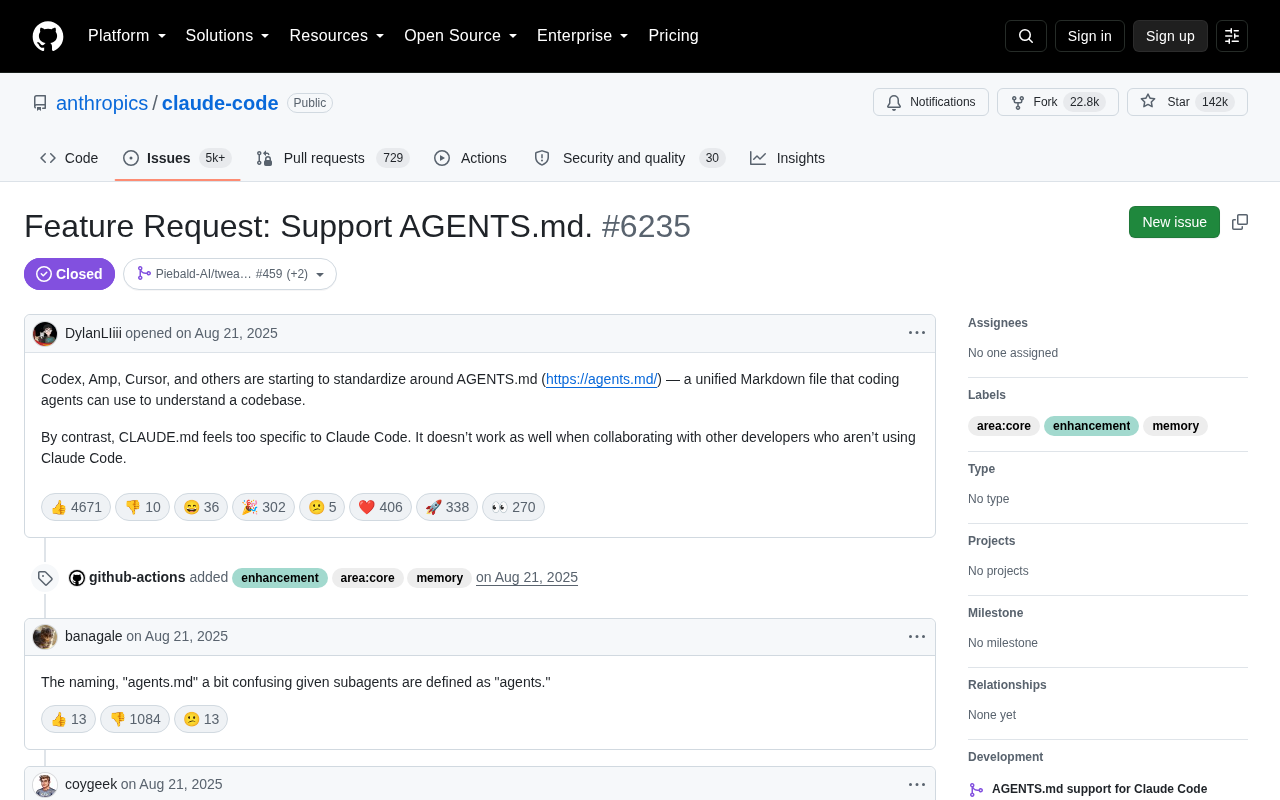
What Is AGENTS.md: An Operations Manual Written for AI Agents
An Attempt at Standardization
The core idea behind AGENTS.md is to provide AI coding agents with a conventional, tool-agnostic configuration entry point. Just as README.md is a project description for human readers, AGENTS.md is an "operations manual" written specifically for AI agents to read.
Here it's worth explaining what "agent" means: in AI, an agent refers to an AI system capable of autonomously perceiving its environment, making plans, and executing actions—distinct from traditional single-turn Q&A models. In programming contexts, an AI Agent can autonomously decide which files to read, which commands to execute, and in what order to complete tasks. For example, when you ask an AI Agent to "add user authentication to this project," it will autonomously browse the project structure, understand the tech stack, find relevant dependencies, write code, and run tests—a process that may involve dozens of file operations and command executions. This autonomy makes project-level configuration especially critical—Agents need to know a project's constraints to make correct decisions.
This file typically contains:
- Project structure description: Telling the AI the responsibilities of each directory and module
- Coding conventions: Naming conventions, code style, formatting rules
- Build and test commands: How to run the project, how to execute tests
- Tech stack constraints: Which frameworks to use, which dependencies to avoid
- Domain knowledge: Project-specific terminology and logic
Through a single unified file, any AI tool supporting this standard can immediately understand the project's context, without developers needing to maintain duplicate configurations for each tool.
From Configuration Fragmentation to Unified Management
In the discussion, many developers expressed frustration with the current "configuration file sprawl." One commenter pointed out that their project root simultaneously contained .cursorrules, CLAUDE.md, and .github/copilot-instructions.md—three files with largely identical content that were extremely tedious to maintain. When teams switch tools or new members use different AI assistants, these scattered configurations easily fall out of sync.
AGENTS.md aims to solve this fragmentation problem with an approach similar to robots.txt or sitemap.xml in the web domain—forming de facto standards through community consensus rather than relying on any single vendor to enforce them. The success of robots.txt is particularly instructive: it was never formally standardized by any RFC (not until a 2022 proposal), yet since its creation in 1994, all major search engines have voluntarily followed this convention, making it one of the most successful informal standards on the internet.
Community Divisions and Reflections on the AGENTS.md Standard
Supporters: Standardization Is Inevitable
Developers supporting this proposal believe the AI coding tool ecosystem is in its early stages, when the cost of establishing open standards is lowest and the benefits highest. If each tool continues going its own way, it will eventually create lock-in effects that are hard to break, damaging developers' freedom of choice. They draw parallels to the success of the Language Server Protocol (LSP)—the open protocol driven by Microsoft that decoupled code editors from language support, fostering a thriving tool ecosystem.
The LSP story is worth expanding on: before LSP, every code editor needed to independently implement syntax highlighting, auto-completion, go-to-definition, and other features for each programming language, creating an M×N complexity problem (M editors × N languages). LSP simplified this to M+N by defining a standard JSON-RPC communication protocol: language developers only need to implement one Language Server, and all LSP-supporting editors gain full language support. Today, LSP has been adopted by virtually all mainstream editors, dramatically reducing toolchain development costs and enabling niche editors like Neovim and Helix to provide language support comparable to VS Code. The standardization of AI coding tool configuration faces a similar M×N challenge.
Skeptics: Another "XKCD 927" Dilemma
However, many commenters hold cautious or even skeptical views. They reference the famous XKCD 927 comic: "There are now 14 competing standards. We need to develop one universal standard that covers everyone's use case... now there are 15 competing standards."
XKCD 927 is a satirical comic widely cited in the programmer community, depicting a dilemma that recurs throughout tech history—from character encoding (the battle among dozens of encoding schemes like ASCII, Latin-1, UTF-8) to instant messaging protocols (XMPP, Matrix, various proprietary protocols), to JavaScript module systems (the long road to unification among CommonJS, AMD, UMD, and ESM). Successful standardization typically requires several conditions to be met simultaneously: endorsement from a powerful backer, sufficient community consensus, and the right timing window. Currently, the AI coding tool market has not stabilized, and no single vendor has the convening power Microsoft had when pushing LSP, making bottom-up community standards face greater uncertainty.
This concern is not unfounded. AGENTS.md itself could become yet another format that tools selectively support, actually worsening fragmentation. Moreover, different AI tools vary enormously in their capability boundaries—some excel at autonomous task execution, while others only provide code completion—and describing all scenarios in a single unified file may be neither precise nor flexible enough.
Technical Debate Over Content Format
There's also a technical discussion focus: what structure should AGENTS.md adopt? Pure natural language Markdown is human-friendly but imprecise for machine parsing; introducing structured YAML frontmatter or a dedicated schema would raise the barrier to writing. How to strike a balance between readability and parseability is key to whether this standard can succeed.
YAML frontmatter is a convention for embedding structured metadata at the top of Markdown files, wrapped by three dashes (---) containing YAML-formatted key-value pairs. This pattern was originally popularized by the static site generator Jekyll and later widely adopted by Hugo, Gatsby, and other tools. The core tension in the AGENTS.md format debate is this: pure Markdown natural language descriptions are very friendly to AI large language models (since LLMs are inherently good at understanding natural language), but lack precise semantic constraints; structured schemas (like configuration formats defined by JSON Schema) are easy for tools to parse precisely but degrade the human writing and maintenance experience. A compromise approach is to adopt "convention over configuration"—using specific Markdown heading levels and code blocks to implicitly express structure, maintaining human readability while providing sufficient parsing anchors for tools.
The Evolution of AI Coding Tool Configuration
From One-off Prompts to Persistent Project Context
This discussion about AGENTS.md fundamentally reflects a deeper shift in AI programming paradigms. Early on, developers guided AI through one-off conversational prompts; now, as agent autonomy increases, persistent project-level context is becoming increasingly important. AI is no longer a simple Q&A tool but a collaborator that needs to "understand" and "remember" the full picture of a project over time.
Configuration files are precisely the carriers of this persistent context. They make AI behavior predictable, reproducible, and version-controllable—qualities that software engineering practices value. In software engineering, "context" has always been the core factor affecting development efficiency. Research shows developers need an average of 23 minutes to regain working context after an interruption. AI coding tools face a similar challenge: at the start of each new conversation session, the AI needs to rebuild its understanding of the project. Persistent context solves this "cold start" problem by solidifying key information into files. More importantly, when context exists as files, it can be incorporated into Git version control—team members can review and refine these AI instructions through Pull Requests, ensuring AI behavior aligns with team consensus. This essentially transforms the tacit knowledge of "how to collaborate with AI" into manageable engineering artifacts.
Toward an Open, Interoperable AI Tool Ecosystem
On a related note, some mainstream AI tools have already begun exploring compatibility with multiple configuration formats. This pragmatic approach may be more easily accepted by the community than pushing a single standard. The ideal end state might be for each tool to retain its own distinctive configuration while also recognizing a common base configuration file, achieving "graceful degradation" style interoperability.
This pattern has precedent in tech: HTML browser compatibility strategy is a classic example—browsers make their best effort to render any HTML, silently ignoring unrecognized tags or attributes rather than throwing errors. For AI coding tools, a similar strategy would mean: tools first read their own proprietary configuration for complete instructions, then fall back to AGENTS.md for base context if none exists, rather than forcing all tools to abandon their respective formats. This gradual approach to standardization tends to be more feasible in practice than revolutionary replacement.
Conclusion
The AGENTS.md proposal may seem like just a small feature request, but it touches on a core issue in the AI coding tool ecosystem: how to balance rapid innovation against standard unification.
Regardless of whether AGENTS.md ultimately becomes an accepted standard, this discussion itself is valuable—it reminds the entire industry that while pursuing the upper limits of AI capability, we cannot neglect the foundational engineering issues of developer experience. For developers, it may be worth trying to maintain a clear AGENTS.md in your projects now. No matter how future standards evolve, a well-organized project context document is never wasted effort.
Key Takeaways
Related articles

Python 3.15 New Feature: Is the sentinel Type Better Than None?
Python 3.15 adds the sentinel type, using named unique sentinel objects to replace None and bare object(), resolving confusion among missing values, explicit emptiness, and invalid input while avoiding type hint failures.

Deep Learning's Three Architectures and the Universal Approximation Theorem: A Complete Guide to MLPs, CNNs, and Transformers
Explaining the inductive bias differences among MLP, CNN, and Transformer, the existence meaning of the Universal Approximation Theorem (UAT), and the role of Taylor expansion in approximation analysis, while clearing up common misconceptions.

GitLab Emergency Patch Release: Analysis of Critical Security Fixes
GitLab releases critical patch 19.5.1, sparking 355 points of discussion on Hacker News. This article analyzes the background, upgrade steps for self-hosted instances, and verification points to help DevOps teams respond quickly to security updates.