What Is an AI Agent? From Chatbots to Digital Employees — How It Actually Works in Practice
AI Agents are moving from concept to enterprise reality — and people who can ship them are the scarcest resource.
As large model inference costs continue to fall and API prices drop sharply, enterprise AI competition has shifted from cash-burning arms races to engineering efficiency — making AI Agents the next breakout category. Unlike chatbots, Agents move from conversation to action: reading business data, calling APIs, decomposing complex tasks, and self-correcting to deliver results. Real deployments already exist in customer service, finance, and operations. The market isn't short on people who understand Agent concepts — it's short on people who can handle real errors and ship working projects. For newcomers, building one small end-to-end Agent beats reading theory for weeks.
Why AI Agents Have Become the New Hotspot
AI infrastructure investment has been ramping up steadily. At the same time, inference costs for large models keep falling, and domestic API prices have been nearly halved within six months. The logic behind enterprise AI adoption is undergoing a fundamental shift — moving away from the early days of cash-burning arms races and toward a relentless pursuit of engineering efficiency.
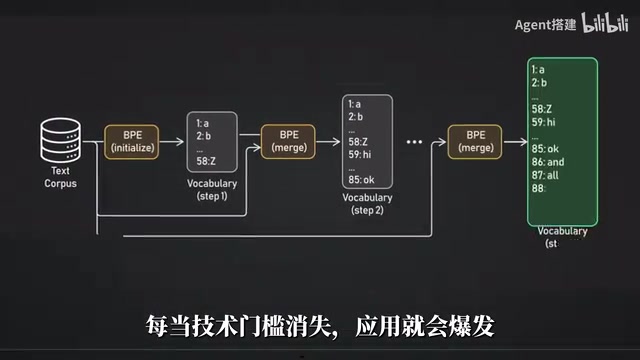
Underlying all of this is a technology pattern that never changes: once the barrier to entry disappears, applications explode. And the answer to this current wave of growth is very likely AI Agents (intelligent agents). When calling a large model is cheap enough and capable enough, packaging that model's abilities into applications that can genuinely get work done becomes the most valuable direction to pursue.
What Exactly Is an AI Agent
In one sentence: an Agent is a digital employee that can do work on your behalf.
The difference between an Agent and a chatbot is stark. A chatbot can only chat with you in a back-and-forth question-and-answer format — it's fundamentally reactive. An Agent is different. It can read your business data, call your system APIs, break a complex task down into steps, and sequence those steps for execution on its own. More importantly, when it runs into a problem mid-execution, it will try to find a way around it — and ultimately deliver a usable result to you.
From "conversation" to "action" — this is the core distinction between Agents and traditional conversational AI. An Agent doesn't just understand intent; it can orchestrate tools, plan workflows, and close the loop on a task from start to finish.
From a technical standpoint, an Agent's core architecture rests on four modules: the perception layer (receiving user input and external data), the planning layer (where the large model handles task decomposition and reasoning decisions), the memory layer (storing conversation history and intermediate states), and the tool layer (calling external APIs, databases, code executors, etc.). The most critical of these is the planning layer — the large model plays the role of the "brain" here, using reasoning paradigms such as ReAct (Reasoning + Acting) or Chain-of-Thought to decompose a vague high-level goal into a sequence of executable subtasks, then dynamically adjusting subsequent plans based on feedback after each step. This closed loop of "plan → execute → observe → re-plan" is what fundamentally distinguishes an Agent from a single LLM call. RAG (Retrieval-Augmented Generation) is often embedded as a memory and knowledge-augmentation mechanism, allowing the Agent to access private knowledge bases rather than relying solely on the model's training knowledge.
What Does an Agent Actually Look Like Inside a Business
These capabilities, applied to concrete business scenarios, are no longer theoretical — they're systems running in production today:
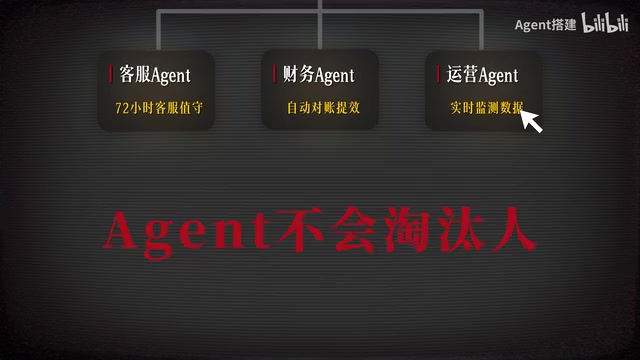
Customer Service Agent
Available 24/7, it can handle 90% of common inquiries on its own, freeing human agents from repetitive Q&A so they can focus exclusively on the small number of genuinely complex, edge-case situations.

Finance Agent
Automatic invoice verification, automatic report generation — the end-of-month reconciliation cycle compressed from three days down to three hours. Rule-based, process-standardized work like finance is exactly where Agents deliver results most quickly.
Operations Agent
Monitoring backend data in real time, automatically triggering restocking when inventory runs low, automatically raising alerts when anomalies appear. It transforms "humans watching data" into "systems watching data, humans making decisions."
These examples send a clear signal: Agents won't make people obsolete, but those who know how to use Agents will pull far ahead of those who don't.
The Real Scarcity Is People Who Can Actually Ship
Looking at the job market, "Agent deployment experience" is already showing up as a requirement in hiring job descriptions. For the same role, if one candidate writes "proficient in office software" and another writes "independently built customer service Agent and reporting Agent from scratch," it's obvious which résumé a hiring manager will click on first.
What the market is truly short of right now isn't people who "understand the concept" of Agents. There's no shortage of people who know what RAG is or can describe Agent architecture. But those who are willing to take on real projects, handle real error messages, and actually get something running end-to-end — you can't find one in ten.
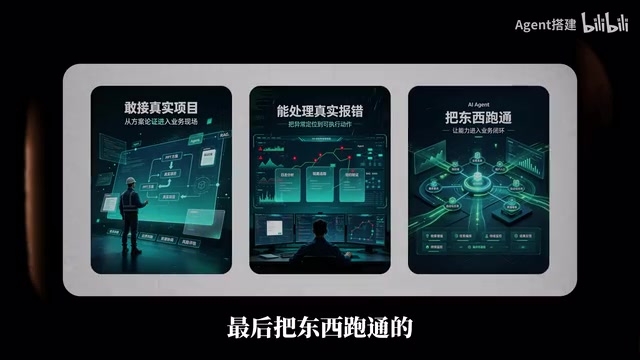
That gap between "knowing" and "doing" is precisely where the opportunity lies for ordinary people.
RAG (Retrieval-Augmented Generation) is one of the most common technical components in real-world Agent deployments. The idea is straightforward: before querying the large model, you first retrieve relevant passages from an external knowledge base (such as company documents or a database) and inject them into the prompt, so the model answers based on real data rather than its training memory. This addresses two major pain points of large models: the knowledge cutoff date, and the inaccessibility of proprietary enterprise data. People who have heard of RAG are now quite common. But those who can actually wire up a vector database (like Chroma or Pinecone), handle document chunking strategies, and troubleshoot low retrieval recall — those people remain a scarce commodity. This is a textbook example of the "knowing vs. doing" gap described above.
The Opportunity Window and the Learning Path
This situation is not unlike WeChat Official Accounts ten years ago, or short-form video five years ago. The people who captured the early gains weren't always the most expert — they were the ones who moved first. Agents are in a similar position right now.
A note of caution: the source material for this article comes from a promotional description of a Bilibili tutorial, which includes claims like "ByteDance is pouring 200 billion RMB into AI infrastructure" and "API prices halved in six months." These are statements made in a marketing context — readers should exercise independent judgment and cross-reference official public sources.
For anyone looking to get started, the key is not to pursue a perfectly structured curriculum from day one. It's to move from "heard of it" to "built it" as quickly as possible. Personally assembling a small Agent that actually runs, wrestling with a real error message, is worth more than watching a hundred tutorial videos. Learning AI Agents comes down to understanding the complete chain — read data → call APIs → decompose tasks → self-correct → deliver results — and then getting your hands dirty and making it work.
Related articles

LynnReal-Omni: 32B Unified Video Diffusion Model Goes Open Source with Multi-Task Coverage in Four Steps
LynnReal-Omni is a 32B unified video diffusion model on MiniMax H3, covering text-to-video, pose guidance, style transfer, restoration in 4 steps. Flash version generates 540p video in 377ms on one H100.

Anthropic Co-Founder: AI 'Kill Switch' May Need to Be Mandatory by Law
Anthropic's co-founder tells the BBC that AI 'kill switches' may need to be legally mandated. We analyze the industry logic, technical challenges, and the tension between regulation and innovation.

The AI Data Center Boom Is Colliding With Cities Scarred by Heavy Industry
The AI data center boom is clashing with post-industrial communities. Philadelphia's case reveals structural conflicts between AI growth, energy use, water, and environmental justice.