What Is Codex? The Core Differences Between OpenAI's Coding Agent and ChatGPT

OpenAI Codex is a coding agent that acts, not just talks — fundamentally different from ChatGPT.
This article explains OpenAI Codex as an AI coding agent that autonomously reads, writes, tests, and debugs code in a sandboxed environment — unlike ChatGPT which only provides advice. It explores how Codex represents a paradigm shift from hand-writing code to directing AI, and why developers must learn to communicate requirements effectively to stay competitive.
From ChatGPT to Codex: AI Programming Enters a New Phase
If you're a programmer, there's one term you can't avoid: Codex. This is an AI coding agent launched by OpenAI, and its positioning is completely different from the ChatGPT we're all familiar with.
Many developers have a misconception when they first encounter Codex — "Isn't this just ChatGPT?" After all, Codex relies on OpenAI's GPT series of large language models under the hood. But if you think of it as merely a chat tool, you're vastly underestimating its value. This article will systematically explain what Codex actually is, how it fundamentally differs from ChatGPT, and why every developer should take the time to learn it.
What Codex Actually Is: Not Just Chat, But Doing the Work for You
Codex is an AI coding agent launched by OpenAI. The word "agent" is crucial here — it means this tool can autonomously complete a series of programming-related tasks for you, rather than passively waiting for your questions.
In the AI field, an agent is a concept with profound implications. Unlike traditional Q&A-style AI, agents possess three key characteristics: autonomy (can operate independently without direct human intervention), reactivity (can perceive environmental changes and respond accordingly), and goal-orientation (can plan and execute multi-step tasks to achieve specific objectives). In programming, an AI agent means the system can not only understand natural language instructions but also autonomously decompose tasks, invoke tools, execute code, and verify results, forming a complete workflow loop. This is the fundamental distinction between Codex and ordinary chatbots.
Specifically, what Codex can do includes:
- Generate code
- Read and understand code
- Fix bugs
- Run tests
- Execute commands and run scripts
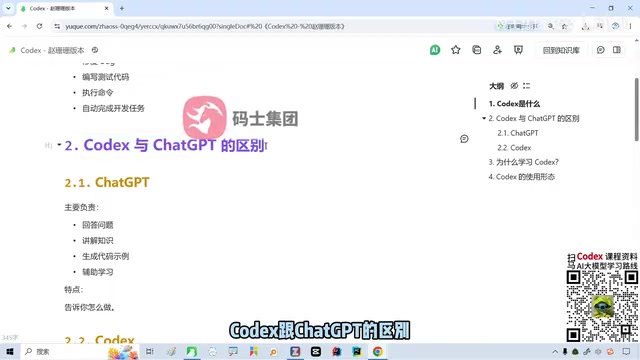
In other words, Codex is not a simple conversational tool. If all you want is an AI to chat with you, generate a small code snippet that you then copy and paste yourself, then tools like Doubao, DeepSeekAd, or ChatGPT itself can meet your needs. But Codex's core positioning is as a "does-the-work-for-you" programming tool — it actively inserts itself into your development workflow.
The Fundamental Difference Between Codex and ChatGPT
This is where newcomers get most confused. Since Codex also uses GPT models under the hood, how is it different from ChatGPT?
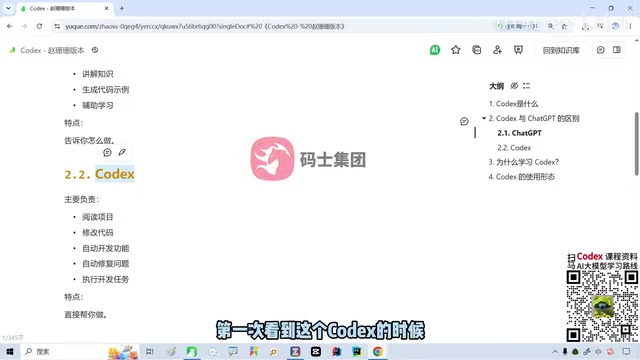
ChatGPT: Like a Teacher Who "Talks"
Here's a vivid analogy: ChatGPT is more like a teacher.
Suppose you ask it: "How do I implement a login feature in Spring Boot?" It will explain the principles and tell you how the code should be written. But everything after that is on you — you need to Ctrl+C, Ctrl+V the code into your development tool, debug it yourself, and get it running on your own.
ChatGPT's strengths are answering questions, explaining concepts, assisting with learning, and generating code snippets. These features are already very useful, but at its core, it only "talks."
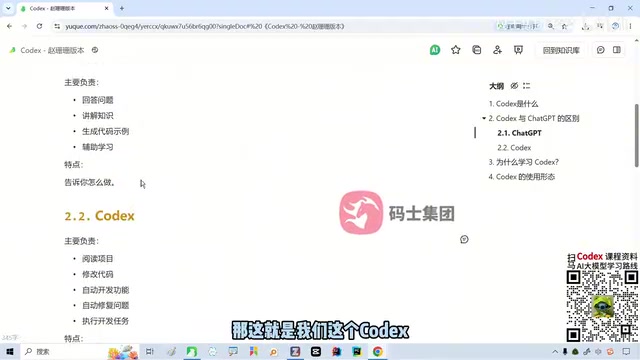
Codex: Like a Programmer Who "Does the Work"
Codex is completely different — it's like a programmer sitting right next to you.
You can directly tell it: "Build this login feature for me." Then it will:
- Read and understand the entire project on its own
- Autonomously modify and generate code
- Run tests and debug by itself
- Tell you "It's done" once everything passes
Codex can do all this because of its underlying sandbox execution environment. A sandbox is a security isolation mechanism that provides a restricted runtime environment for programs, preventing them from accessing or affecting external systems. This means Codex executes code in an isolated container — even if it generates problematic code, it won't affect your production environment. This design ensures both security and the freedom for AI to experiment with code, run tests, and debug — this is the technical foundation that enables an AI coding agent to truly "do the work."
To summarize the difference in one sentence: ChatGPT talks; Codex acts. Once you understand this, you've grasped Codex's core value — it upgrades AI from "advisor" to "executor."
Why Developers Must Learn Codex
We've entered the AI era, and software development patterns are undergoing fundamental changes.
From "Hand-Crafting Code" to "Directing AI to Code"
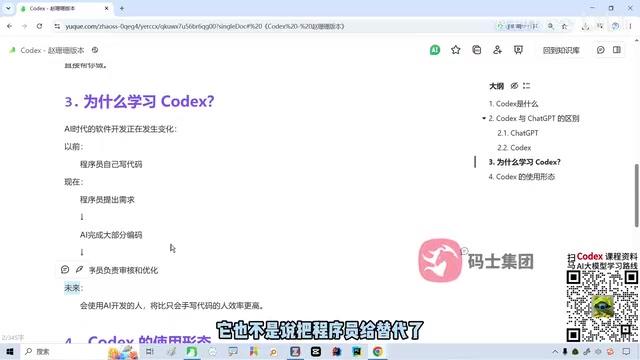
Previously, programmers wrote code entirely by hand, typing every single line themselves. Now, the development workflow is evolving into:
Programmer provides requirements → AI tools/agents complete most of the code → Programmer reviews and optimizes
This means tools like Codex, Claude Code, and Trae aren't meant to "replace" programmers but to reshape how programmers work. Those who can leverage AI-assisted development will be far more productive than those who write everything by hand.
It's worth noting that the concentrated emergence of these competitors marks AI programming's evolution from the early "code completion" stage (like the line-by-line completions GitHub Copilot initially offered) to a new stage of "autonomous programming." Claude Code is a terminal-based AI coding agent launched by Anthropic based on the Claude model, while Trae is an AI-integrated development environment from ByteDance. Their competitive focus has shifted from pure code generation capability to the ability to understand and execute complete development workflows. The ultimate beneficiaries of this competition are developers — more choices mean stronger tools and lower barriers to entry.
The Most Valuable Skill of the Future: Communicating Requirements to AI
Here's a thought-provoking perspective: In the future, the most valuable person won't be the one who types code fastest, but the one who's best at communicating requirements to AI.
Why is the review step still indispensable for programmers? Because AI-generated code needs someone to quality-check it. If you know nothing about programming, you can't judge whether the AI's code is good or needs optimization. So Codex isn't asking you to abandon your programming skills — it's upgrading your role from "writing" to "directing + reviewing + optimizing."
This is precisely the most important reason to learn AI coding tools like Codex and Claude Code — the development paradigm has shifted from "writing code yourself" to "directing AI to write code."
Embracing the New AI Programming Paradigm
Codex represents not just a new tool, but an overall migration in the software development paradigm. For developers, rather than worrying about "being replaced by AI," it's better to master how to harness these coding agents as early as possible.
Starting from understanding the difference between Codex and ChatGPT, progressing to proficiently using it for multi-task parallelism, sandbox environment execution, MCP integration, and other advanced capabilities — this learning path will help you stay competitive in the AI era.
Among these, MCP (Model Context Protocol) is a key technology worth paying attention to. It's a standardized protocol designed to enable AI models to interact with external tools and data sources in a structured way. You can think of MCP as the "USB port" of the AI world — it defines a unified communication specification that allows AI agents to connect to databases, APIs, file systems, version control tools, and various other external resources. Through MCP integration, Codex can directly read project repositories, call third-party services, and access real-time data, truly embedding itself into a developer's complete workflow rather than being limited to standalone code generation.
After all, in the future, the true experts will be those who know how to clearly communicate complex requirements to AI and make professional judgments about the results.
Key Takeaways
Related articles

iPhone Duo vs Z Fold 8: Which Foldable Nails Cover Screen and Form Factor Experience Better?
Based on a YouTube comparison, we analyze the iPhone Duo vs Samsung Z Fold 8 in cover screen ratio, one-handed grip, pocketability, app adaptation, multi-posture use, and keyboard input.

Why Tech Media Always Gets Accused of "Shilling"? The Verge Editor-in-Chief Responds to Bias Allegations
After The Verge's Duo review drew accusations of bias, Editor-in-Chief Nilay Patel responds: no paid reviews, no brand deals, editorial independent of sales, and details the ethics policy.

Claude Code 3x Speedup: Thanks to 1997's GZip Technology
Claude Code achieves 3x faster local sessions and 2.8x faster cloud sessions by enabling GZip compression. This article analyzes how this classic technology optimizes message transmission efficiency in AI coding tools and what it means for developers.