What Is DeepSeek Harness: A Full Breakdown of the Engineering Beyond the Model

DeepSeek Harness uses a plugin-based engineering layer to steer large models, turning an unruly wild horse into a deliverable Agent.
Using the metaphor of "harness gear," the article explains what DeepSeek Harness solves: models are powerful, but in real tasks they forget context, call tools erratically, and overstep sandbox boundaries. Harness is defined as all engineering layers outside the model, including system prompts, tool calling, file system, sandbox, memory, context management, constraint feedback, and orchestration logic, with the core idea that "the model handles judgment, and the Harness handles everything else." DeepSeek Harness adopts an "everything is a plugin" architecture—models, tools, skills, sandboxes, and UI can all be swapped and combined—installs with a single command, and can be cloned from Git. Released as a developer preview open to global developers with open-sourced code, it signals ecosystem ambitions. The article advises developers to shift focus from stronger models to a solid steering layer, prioritizing the memory system, sandbox, and orchestration logic.
When the Model Becomes a Wild Horse: What DeepSeek Harness Is Meant to Solve
Large models are getting more capable by the day, but in practice many people run into an awkward reality: the model itself is smart, yet the moment it's plugged into real tasks, things spiral out of control—it forgets context, calls tools erratically, and steps outside the sandbox. DeepSeekAd's Harness (developer preview) is aimed squarely at this problem.
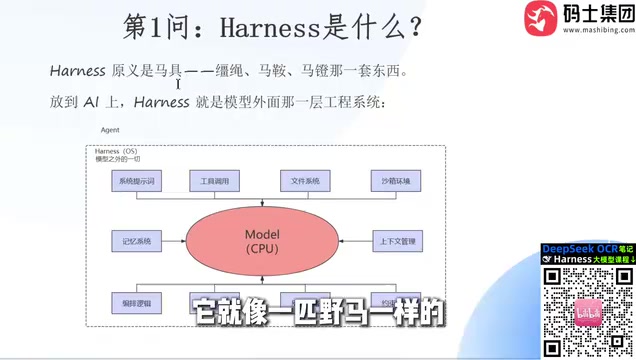
According to a Bilibili creator's video, the word "harness" originally refers to the whole set of gear—bridle, reins, saddle—used on horses. It's a fitting metaphor for tech: an AI model is like a powerful but unbroken wild horse, and you have to put a bridle and saddle on it before it will run in the direction you intend. The Harness is that engineering layer wrapped around the model.
Behind this metaphor is an important shift in thinking: the model handles judgment, and the Harness handles everything else. Understanding this is understanding Harness's fundamental role as "steering engineering."
What Harness Actually Is: Everything Outside the Model
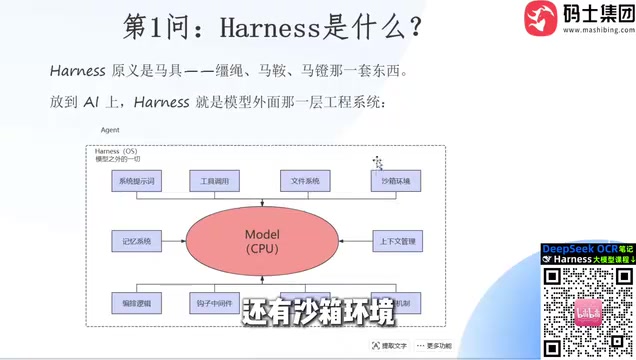
If an interviewer asks you "what is a Harness," an accurate answer is: it's every engineering layer outside the model. What specifically does that include?
- System prompts
- Tool calling
- File system
- Sandbox environment
- Memory system
- Context management
- Constraint mechanisms and feedback loops
- Hooks, middleware, and orchestration logic
Together, these components form the "steering apparatus" between the model and the real world. No matter how strong the model is, without this layer it can't reliably complete long-horizon tasks. Conversely, the quality of the Harness design directly determines how differently the same model performs across different products.
The creator breaks down the various facets of Harness through a "ten questions" format, and the very first question nails the core: a Harness is not part of the model—it's everything outside the model.
Context management refers to the entire set of strategies for deciding, within a limited model context window, which information enters, in what order and form, and when old information gets compressed or discarded. Since a large model only sees the tokens stuffed into its window on each inference, long-horizon tasks that exceed the window must rely on summarization, retrieval, rolling eviction, and similar techniques to stay coherent—this is also where Agents most easily "lose their memory."
The sandbox environment is a controlled runtime that isolates the model's code execution and file operations. It restricts file system read/write scope, network access, and system calls, fencing potentially destructive model operations within safe boundaries while providing reproducible execution results. The granularity of sandbox isolation (process-level, container-level, VM-level) directly determines the trade-off between security and overhead.
Hooks and middleware are the interception and enhancement mechanisms in a Harness. Hooks allow custom logic to be inserted before and after model calls and tool executions—for example, audit logging, permission checks, or result rewriting; middleware wraps the request flow in a chain to implement cross-cutting concerns like retries, rate limiting, and caching. Together they form the Harness's programmable extension surface.
Everything Is a Plugin: Harness's Architectural Philosophy
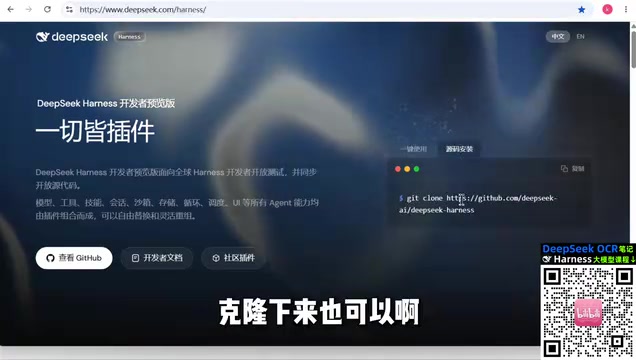
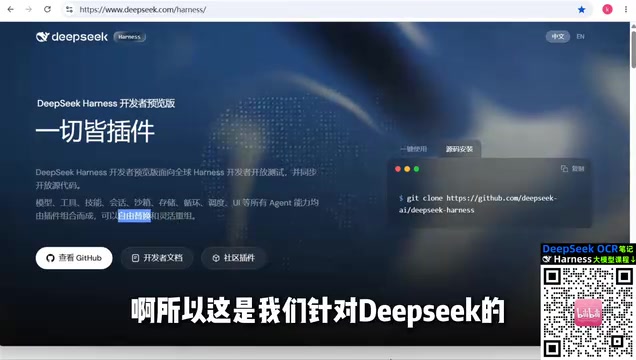
DeepSeek Harness puts forward a striking concept in its architecture—"everything is a plugin." The model, tools, skills, drawing sandbox, storage loops, UI, and every other capability an Agent needs are all made up of plugins that can be freely swapped and flexibly combined.
The value of this design lies in decoupling. In the traditional approach, an Agent's capabilities are often tightly bound to the main program, so swapping out a memory system or a sandbox affects everything. With pluginization, each capability unit can evolve independently, and developers can assemble different Agent forms according to task needs.
Installation reflects this lightweight approach too: a single command installs it in one step; if you want to study the source code, you can clone it directly from the Git repository. For developers who want to deeply understand Agent engineering implementation, the barrier to entry is very low.
Plugin architecture is fundamentally about defining a set of stable interface contracts so that capability units can work together without knowing each other's implementation details. In Agent scenarios, this means model adapters, tools, memory storage, sandbox executors, and the like must all expose unified registration, discovery, and invocation protocols, with the main program depending only on abstract interfaces rather than concrete implementations.
The cost of this pattern is an extra layer of indirection: if the interface design isn't general enough, plugins will rub against each other during adaptation; and as the number of plugins grows, version compatibility and dependency management become more complex. That's why mature plugin systems typically come with lifecycle management, capability declarations, and priority mechanisms. For developers, judging whether a Harness plugin design is mature comes down to whether core components can be replaced without modifying the main program, and whether there's a clear fallback path when a plugin fails.
Open Source and Ecosystem: Signals from a Developer Preview
DeepSeek positions Harness as a developer preview, open for testing to Harness developers worldwide, with the code open-sourced alongside. This move sends several signals.
First, Harness is treated as an ecosystem product rather than a closed, single-point tool. Open testing means DeepSeek wants external developers to participate in extending capabilities—the plugin system itself is an interface reserved for the ecosystem.
Second, open-sourcing the code lets Harness's engineering details be examined and reused. For teams studying Agent architecture, this is a rare reference sample—how the memory system is designed, how the sandbox isolates, how orchestration logic is organized can all be found in the source code.
Third, separating the model from the Harness lets DeepSeek continuously iterate on peripheral engineering capabilities without frequently changing the model. For a fast-evolving product, this is a pragmatic rhythm.
What It Really Means for Developers
Understanding the concept of a Harness isn't just about passing interviews. In real development, it provides a clear thinking framework: when you find the model performing poorly, the problem may not be the model but the Harness layer—whether prompts are organized sensibly, whether tool descriptions are accurate, whether context management is in place, and whether constraint mechanisms are sound.
Shifting attention from "switching to a stronger model" to "building a solid steering layer" is often the more cost-effective path. DeepSeek Harness's plugin-based design and open-source strategy offer a starting point you can dig into directly along this path.
For developers who want to go deeper into Agent engineering, it's recommended to start by cloning the source code and focusing on three areas—the memory system, the sandbox environment, and orchestration logic—as they best reflect Harness's design trade-offs.
One-line Summary
DeepSeek Harness uses a plugin-based engineering layer to steer large models, turning an unruly wild horse into a deliverable Agent.
Paragraph Summary
Using the metaphor of "harness gear," the article explains the problem DeepSeek Harness aims to solve: models are powerful, but once plugged into real tasks they tend to forget context, call tools erratically, and step outside the sandbox. Harness is defined as every engineering layer outside the model—system prompts, tool calling, file system, sandbox, memory, context management, constraint feedback, and orchestration logic—with the core insight being that "the model handles judgment, and the Harness handles everything else." DeepSeek Harness adopts an "everything is a plugin" architecture, where models, tools, skills, sandboxes, and UI can all be freely swapped and combined; it installs with a single command or can be cloned from a Git repository. The product is released as a developer preview, open for testing to developers worldwide with the code open-sourced, signaling ecosystem ambitions. For developers, the article suggests shifting focus from swapping in stronger models to building a solid steering layer, and prioritizing research into the memory system, sandbox environment, and orchestration logic.
Related articles

When Among Us Meets Werewolf Fairy Tale: A Social Deduction Game That Had Everyone Dying of Laughter
A gameplay recap of a fairy-tale social deduction game blending Among Us tasks with Werewolf roles: Raven Master identity chaos, a Jester baiting with the truth, and an Assassin forced to negotiate.

Azure SQL Hyperscale Benchmark: 52% Higher Throughput, 51% Better Price-Performance
Microsoft commissioned an independent benchmark comparing Azure SQL Hyperscale with Amazon Aurora, showing 52% higher throughput and 51% better order-processing performance per dollar. Learn the test methodology, price-performance comparison, and use cases.

Mozilla Uses GPT-6 Cyber to Strengthen Firefox's Security Defenses
Mozilla Distinguished Engineer Brian Grinstead explains how Firefox uses GPT-6 Cyber to find unknown vulnerabilities, generate reproducible test cases and fix patches, and ship fixes to millions of users—revealing the path of AI-assisted security from research to engineering pipelines.